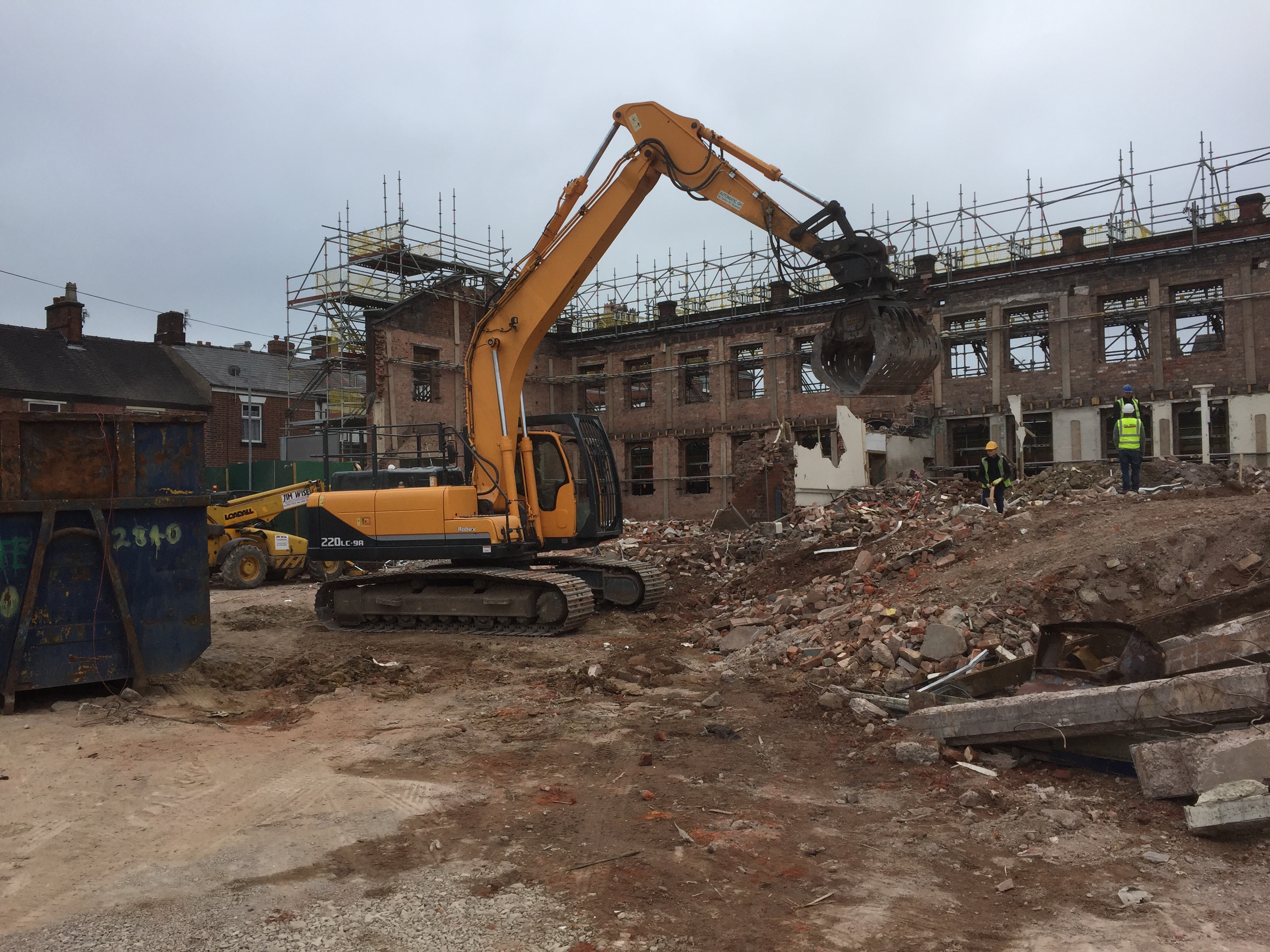
No British city rebuilt itself after the war quite like Coventry. The blitzed medieval centre was replanned almost from scratch, and the city that rose through the 1950s and 60s — the precincts, the ring road, the concrete-framed offices, car plants and multi-storeys — was a statement of confidence in a new way of building. Seventy years on, a lot of that stock has reached the end of its life, and taking it down carefully has become one of the defining jobs for demolition contractors in Coventry.
We work across Coventry and Warwickshire — the city centre, Nuneaton, Bedworth, Rugby, Kenilworth and Leamington — and post-war concrete is a class of structure we know inside out. This guide covers why it behaves the way it does, what renewal-era demolition involves, and how the material from Coventry's first rebuild can literally form the base of its second.
Why the Post-War Generation Is Coming Down Now
Timing, economics and standards have converged on Coventry's mid-century stock all at once. Buildings engineered for a 60-year design life are arriving at exactly that birthday; concrete-era defects — carbonation, corroding reinforcement, failing panel fixings — are moving from survey footnotes to structural line items; and energy performance expectations that pre-war buildings can sometimes meet with sympathy, thin-walled 1960s slabs frequently cannot meet at all. Meanwhile the city centre's ongoing renewal keeps demand for cleared, well-documented plots strong.
There's also a quieter shift: embodied carbon arguments now cut both ways. Retention is rightly the first question — but where a concrete frame genuinely can't serve a new life, crushing it into the next scheme's groundworks on the same plot has become the strongest sustainability story demolition can tell, and clients increasingly procure for it explicitly. The sections below cover both the engineering and that materials case in detail.
Why Post-War Concrete Is Its Own Discipline
Mid-century concrete buildings are honest structures — the frame is the building — but they demand a different kind of respect from Victorian brick. Reinforced concrete frames carry load in carefully balanced ways, and cutting the wrong element in the wrong order redistributes forces fast. Some 1960s systems used precast panels and connections that are unforgiving once disturbed, and early post-tensioned elements, where they exist, need identifying before anything is cut — a tendon released without planning is genuinely dangerous.
So the engineering homework comes first: original drawings where they survive, intrusive investigation where they don't, and a structural appraisal that drives the demolition sequence. The actual reduction is typically top-down mechanical work under BS 6187:2011 — high-reach excavators processing the frame floor by floor into its own footprint, with munchers and shears rather than impact wherever neighbours are close. Every stage sits inside a demolition phase plan prepared under CDM 2015.
The Hazards the 1960s Built In
Post-war construction embraced asbestos with enthusiasm. Coventry's mid-century stock routinely contains asbestos insulation board in ceilings, partitions, soffits and service risers, sprayed coatings to steelwork, lagged pipework and asbestos cement roofing. Much of it is exactly the material that licensed removal exists for — and under the Control of Asbestos Regulations 2012, all of it must be found by a demolition and refurbishment survey and removed before structural work begins.
Holding a current HSE asbestos licence means our own teams handle the licensed removal, the four-stage clearance and the air monitoring, then roll straight into the soft strip and demolition without a contractor handover in between. On end-of-life 1960s buildings, that single-programme approach routinely saves weeks.
Demolition as the First Act of Renewal
Coventry's centre is changing again — precinct-era blocks giving way to new mixed-use development, tired office slabs coming down for homes, and awkward post-war plots being reshaped around a city that moves differently than it did in 1960. Demolition is where all of it starts, and on ring-road-adjacent sites the constraints are real: live carriageways, pedestrian routes that stay open, services running everywhere, and neighbours in every direction.
The controls we bring are the same as on any tight urban site — exclusion zones sized honestly, dust suppression at source, noise and vibration monitored against agreed levels, timed deliveries and banksman control on every movement — but the sequencing around the ring road's geometry is a Coventry speciality all of its own. We wrote more broadly about this in the role of demolition in regeneration.
| Get a Free Quote → | 0800 222 9772 |
Coventry's Concrete, Coventry's Aggregate
Here's the satisfying part: a concrete city is a quarry in waiting. The frames and slabs of post-war Coventry produce vast tonnages of clean, crushable material, and with on-site concrete crushing that material becomes graded recycled aggregate without ever leaving the plot — piling mats, capping layers and sub-base for the scheme that follows. Rebar is stripped out by the crusher's magnet and recycled as scrap steel.
The arithmetic is compelling. Every tonne crushed on site is a tonne that doesn't leave on a wagon and a tonne of virgin stone that isn't imported — fewer movements past Coventry's homes and businesses, lower cost, lower carbon. It's the biggest single reason we divert around 96% of demolition waste from landfill across our projects, and our clean demolition post explains the wider approach.
A Coventry Concrete-Frame Project, Step by Step
- Engineering first — original drawings sourced, frame type identified, any precast systems or post-tensioning confirmed by investigation.
- Intrusive asbestos survey — under CAR 2012; mid-century buildings rarely disappoint, so the survey sets the real programme.
- Notifications — Section 80 to the council, HSE notice for licensed removal, utilities proved dead.
- Asbestos removal — enclosures, air monitoring and clearances by our in-house licensed teams.
- Soft strip — the building taken back to frame, streams segregated at source.
- Frame reduction — high-reach, top-down to BS 6187:2011, floor by floor into the footprint, munchers over impact near neighbours.
- Crush and clear — slab and frame processed to graded aggregate on site, rebar recycled, plot handed over level and documented.
A CDM 2015 phase plan governs every stage, and on ring-road sites the traffic-management drawings get as much review as the demolition ones. Done this way, a concrete building isn't waste at all — it's the next scheme's groundworks, stacked neatly where it fell. That's renewal in the most literal sense, and Coventry has always understood rebuilding better than anywhere.
What Drives Cost and Programme on Coventry's Concrete Stock
Concrete-era buildings price differently from brick ones. Frame processing time dominates: reinforced concrete takes plant hours to munch and separate, and the tonnages are enormous — though crushing on site claws much of that back as saved haulage and imported stone. Asbestos scope in 1950s–70s buildings is routinely heavy and only truly known post-survey. Structural complexity matters where precast systems or post-tensioning appear — the investigation and engineering to sequence them safely is real cost that protects the whole project. And setting: ring-road-adjacent logistics, protected pedestrian routes and live neighbours all shape the method and the price.
Programme-wise, a mid-rise concrete building is typically months rather than weeks once licensed asbestos, strip and top-down reduction are sequenced — with the HSE's fourteen-day licensed-work notice built in. What keeps concrete programmes honest is processing rate: how fast the frame can come down, be crushed and leave (or stay) — which is why our own plant fleet and in-house crushing matter to the schedule, not just the price.
Coventry Demolition: Quick Answers
Is 1960s concrete dangerous to demolish?
Not with proper engineering — but it punishes guesswork. Precast connections and any post-tensioned elements must be identified and sequenced before cutting. That appraisal is standard on our concrete projects.
Can the crushed concrete really be reused on the same site?
Yes — graded recycled aggregate from on-site crushing is routinely used for piling mats, capping and sub-base on the following scheme. It's the biggest cost and carbon win available on concrete demolition.
What notice does the council need?
A Section 80 demolition notice before works begin, plus any planning consents the site requires — we prepare notifications as standard and flag consent issues at survey.
Do you cover the wider area around Coventry?
Yes — Nuneaton, Bedworth, Rugby, Kenilworth, Leamington and the whole of Warwickshire, plus Birmingham and the West Midlands.
Getting the Right Contractor for a Coventry Project
For concrete-era structures especially, the questions to ask any contractor are: show me the structural appraisal behind your sequence; show me your HSE asbestos licence and who actually does the removal; show me comparable frame demolitions; show me how arisings will be processed and documented. Vague answers to any of those are your cue to keep looking — our complete guide to choosing a demolition contractor sets out the full test.
We bring ConstructionLine Gold, SSIP Acclaim, NEBOSH and IOSH qualified management, our own plant fleet and a directly employed workforce to every project across Coventry and Warwickshire — with zero prohibition notices in over a decade of work. Family-run since 1982: plan it properly, do it safely, leave the site clean.
Planning a project in the city? Start at our Coventry demolition contractors page, book a free site visit, or call 0800 222 9772.
.svg)