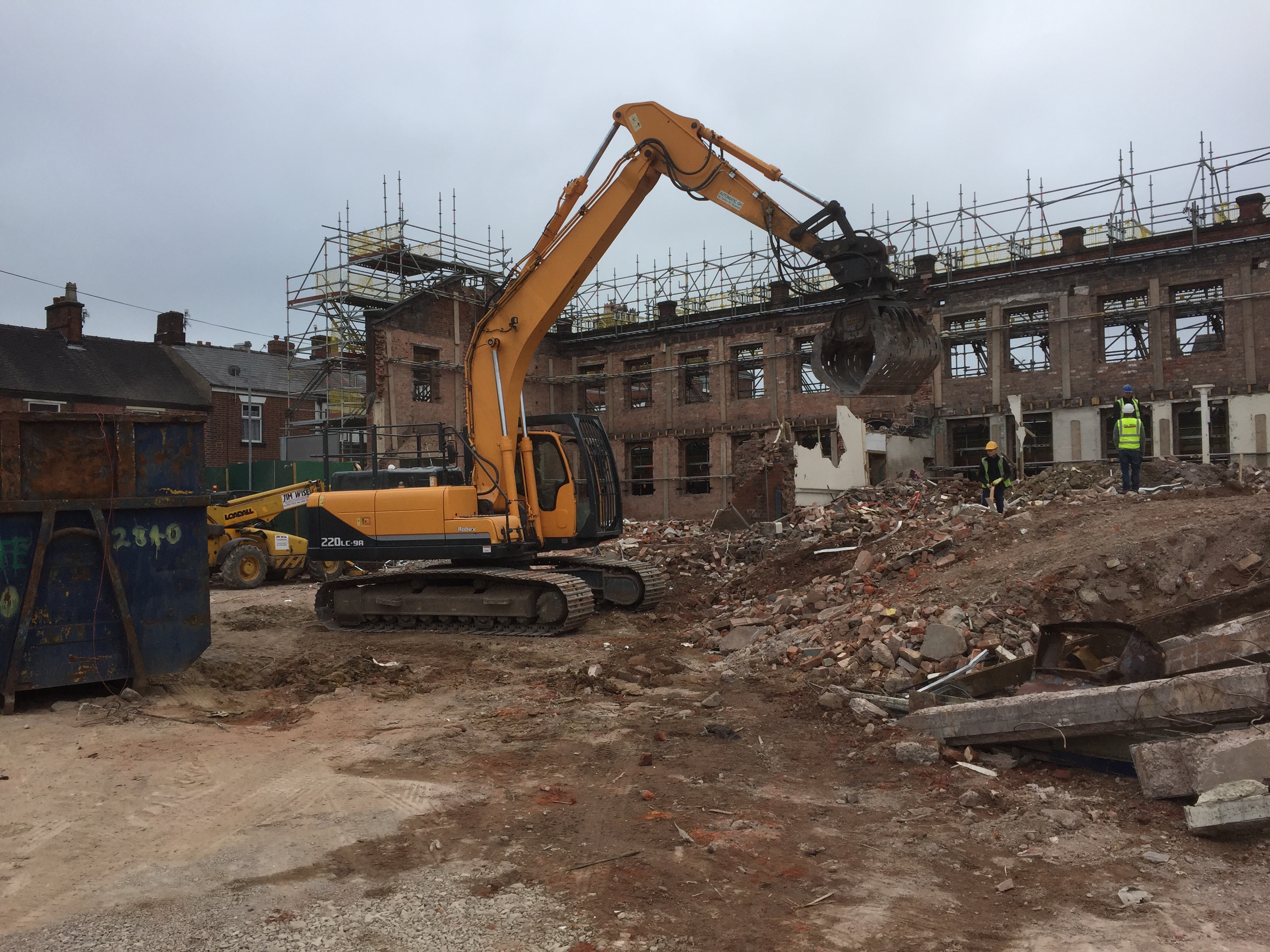
Warwickshire doesn't look like demolition country at first glance — and that's exactly why it's interesting. Between the growth corridors around Warwick, Leamington and Rugby, the industrial edges of Nuneaton and Bedworth, and a rural county full of farms and village commercial buildings reaching the end of their lives, there's a steady, varied stream of work here that rewards a contractor who can move between settings without changing standards. That's the job for demolition contractors in Warwickshire, and this guide covers what it looks like in 2026.
We deliver across the whole county — Warwick, Leamington Spa, Kenilworth, Rugby, Nuneaton, Bedworth, Stratford-upon-Avon, Atherstone, Alcester and Southam — from our Midlands base, with Coventry covered from the same team.
Why Warwickshire's Demand Keeps Growing
The county sits in the middle of everything — motorway network, rail spine, the Birmingham and Coventry economies on its shoulder — and 2026 finds that position paying out in steady development pressure. Employment space around Warwick, Leamington and Rugby keeps churning as older stock makes way for what modern occupiers want; housing allocations push at the edges of every market town; and rural building retirement continues its quiet, constant flow as farms consolidate and diversify.
Two newer pressures sharpen the picture. Energy standards are pulling forward strip-and-refurbish decisions on commercial stock that might otherwise have drifted for years. And community expectations around construction impact — dust, noise, wagon movements — have genuinely risen: in towns this proud of their setting, a contractor's site conduct is part of the client's local reputation. Both trends favour exactly the disciplined, communicative delivery this guide describes, which is no accident.
Market Towns: Demolition With the Neighbours Watching
Warwickshire's towns are handsome, historic and busy — which makes them demanding places to demolish anything. Sites back onto conservation areas and listed frontages; access runs through streets laid out for carts; and the community genuinely cares what happens behind the hoarding. Town-centre work here is defined by three things: protection of everything that stays (scaffold fans, crash decks, monitored party walls), sequencing that respects tight access (timed deliveries, banksman control, no queuing wagons on market day), and communication — neighbours told what's happening before it happens, every time.
Behind those constraints, the technical work is often facade-sensitive: taking down a tired rear range while a protected frontage stays, or removing a twentieth-century infill from between older neighbours by hand and small plant, top-down, under BS 6187:2011. Our post on strategic demolition planning covers the thinking that makes these jobs uneventful — which is the goal.
The Growth Corridors: Strip Out and Site Assembly
Around Warwick, Leamington and Rugby, Warwickshire's economy has been growing for years, and the demolition work follows the development cycle: 1970s–90s office and light-industrial stock being stripped or cleared for new employment space and housing, retail units changing use, and awkward brownfield plots being assembled into viable sites.
Much of this is soft strip rather than structural work — buildings taken back to frame for repositioning, with services safely disconnected and every material stream segregated at source. Where full clearance is the answer, the buildings are typically straightforward but the asbestos rarely is: pre-2000 commercial stock across the county carries AIB ceilings, lagged services and cement roofs as standard, all surveyed under CAR 2012 and removed by our HSE licensed in-house teams before anything structural moves. The strip-or-demolish decision itself is covered in soft strip versus full demolition.
Rural Warwickshire: Farms, Yards and Village Works
Beyond the towns, the county generates constant smaller-scale work: redundant agricultural buildings, former yards and depots, village garages and works. The recurring themes are asbestos cement roofing on almost everything post-war, fuel tanks and stores that need controlled removal, ecology surveys — bats and barn owls especially — that must be programmed before works, and lane access that dictates plant selection. None of it is complicated for an experienced team, and all of it goes wrong for an inexperienced one. Same standards, smaller canvas: CDM 2015 planning, documented waste, tidy handover.
| Get a Free Quote → | 0800 222 9772 |
Materials, Waste and the Paper Trail
Warwickshire clients — councils, developers and landowners alike — increasingly ask for the waste story up front, and ours is consistent: segregation at source into dedicated streams, reclaimable brick and stone kept separate from day one, concrete and hardcore crushed for reuse via our on-site crushing where volumes justify it, and a waste transfer note for every load to a licensed facility. Around 96% of our demolition waste is diverted from landfill across projects, and the full documentation pack lands with the client at handover — which is what makes the number credible rather than decorative.
Urgent Work: When a Warwickshire Building Becomes a Risk
Not every project is planned. Fire damage, storm damage, vehicle impact and simple structural failure all produce buildings that need making safe today, not next month — and in market towns, a dangerous structure usually means a closed road, a cordoned footway and a council with a statutory duty to act. Our emergency demolition service covers Warwickshire around the clock: attend, assess, make safe in coordination with the emergency services and building control, then plan the permanent works once the immediate risk is gone.
The important discipline in urgent work is restraint. It's tempting — and occasionally profitable for the wrong sort of contractor — to take down more than the situation requires. We do the opposite: stabilise what can be stabilised, remove only what genuinely must go, and give the client an honest assessment of what remains once daylight and a proper survey allow a considered decision. Over-demolition in a conservation-area town isn't just costly, it's often irreversible.
A Warwickshire Project, Step by Step
- Setting and neighbours — conservation context, access geometry and the neighbour map established first; in market towns these decide the method.
- Surveys — intrusive asbestos survey under CAR 2012, structural appraisal, ecology screening on rural buildings.
- Consents and notifications — Section 80 notice, planning or prior approval as the site requires, HSE notice for licensed works.
- Protection — scaffold fans, monitored party walls and footway management where the public realm touches the site.
- Asbestos and strip — in-house licensed removal, then strip out with streams segregated at source.
- Structure — hand work at sensitive interfaces, mechanical top-down elsewhere, to BS 6187:2011.
- Handover — waste documentation complete, reinstatement done, neighbours left with a good story about the works next door.
CDM 2015 planning and daily RAMS briefings run throughout, on a farmyard as on a high street. Warwickshire work is judged by the people who watch it happen — and a site that's quiet, clean and communicative is the best marketing any client's project can have. We treat that as part of the specification, not a bonus.
What Drives Cost and Programme in Warwickshire
Across the county's mixed workload, four factors set prices. Setting: town-centre and conservation-adjacent projects carry protection, logistics and communication costs an open site never sees. Asbestos scope in pre-2000 stock, fixed only by the intrusive survey and carrying the fourteen-day HSE notice where licensed work applies. Retention: strip outs and facade schemes cost more per cubic metre than clearance because the skill concentrates at what stays. And access and ecology on rural jobs — lanes decide the plant, and bats decide the calendar.
Programmes are correspondingly varied: a commercial strip out runs weeks; a rural clearance days to weeks once ecology windows are satisfied; a town-centre structural job runs months, paced by protected logistics. What every version shares is the sequence — survey, notifications, asbestos, strip, structure, clearance — and the value of one contractor owning it end to end.
Warwickshire Demolition: Quick Answers
Our site is next to a listed building — can you still demolish?
Usually yes, with the right consents and a method built around protecting the neighbour: monitored vibration, hand work at the interface, temporary support where needed. The setting shapes the method; it rarely prevents the project.
What notice does the district council need?
A Section 80 demolition notice before works start, plus planning or prior approval depending on building and setting. We prepare notifications as standard and flag consent issues at survey.
Do rural jobs get the same standards as big sites?
Identical — CDM planning, safe isolations, documented waste and a clean handover apply to a barn exactly as to a factory. Scale changes; standards don't.
Which towns do you cover?
All of them — Warwick, Leamington, Kenilworth, Rugby, Nuneaton, Bedworth, Atherstone, Stratford, Alcester, Southam — plus Coventry from the same teams.
Appointing the Right Firm for a Warwickshire Project
Whatever the setting — town centre, business park or farmyard — apply the same tests: current HSE asbestos licence, ConstructionLine or SSIP accreditation you can verify, references from comparable settings, an intrusive survey before the price is fixed, sensible answers on ecology and neighbours, and a documented waste trail. Our complete UK guide to choosing a demolition contractor sets out every check in plain English.
We bring ConstructionLine Gold, SSIP Acclaim, NEBOSH and IOSH qualified management and a directly employed workforce to every Warwickshire project — with zero prohibition notices in over a decade. Family-run since 1982: plan it properly, do it safely, leave the site clean.
From Rugby to Stratford: start at our Warwickshire demolition contractors page, book a free site visit, or call 0800 222 9772.
.svg)