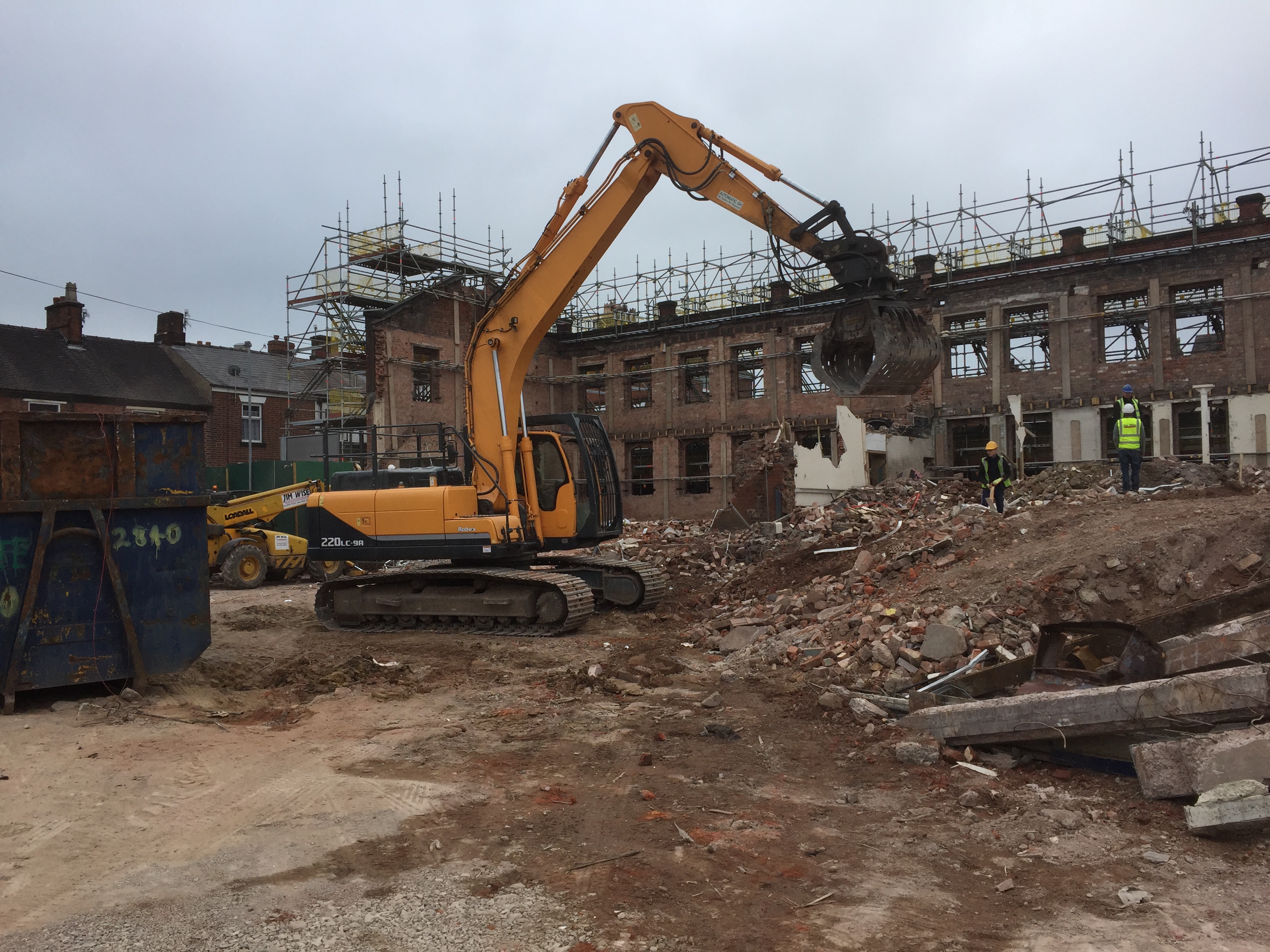
In England, demolishing most buildings does not need a full planning application. It is "permitted development", but one with strings: a prior approval application to the council covering the method of demolition and site restoration, and a separate six-week Section 80 notice under the Building Act. Listed buildings, buildings in conservation areas, pubs and a few other categories do need full consent. Here is how it works in 2026, in the order you need to do it.
- Most demolition is permitted development under Part 11 of the General Permitted Development Order 2015, so no full planning application.
- You still need prior approval: the council has 28 days to decide whether it wants to approve the method of demolition and restoration.
- You always need a Section 80 notice, six weeks before demolition, to the local authority. This is separate from planning.
- Full planning permission is required for listed buildings (listed building consent), buildings in conservation areas, pubs, theatres, concert halls and live music venues.
- Realistic lead time from decision to first machine on site: 8–10 weeks, running the notices in parallel.
Permitted development: the default position
Demolition of a building is "development" under the Town and Country Planning Act 1990, but Schedule 2, Part 11, Class B of the Town and Country Planning (General Permitted Development) (England) Order 2015 grants permission for it automatically. That is why a developer taking down a disused factory does not submit a planning application for the demolition alone. The permission comes with conditions, the main one being prior approval.
The exemptions from needing even prior approval are narrow: buildings under 50 cubic metres, demolition required by a statutory notice (a dangerous structure order, for example), and demolition that is already covered by an existing planning permission for the redevelopment.
Prior approval: what it is and the 28-day clock
Before demolition starts you apply to the local planning authority for a determination as to whether its prior approval is required for the method of demolition and the proposed restoration of the site. You submit a written description, a site plan and a statement of the method and restoration, and you put up a site notice. The authority then has 28 days to do one of three things:
- Say prior approval is not required, in which case you proceed.
- Say it is required and approve the details.
- Say it is required and refuse, or ask for changes.
If the 28 days pass with no decision, you may proceed. In practice the authority's interest is in dust, noise, traffic, hours of work and what the site looks like afterwards (fenced, levelled, drained). A competent method statement answers all of that up front.
When you need full planning permission
| Building | What is needed |
|---|---|
| Listed building (any grade) | Listed building consent under the Planning (Listed Buildings and Conservation Areas) Act 1990. Demolition without it is a criminal offence. |
| Building in a conservation area | Full planning permission for the demolition (conservation area consent was merged into planning in 2013). |
| Pubs, wine bars, theatres, concert halls, live music venues | Full planning permission. Permitted development rights were removed for these in 2020 and 2021. |
| Scheduled monument | Scheduled monument consent from the Secretary of State. |
| Building subject to an Article 4 direction | Full planning permission if the direction withdraws Part 11 rights. |
| Demolition that is part of a wider redevelopment | Normally covered in the redevelopment's planning application; check the conditions. |
Our heritage demolition guide covers listed buildings and conservation areas in detail.
The Section 80 notice: separate, and always required
Independent of planning, section 80 of the Building Act 1984 requires anyone intending to demolish a building (with the same small exemptions: under 50 m³, agricultural buildings, internal works) to notify the local authority's building control department at least six weeks before starting, and to copy the notice to the gas and electricity suppliers and to adjoining owners. The authority may respond with a Section 81 counter-notice setting conditions: shoring adjoining buildings, weatherproofing exposed walls, sealing drains, removing material, and so on. You may start once the counter-notice is received or the six weeks have passed.
Other notifications and consents that sit alongside planning
- CDM 2015 / F10. A demolition project lasting more than 30 working days with more than 20 workers at once, or over 500 person-days, must be notified to the HSE by the client before work starts.
- Asbestos. A refurbishment and demolition survey before any work, and 14 days' notice to the HSE for licensed removal. See asbestos removal before demolition.
- Party Wall etc. Act 1996. If the building shares a wall with a neighbour, or the demolition affects their structure, a party wall notice is needed, normally two months ahead.
- Protected species. Bats roost in roofs; demolishing a roost without a Natural England licence is an offence. An ecology survey early avoids a season's delay.
- Trees. Works to trees with a preservation order or in a conservation area need consent.
- Utilities. Gas, electricity, water and telecoms disconnections take four to eight weeks to arrange with the suppliers and are not controlled by the contractor.
- Highways. A hoarding licence, scaffold licence or temporary traffic order if the works affect the public highway.
A realistic timeline
- Week 0: decision to demolish. Submit the Section 80 notice and the prior approval application; instruct the asbestos R&D survey, ecology walkover and utility disconnections the same week.
- Weeks 1–4: survey reports back; method statement and restoration plan finalised; prior approval decided (28 days).
- Weeks 2–6: HSE notification for licensed asbestos (14 days) and licensed removal.
- Week 6: Section 80 period ends; counter-notice conditions built into the method.
- Weeks 6–8: utilities disconnected and proved; site set up.
- Weeks 8–10: structural demolition starts.
Done in series rather than parallel, the same list takes four to five months.
Frequently asked questions
Do I need planning permission to demolish a building in the UK?
In England, usually not a full application: demolition of most buildings is permitted development. You do need a prior approval application (28 days) and a Section 80 notice (six weeks). Listed buildings, conservation areas, pubs and music venues need full consent. Wales and Scotland have their own, broadly similar, regimes.
What is a Section 80 notice?
A legal notice under the Building Act 1984 telling the local authority you intend to demolish a building, given at least six weeks in advance. The council may reply with a Section 81 counter-notice setting conditions.
How long does demolition prior approval take?
The authority has 28 days from a valid application. If it does not respond, you may proceed after the 28 days.
Can I demolish a house without planning permission?
Demolishing a dwellinghouse is permitted development but requires prior approval under the same Part 11 process, and a Section 80 notice if the house is over 50 m³ (which all are). Our residential demolition guide covers the detail.
What happens if I demolish without the right consents?
For permitted development breaches, enforcement action and potentially a requirement to restore. For a listed building, a criminal offence with an unlimited fine. For a Section 80 breach, a fine on summary conviction. For protected species, a criminal offence.
Does the contractor handle the notices?
The legal duty sits with the owner or developer, but we prepare and submit the Section 80 notice and the prior approval method statement on behalf of most of our clients, because the content is the demolition method we are going to use.
- GPDO 2015, Schedule 2, Part 11: Heritage and demolition
- Building Act 1984, Sections 80–83
- GOV.UK Planning Practice Guidance: When is permission required?
- HSE: F10 notification of construction project
- GOV.UK: Party Wall etc. Act 1996 explanatory booklet
- GOV.UK: Bats — protection, surveys and licences
