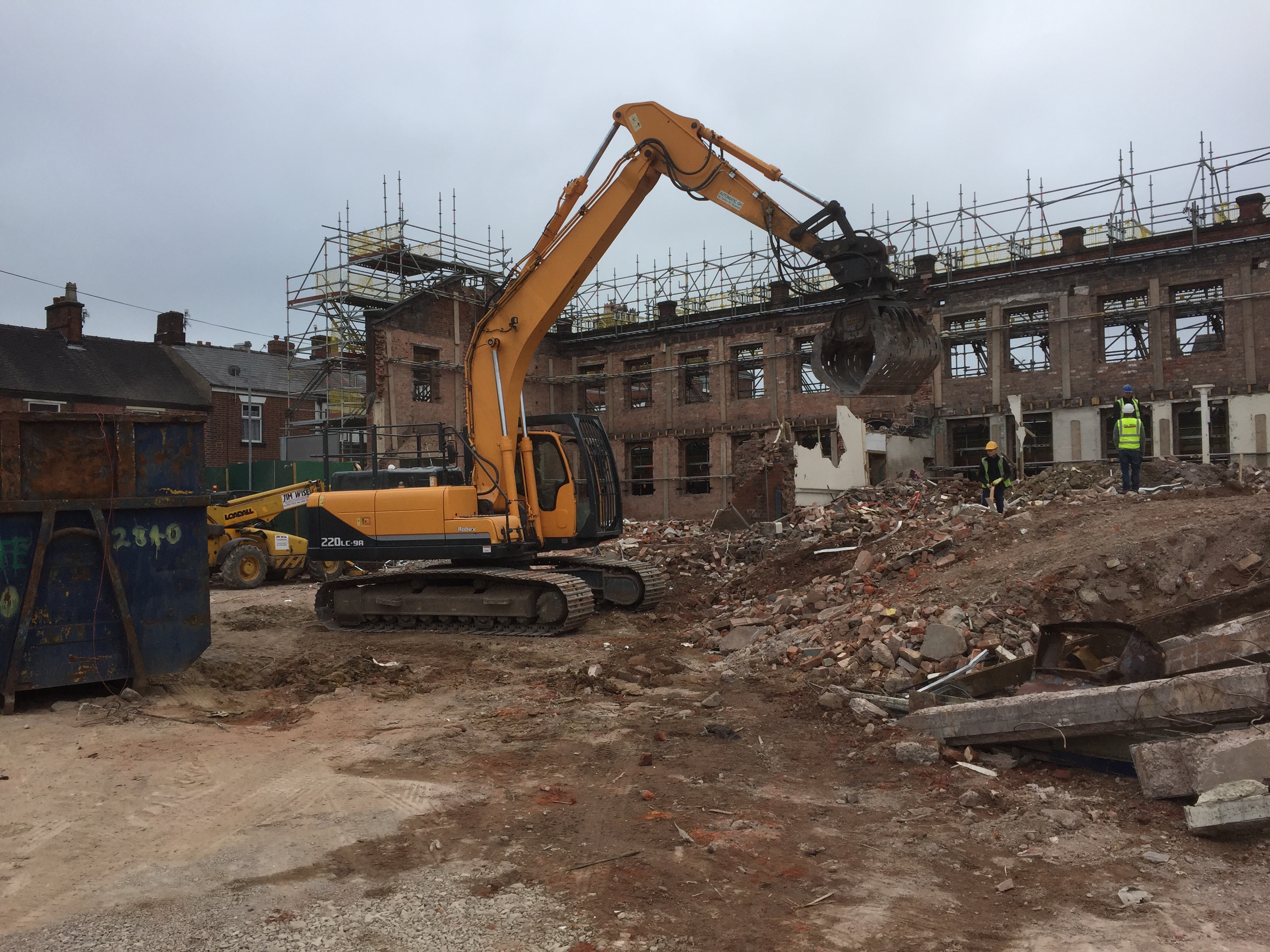
Industrial demolition is among the most technically demanding work in the construction industry. Factories, warehouses, power stations, mills, and process facilities present unique challenges: large-span structural frames, embedded services, contaminated ground, and materials that cannot be handled with standard demolition plant.
Industrial Structure Types and What They Require
Portal frame steel structures are the most common industrial building type in the UK. Demolition typically involves systematic removal of cladding and roof sheets, decommissioning of embedded services, cutting and removing steel columns and rafters, and breaking out concrete floor slabs. Steel is typically sold for scrap, offsetting disposal costs.
Reinforced concrete (RC) frame structures — older mills, warehouses, and production facilities — require careful top-down demolition or deliberate progressive collapse, depending on structural assessment.
Process facilities — chemical plants, utilities infrastructure, data centres — involve additional complexity around contaminated materials, pressurised systems, and specialist decommissioning before any structural work can begin.
Pre-Demolition Surveys Are Not Optional
Before any intrusive works begin on an industrial structure, a full Refurbishment and Demolition (R&D) asbestos survey is required by law. Industrial buildings constructed before 2000 are particularly likely to contain multiple ACM types — pipe lagging, insulating board, cement roof sheets, floor tiles, and spray coatings. Our guide to asbestos and hazardous material removal covers what to expect.
| Get a Free Quote → | 0800 222 9772 |
Specialist Plant for Industrial Demolition
Industrial sites typically require high-reach demolition excavators (capable of reaching 20m+), purpose-built processing attachments (shears, pulverisers, crushers), and occasionally controlled explosive techniques for specific elements. Our fleet includes the specialist equipment needed to work on large industrial sites efficiently and safely.
Concrete Crushing and Material Recovery
Industrial demolition generates large volumes of concrete arisings. On-site concrete crushing converts demolition rubble into recycled aggregate — reducing haulage costs and landfill tonnage significantly. We achieve a 96% waste diversion rate across our industrial projects.
Safety Management on Industrial Sites
CDM 2015 places strict duties on clients, principal designers, and principal contractors for notifiable projects — which industrial demolition almost always is. At JWD, every industrial project is managed under a comprehensive Construction Phase Plan, with project-specific RAMS, full pre-start inspections, and daily briefings. Browse our recent industrial projects for examples across England and Wales.
.svg)