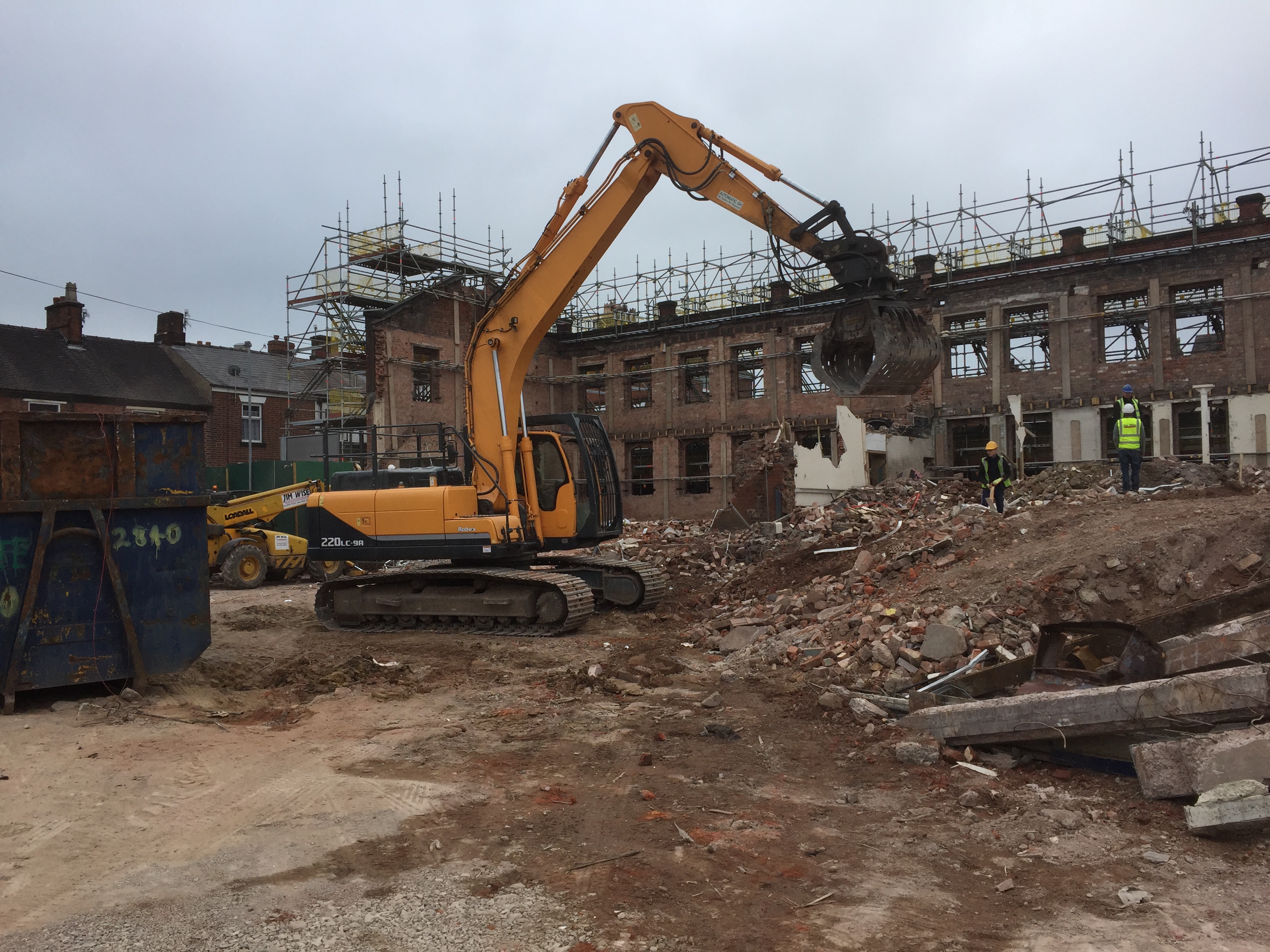
Knocking down a house is more regulated than most owners expect: a prior approval application to the council, a six-week Section 80 notice, party wall notices if you share a wall, four to eight weeks to get the gas and electricity disconnected, and an asbestos survey before anyone touches the building. Done in the right order, the house itself comes down in two or three days and the plot is cleared inside a week. This guide walks through the permissions, the sequence, the timescales and what actually drives the cost.
- You need prior approval (28 days) and a Section 80 notice (6 weeks) to demolish a house in England. Listed houses and conservation areas need full consent.
- Utility disconnections are the long pole: allow 4–8 weeks for gas and electricity. Start them first.
- Any house built before 2000 needs an asbestos survey before demolition. Artex, soffits, garage roofs and floor tiles are the usual finds.
- The demolition itself takes 2–5 days for a typical detached house; the lead-in takes 8–10 weeks.
- Cost is driven by asbestos, access and foundations, not by the number of bedrooms.
Do you need planning permission to demolish a house?
In England, demolishing a dwellinghouse is permitted development under Schedule 2, Part 11 of the General Permitted Development Order 2015, so you do not submit a full planning application for the demolition alone. You do have to apply to the council for a prior approval determination covering the method of demolition and how the site will be restored. The council has 28 days to respond; if it does not, you can proceed. If you are rebuilding, the demolition is usually included in the planning application for the new house, and its conditions apply instead.
Full consent is needed if the house is listed (listed building consent, and total demolition is rarely granted), if it is in a conservation area (planning permission), or if an Article 4 direction has removed permitted development rights in your area. Our planning permission guide has the full picture.
The Section 80 notice
Separately from planning, section 80 of the Building Act 1984 requires you to give the local authority's building control team at least six weeks' notice of intended demolition of any building over 50 cubic metres (every house). The notice also goes to the gas and electricity suppliers and the owners of adjoining buildings. The council may issue a Section 81 counter-notice requiring, for example, that the neighbour's exposed wall is weatherproofed, that drains are sealed and that the site is left level and fenced. We prepare and submit this notice for our residential clients as standard.
The Party Wall etc. Act 1996
If the house is semi-detached or terraced, the wall you share is a party wall and demolishing your side of it, or working within three to six metres of a neighbour's foundations, triggers the Act. You serve notice (two months for party structure work, one month for adjacent excavation), the neighbour consents or dissents, and if they dissent a surveyor produces a party wall award setting out how the work is done and who pays for making good. It is not a planning matter and the council is not involved, but ignoring it leaves you open to an injunction. Start it alongside the Section 80 notice.
Utilities: the step that sets the timetable
Gas and electricity must be disconnected at the main, not just the meter, before demolition, and only the network operators can do it. Gas disconnection is arranged with the gas transporter (Cadent in most of our area) and electricity with the distribution network operator; both typically quote four to eight weeks and charge a fee. Water is capped at the boundary by the water company; telecoms and broadband are simpler. None of this is in the contractor's control, which is why we tell every residential client to start the disconnections the day they decide to demolish.
Asbestos in houses
Any house built or altered before 2000 is likely to contain asbestos somewhere, and the Control of Asbestos Regulations 2012 require a refurbishment and demolition survey before demolition. The common domestic finds are textured coatings (Artex), soffits and fascias, asbestos cement garage roofs and sheds, floor tiles and their adhesive, boiler flues, bath panels and insulation board around fires. Most domestic asbestos is non-licensed or notifiable work our trained team removes before demolition; insulation board and lagging need licensed removal, which we also do under our own HSE licence. See asbestos removal before demolition.
What residential demolition involves
- Survey and quotation. We visit, check access, services, neighbours, trees and the likely foundations, and price the job as a lump sum with asbestos as a provisional item until the survey report is in.
- Notices and disconnections. Prior approval, Section 80, party wall, utilities, and an ecology check for bats if the roof is old or the house is rural.
- Asbestos removal once the survey is back.
- Soft strip. Kitchens, bathrooms, boilers, radiators, windows and anything with resale or recycling value comes out first.
- Demolition. Top-down with a 13–20 tonne excavator and a selector grab, dust suppressed by water, neighbours' property protected.
- Foundations and slab. Grubbed up and removed, or crushed on site for reuse as hardcore for the new build.
- Clearance and handover. Site levelled, fenced, drains sealed, waste transfer notes issued.
How long does it take?
- Lead-in: 8–10 weeks, set by the Section 80 period and the utility disconnections, run in parallel.
- Asbestos removal: 1–3 days for typical domestic materials; longer if licensed work is needed (14 days' HSE notice).
- Demolition and clearance: 2–5 days for a detached house or bungalow; a day for a garage; a week or more for a large house with outbuildings, deep foundations or restricted access.
What drives the cost of demolishing a house
Two houses of the same size can differ by a factor of two or more. The variables:
- Asbestos. The single largest swing. A 1930s semi with Artex ceilings and an asbestos garage roof is a different job from a 2005 house.
- Access. A detached house on a drive takes a 20-tonne machine and articulated lorries; a terrace with a three-metre side passage takes a mini excavator and a dumper, and twice as long.
- Foundations and basements. Grubbing up deep strip foundations, a cellar or a swimming pool adds days of excavation and lorries of material.
- Attachment. Semi-detached and terraced houses need the party wall left sound and weatherproofed, which is hand work.
- Reuse on site. Crushing brick and concrete for the new build's hardcore saves disposal and import costs.
- Disposal distance. Rural sites far from a licensed facility carry more haulage.
Recent residential projects
Licensed asbestos removal and full house demolition
Multiple asbestos-containing materials removed under licence with air monitoring, then the property demolished, foundations grubbed up and the plot cleared for the owner's new build.
House demolition on a residential street
Pre-demolition asbestos survey and removal, full demolition with dust, noise and access managed for the neighbours, and the plot cleared for the new house.
Portland Mill: clearing a site for retirement living
For developers: full demolition, crushing and clearance of a former mill to hand over a development-ready site to McCarthy & Stone.
Frequently asked questions
Do I need planning permission to knock down my house?
Not a full application in most cases, but you need prior approval from the council (28 days) and a Section 80 demolition notice (six weeks). Listed houses need listed building consent and houses in conservation areas need planning permission.
How long does it take to demolish a house?
Two to five days for the demolition and clearance of a typical detached house. The lead-in for notices, utility disconnections and the asbestos survey is eight to ten weeks.
Can I demolish a semi-detached house?
Yes, with a party wall notice and, usually, a party wall award. The shared wall is left standing, made sound and weatherproofed. The work on that wall is done by hand.
Can I live next door while it happens?
Yes. Dust is suppressed with water, working hours are agreed with the council (typically 8am–6pm weekdays), and neighbours' property is protected. We write to adjoining owners before we start.
Can the rubble be reused for the new house?
Usually, yes. Brick and concrete are crushed on site to a graded hardcore for the new build's sub-base, saving both the disposal cost and the cost of importing stone.
Do I need an asbestos survey to demolish a house?
If it was built or altered before 2000, yes, a refurbishment and demolition survey is a legal requirement before demolition. We arrange it as the first item in the contract.
