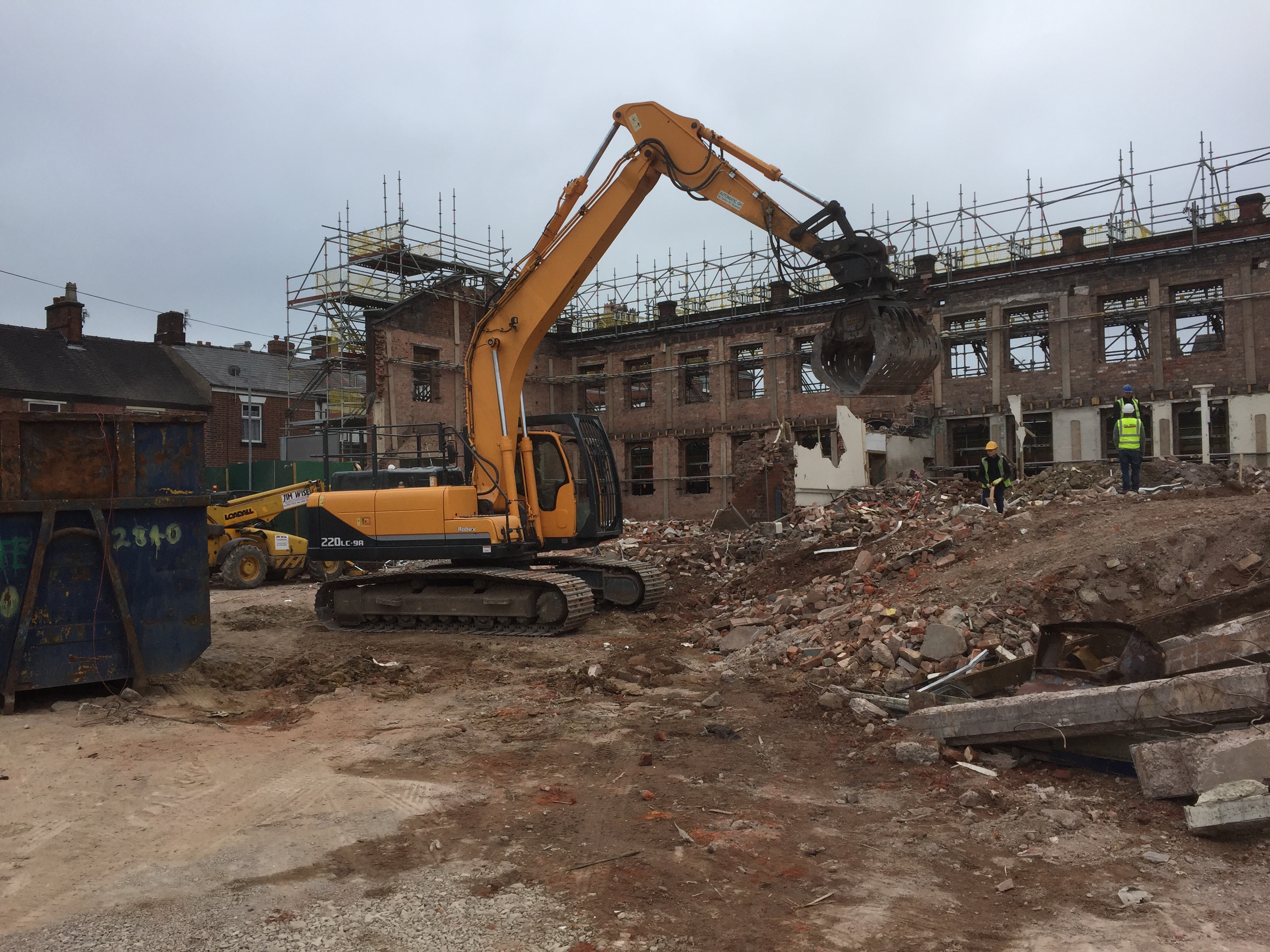
Leeds has spent the last two decades quietly becoming one of the busiest development markets outside London, and 2026 finds the city still building — offices, build-to-rent towers, student schemes and the long-running regeneration of the South Bank. Every one of those projects starts the same way: something has to come off the site first. That's where demolition contractors in Leeds earn their money, and it's what this guide is about.
We work across West Yorkshire from our base in the Midlands — Leeds, Bradford, Wakefield, Huddersfield and Halifax — and the pattern of work in Leeds has a distinct shape: tight city-centre sites, a deep stock of Victorian commercial and industrial buildings, and clients whose programmes are driven by development finance rather than convenience. Here's what that means in practice.
Why 2026 Is a Distinctive Moment for Leeds
Three currents are shaping the city's demolition workload right now. First, the office market's flight to quality: older stock that can't meet modern energy standards is being stripped for deep refurbishment or cleared entirely, and tightening EPC expectations for commercial lettings have turned marginal buildings into decisions rather than assets. Second, the South Bank's long transformation keeps releasing complex plots — former industrial land with layered histories that need careful clearance before anything rises. Third, embodied carbon has entered the conversation for real: Leeds clients now routinely ask for pre-demolition audits, material passports and reuse percentages alongside the price, and contractors who can evidence a 96% diversion rate rather than assert one hold a genuine advantage.
None of this changes the fundamentals of safe demolition — but it changes what a good tender response looks like, and it rewards contractors whose documentation is as strong as their machinery. That's the market this guide is written for.
City-Centre Demolition: The Logistics Are the Project
Leeds city centre gives a demolition contractor almost nothing for free. Sites are hemmed in by live offices, retail, the rail station approaches and some of the busiest bus corridors in the north. There's rarely a compound, rarely a quiet elevation, and never a route where a wagon movement doesn't matter.
On sites like these the method statement is really a logistics plan with demolition attached. Deliveries and muck-away booked into timed slots. Banksman control on every vehicle movement. Scaffolding and crash decks protecting footways that stay open. Dust suppression at source, monitored daily, because the neighbouring buildings have windows that open and facilities managers with our phone number. The demolition itself — typically top-down mechanical reduction within the site footprint under BS 6187:2011 — is often the most straightforward part of the job.
If you're a developer weighing up a constrained plot, our plain-English guide to what commercial demolition involves is a useful starting point before you brief anyone.
The Victorian Inheritance: Mills, Warehouses and Works
West Yorkshire's textile wealth left Leeds and its neighbours with a huge stock of nineteenth-century mills, warehouses and works — Holbeck and the South Bank are full of them. Some are rightly protected and brilliantly converted. Others are structurally tired, fire-damaged or simply unviable, and demolition is the honest answer.
Victorian industrial buildings demand respect on the tools. Timber floors soaked in a century of machine oil burn ferociously and fail unpredictably. Cast-iron columns shatter rather than bend. Stone and brick walls of enormous thickness stand on foundations nobody has seen since the 1870s, and basements, wells and culverts turn up without warning. Add the asbestos introduced through decades of piecemeal refurbishment — surveyed under CAR 2012 and removed before anything structural happens — and you have exactly the type of building where an experienced contractor pays for itself. We've handled this class of structure many times, including a former mill in Hyde that combined licensed asbestos removal, soft strip and full demolition in one programme.
Soft Strip: The Quiet Workhorse of the Leeds Market
Not every Leeds project is a clearance. A large share of the city's demolition work is soft strip out — taking office floors, retail units and whole buildings back to structure ahead of refurbishment or repositioning. With so much 1980s and 1990s office stock being upgraded rather than replaced, strip out is often the whole instruction.
Done well, it's a precise trade: ceilings, partitions, raised floors, M&E and fixtures removed in sequence, segregated at source into dedicated waste streams, without damaging the frame, the facade or the neighbours' Tuesday. Done badly, it writes off recyclable material as mixed waste and hands the fit-out contractor a building full of surprises. The difference is explained in our guide to soft strip versus full demolition.
| Get a Free Quote → | 0800 222 9772 |
Where the Material Goes
Leeds clients increasingly ask the waste question before the price question, and rightly so. Our answer is the same across every project: segregate at source, weigh and document every load, and keep reclaimable material out of the general stream from day one. Brick, stone, timber, metals and plasterboard each travel separately; concrete and hardcore are crushed — on site where volumes justify our concrete crushing service — and across our work we divert around 96% of demolition waste from landfill. Every load leaves on a waste transfer note to a licensed facility, and the documentation pack comes to you at handover.
A Leeds City-Centre Project, Step by Step
- Constraints first — access routes, neighbour schedule, highway requirements and crane oversail issues mapped before method.
- Intrusive survey — demolition and refurbishment asbestos survey under CAR 2012 plus structural appraisal, fixing the real scope.
- Notifications — Section 80 to the council, HSE notice for licensed asbestos, utilities disconnections booked early because they pace everything.
- Protection — scaffold, crash decks and monitored party walls installed so the public realm never meets the works.
- Asbestos and soft strip — licensed removal by our in-house teams, then floor-by-floor strip with materials segregated at source.
- Structure — top-down reduction to BS 6187:2011 within the footprint, arisings processed and removed on timed movements.
- Handover — level site, complete waste documentation, party walls made good and neighbours thanked.
All of it runs under a CDM 2015 construction phase plan with daily briefings, and the difference between a smooth Leeds job and a difficult one is almost always decided in steps one to three — before a machine arrives. That front-loading is where forty years of city-centre experience earns its keep, and why repeat clients hand us their tightest sites first.
What Drives Cost and Programme on Leeds Projects
Leeds pricing is shaped less by the building than by everything around it. Logistics lead: timed deliveries, restricted hours, scaffold protection to live footways and the absence of on-site storage all add cost that an open site never sees. Asbestos scope is the great unknown until the intrusive survey is done — pre-2000 office stock varies enormously — and what stays matters as much as what goes: strip outs that protect a retained frame and facade demand slower, more skilled work than clearance. Finally, waste logistics in a city centre mean more, smaller movements, each one managed.
On programme, the rhythm is consistent: survey and notifications first (including the fourteen-day HSE notice where licensed asbestos work applies), asbestos removal, then strip or structure. City-centre strip outs typically run weeks; full structural demolition on constrained sites runs months, driven mostly by how fast material can safely leave the site. A contractor who controls the whole sequence in-house — as we do — removes the handover gaps where programmes usually slip.
Leeds Demolition: Quick Answers
Do you work outside normal hours in Leeds?
Where the council and neighbours agree, yes — some city-centre logistics only work early or late. Percussive works stay inside agreed hours; deliveries and quiet tasks can flex.
Who tells the council before demolition starts?
A Section 80 notice under the Building Act 1984 must go to the local authority before works commence — the client's duty, but we prepare and manage it as standard on every project.
Is a survey really needed before you price?
For anything pre-2000, yes — a demolition and refurbishment survey under CAR 2012. Prices fixed without one are guesses, and the variation claims arrive later. We'd rather survey first and stand behind the number.
Do you cover Bradford, Wakefield and the rest of West Yorkshire?
All of it — Bradford, Wakefield, Huddersfield, Halifax, Dewsbury and the surrounding towns, with South Yorkshire served by the same teams.
What to Check Before You Appoint
The Leeds market has no shortage of contractors; it has a shortage of contractors who can evidence what they claim. Before appointing anyone, verify five things: a current HSE asbestos licence (most pre-2000 buildings need one somewhere in the programme), ConstructionLine or SSIP accreditation, comparable project references you can actually visit, a demolition and refurbishment survey before the price is fixed, and insurance appropriate to working beside occupied buildings. Our complete UK guide to choosing a demolition contractor covers the full checklist.
We bring ConstructionLine Gold, SSIP Acclaim, NEBOSH and IOSH qualified management, our own plant and a directly employed workforce to every West Yorkshire project — the same standards on a Leeds tower strip out as on a Wakefield shed. Family-run since 1982: plan it properly, do it safely, leave the site clean.
Starting a project in Leeds or anywhere across West Yorkshire? See our Leeds demolition contractors page, request a free site visit, or call 0800 222 9772.
.svg)