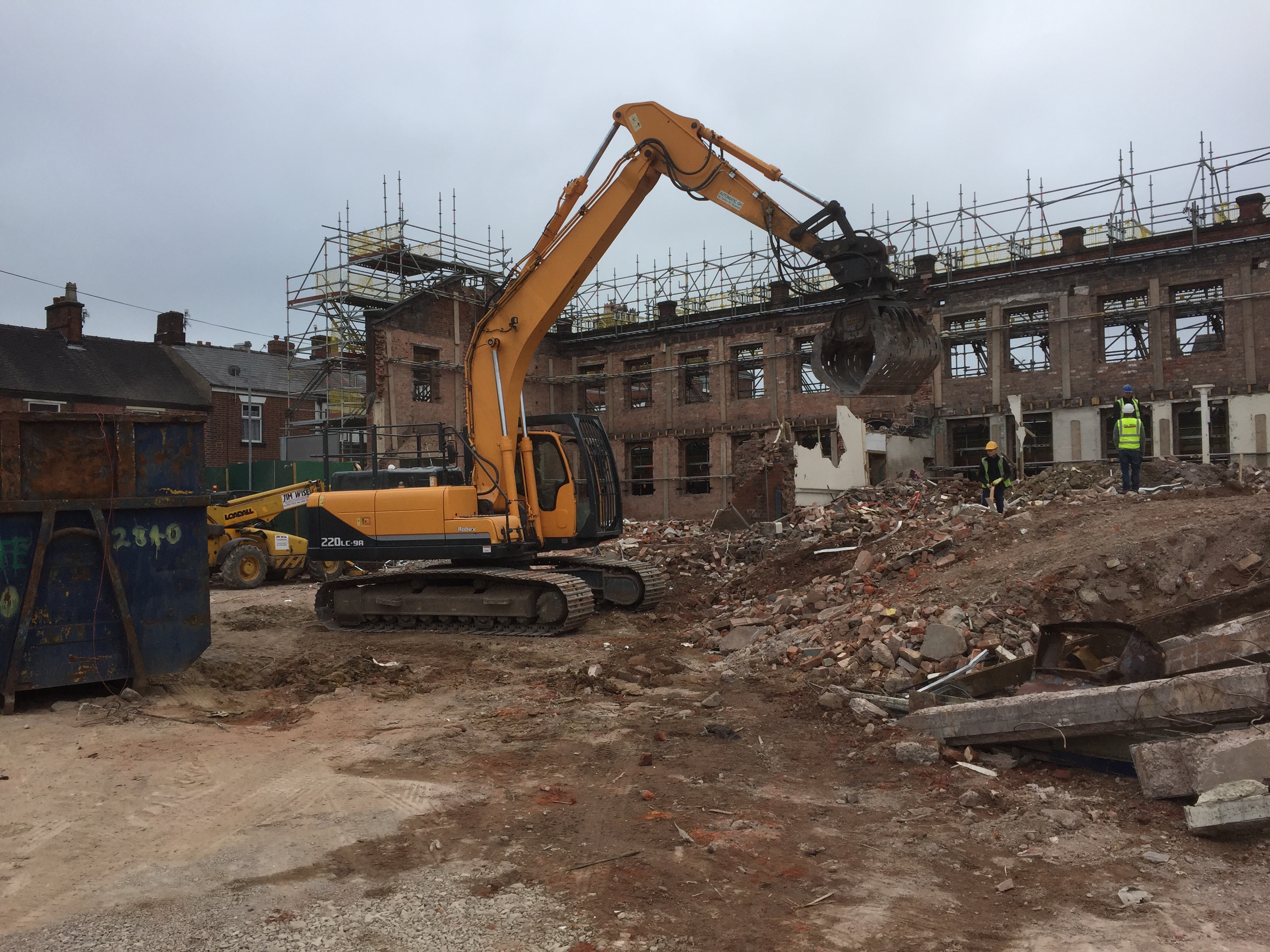
Derbyshire packs three different demolition landscapes into one county. The Derwent Valley holds some of the most historically important mill buildings on earth — the birthplace of the factory system, and rightly protected. The eastern coalfield around Chesterfield and the Erewash carries a century of pit-era industry and its buildings. And across the Peak fringe and the rural west, farms, quarry buildings and village works quietly reach the end of their lives every year. Each landscape asks something different of demolition contractors in Derbyshire, and this guide covers all three.
We work across the county — Derby, Chesterfield, Matlock, Belper, Ripley, Ilkeston, Long Eaton, Buxton and Glossop — from our base just over the Staffordshire border, close enough for same-week site visits almost anywhere in Derbyshire.
Why Derbyshire's Workload Is Shifting in 2026
Across the county's three landscapes, the drivers are moving in the same direction. On the coalfield, brownfield-first planning and remediation funding keep former industrial land coming forward, each site needing documented clearance before anything else. In the rural west, agricultural change is retiring buildings steadily — modern farming simply doesn't fit century-old footprints — while permitted development routes for converting or replacing farm structures keep decisions flowing. And along the Derwent corridor, condition presses hardest: unheated mill-era buildings outside the protected core deteriorate winter by winter, making early, honest appraisal the difference between planned works and emergency ones.
Layer on ecology obligations that are enforced more consistently than a decade ago — bat surveys are now simply part of rural programming — and the pattern is clear: Derbyshire rewards contractors who front-load the paperwork, the surveys and the seasonal planning. That's the discipline running through every section of this guide.
The Derwent Valley: Where Demolition Means Judgement
Between Matlock Bath and Derby, the Derwent Valley Mills World Heritage Site protects the very first factories — and around the protected core sits a wider stock of mill-era buildings in every condition from lovingly converted to dangerously derelict. Working in and around heritage of this significance demands a contractor who understands what must never be touched, what can be sensitively altered, and what has genuinely reached the end.
Where demolition is consented in sensitive settings, method changes completely: hand demolition and salvage take over from machines, materials are reclaimed for repairs elsewhere, and interfaces with retained fabric are protected with temporary works designed before work starts. We've delivered exactly this kind of work, including specialist demolition at the Grade II* listed Wedgwood Institute, and our thinking on the keep-or-clear question is set out in balancing demolition and conservation.
The Coalfield East: Industry's Second Landscape
Eastern Derbyshire's story is coal and what coal fed — engineering works, foundries, railway buildings and acre after acre of twentieth-century sheds around Chesterfield, Staveley and the Erewash valley. This is classic industrial demolition territory: steel frames, asbestos cement roofs, lagged services, and ground with mining history beneath it.
The asbestos load in this stock is heavy and predictable — sprayed coatings, AIB, lagging, cement sheets — and under CAR 2012 the demolition and refurbishment survey comes first on every project. Our HSE licensed teams remove licensed and non-licensed materials in-house before strip and structure begin. The ground needs equal respect: former colliery and works land carries made ground, voids and contamination, and clearance has to be done in a way that documents everything and spreads nothing. Our guide to what site clearance includes covers the essentials.
The Rural West: Farms, Quarries and Village Works
The county's third landscape rarely makes headlines but generates constant work: redundant agricultural buildings, quarry-era structures, village workshops and rural commercial premises across the Peak fringe. Rural demolition has its own character — asbestos cement roofing on almost every post-war farm building, fuel and chemical stores to handle carefully, bats and nesting birds to survey for before works are programmed, and access along lanes that were never designed for low-loaders.
Smaller doesn't mean casual. The same BS 6187:2011 methods, the same CDM 2015 planning and the same waste documentation apply to a barn as to a factory — the difference is scale, not standard. And in National Park and conservation settings, tidy sites, quiet methods and honest reinstatement matter as much as the demolition itself.
| Get a Free Quote → | 0800 222 9772 |
Derbyshire Materials Deserve a Second Life
Gritstone, limestone, handmade brick, blue slate — Derbyshire's traditional buildings are made of materials with genuine reclaim value, and crushing them indiscriminately is a waste in every sense. We keep reclaimable stone and brick separate from the first day on site, timber and metals travel in their own streams, and concrete and hardcore are processed for reuse — through our on-site crushing service where volumes justify it. Across our projects, around 96% of demolition waste is diverted from landfill, and on heritage-adjacent sites the reclaim percentage climbs higher still.
When Derbyshire Buildings Fail Without Warning
Rural and mill-era counties generate a particular kind of urgent work. A gable that shifts after heavy rain, a fire in a redundant farm building, a roof that finally lets go over winter — these arrive without notice and usually with a highway, a footpath or a neighbouring property at risk. Our emergency demolition response covers the whole county around the clock: make safe first, working with the fire service and building control where they're already in attendance, then assess, then plan the permanent solution once the immediate danger is controlled.
What makes emergency work go well is having a contractor who already understands the region's building types. Knowing how a rubble-filled stone wall behaves when it's saturated, or how a mill floor fails once its timbers have burned, is not something you want your contractor learning at two in the morning. Four decades of Derbyshire and Staffordshire buildings means our supervisors have usually seen the failure mode before — and that experience is the difference between a controlled intervention and an expensive over-demolition.
A Derbyshire Project, Step by Step
- Setting assessment — heritage designations, National Park constraints and ecology likelihood established before anything else is planned.
- Surveys — intrusive asbestos survey under CAR 2012, structural appraisal, and preliminary ecology where the building type suggests roosts.
- Consents and notifications — Section 80 notice, heritage or Park consents where they apply, HSE notice for licensed asbestos, ecology licensing programmed if needed.
- Asbestos removal — cement roofing to licensed materials, all handled by our in-house teams.
- Salvage and strip — stone, brick and slate set aside; interiors and services out, segregated.
- Demolition — hand and salvage-led in sensitive settings, mechanical to BS 6187:2011 where the site allows.
- Clearance and reinstatement — ground handled to its risk, waste documented, rural sites reinstated tidily.
A CDM 2015 phase plan governs every version — barn or works, Belper or Buxton. The Derbyshire habit worth naming is patience: ecology windows, heritage consents and reclaim all reward the contractor who programmes them from day one rather than discovering them at week six. We've been working this county for four decades, and the patient route is reliably the fast one.
What Drives Cost and Programme Across Derbyshire
Derbyshire's three landscapes price differently. Heritage-adjacent work costs more per cubic metre because hand demolition, salvage and interface protection are skilled, slow trades — and worth it where they're required. Coalfield industrial prices on asbestos scope and ground risk, with metal credits from steel-framed works flowing back. Rural projects price on access, ecology programming and the near-universal asbestos cement roofing of post-war farm stock. Everywhere, the intrusive survey sets the real number — walk-round estimates on pre-2000 buildings are guesses.
On programme: rural buildings clear in days to weeks once surveys and any ecology windows are satisfied; works complexes run weeks to months with licensed asbestos (and its fourteen-day HSE notice) usually pacing the job; heritage-adjacent schemes move at the speed the fabric allows. Seasonal ecology windows — bats and nesting birds — are the constraint clients most often discover late, so we programme them first, not last.
Derbyshire Demolition: Quick Answers
Our barn probably has bats — what happens?
A preliminary ecology survey before anything else, and if roosts are present, works are programmed around licensing and mitigation. Discovering bats mid-works stops a job dead; surveying first keeps you legal and on programme.
Can you work within the Peak District National Park?
Yes — with the extra consents, quieter methods and reinstatement standards those settings demand. Tidy, low-impact working isn't an upgrade there; it's the baseline.
Is stone from our building worth reclaiming?
Derbyshire gritstone and limestone usually are — we keep reclaimable stone, brick and slate separate from day one, and their value flows back into the project rather than into hardcore.
How quickly can you get to site in Derbyshire?
Our base sits just over the county line, so site visits are typically same-week anywhere from Glossop to Swadlincote — call 0800 222 9772.
Choosing a Contractor for Derbyshire Work
Whether the site is a Belper mill yard, a Chesterfield works or a Peak fringe farm, the tests for a contractor don't change: current HSE asbestos licence, verifiable ConstructionLine and SSIP accreditation, references from comparable settings, an intrusive survey before the price, ecology awareness where the site demands it, and a complete waste paper trail at handover. The full checklist is in our complete UK guide to choosing a demolition contractor.
We bring ConstructionLine Gold, SSIP Acclaim, NEBOSH and IOSH qualified management and forty-plus years of experience to every Derbyshire project, large or small — with zero prohibition notices in over a decade. Family-run since 1982: plan it properly, do it safely, leave the site clean.
From Derby to the Dales: start at our Derbyshire demolition contractors page, arrange a free site visit, or call 0800 222 9772.
.svg)