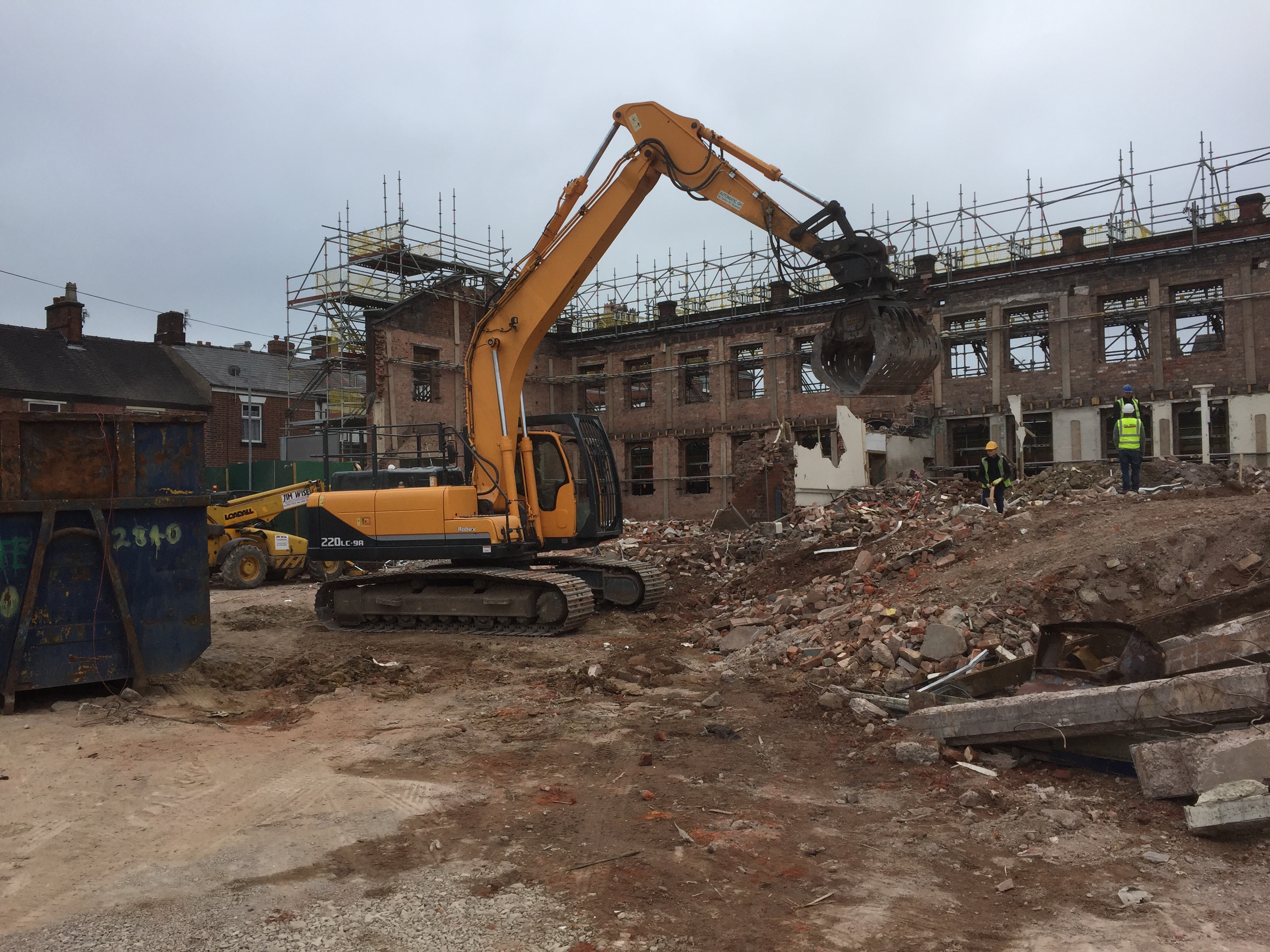
Leicester made its money in textiles, hosiery and footwear, and the factories that powered that trade still shape whole quarters of the city — from the big waterside mills along the Soar to the tight streets of workshops and warehouses around Frog Island and the northern edge of the centre. As the city regenerates, a steady share of that stock is coming down or being stripped back for new uses, and doing it well is what demolition contractors in Leicester are for.
We work across Leicester and Leicestershire — the city, Loughborough, Hinckley, Coalville, Melton Mowbray and Market Harborough — and this guide covers what the city's factory inheritance means on the tools, where soft strip fits, and how to appoint the right firm for the job.
Why Leicester's Factory Quarter Is Changing Now
Several currents have converged on the city's industrial stock in 2026. Waterside regeneration keeps working north along the Soar, turning factory plots into homes and workspace year by year. The economics of conversion have sharpened in both directions — construction costs make marginal retentions harder to justify, while housing demand makes cleared or converted sites more valuable — so the keep-or-clear decision is being made on more buildings, faster. And condition doesn't pause: unheated mills deteriorate quickly, and each winter moves a few more from viable to urgent.
Add tightening energy standards for lettable space and growing client interest in reclaimed materials — Leicester brick has never been more sought after — and the shape of the market is clear: more decisions, earlier, made on evidence. That's why this guide leans so hard on surveys, structural appraisal and strip-out-as-investigation; in this city, in this cycle, information is where the money is.
Textile Mills: What the Trade Left Behind
Leicester's mills and factories are classic products of their era: multi-storey brick structures with timber or early concrete floors, big window openings for daylight, cast-iron or steel columns, and roofs of slate or asbestos cement depending on the decade. Many have been extended sideways and upwards repeatedly, so a single site can contain four construction eras leaning on one another.
Their hazards are the classic set too. Timber floors soaked in decades of machine oil. Cast iron that fails without warning. Basements, wells and culverts from the water-powered years. Lead paint throughout, and asbestos introduced across a century of refits — boiler houses, lagged pipe runs, AIB partitions and ceiling linings, cement roofs. Under the Control of Asbestos Regulations 2012, a demolition and refurbishment survey comes first, and everything it finds is removed before structural work starts — licensed materials by our own HSE licensed teams, with clearances and air monitoring handled in-house.
Keep, Convert or Clear?
Leicester has some superb mill conversions, and where a building can carry a new life, conversion is often the right answer. But romance doesn't hold a roof up: fire damage, rot in floor timbers, failed brickwork and simple economics rule plenty of buildings out, and pretending otherwise just leaves them to deteriorate dangerously. The honest path is an early, evidence-based decision — structural appraisal, survey findings, viability — made before machines are anywhere near the site. We've set out how we think about those calls in balancing demolition and conservation, and it applies to Leicester's factory quarter as much as to any listed landmark.
Where the answer is partial — keep the facade, keep the front range, clear the rest — the demolition becomes surgical: hand and small-plant work at the interfaces, temporary works to restrain what stays, and mechanical reduction only where clearances allow, all sequenced under BS 6187:2011.
The Strip Out Economy
A large share of Leicester's demolition work never touches the frame. Factory floors becoming studios, warehouses becoming homes, retail units changing hands — all of it starts with soft strip out: interiors taken back to structure, services removed safely, and every material stream segregated at source. On conversion projects the strip is where the building's secrets surface — hidden asbestos, unrecorded alterations, floors weaker than they look — which is why we treat strip out as investigation as much as removal, feeding what we find straight back to the design team. The difference between stripping and demolishing is explained in our guide to soft strip versus full demolition.
| Get a Free Quote → | 0800 222 9772 |
Working in a Busy, Close-Knit City
Leicester's factory districts are dense and lived-in: homes, businesses, places of worship and schools sit tight against former industrial buildings, and the city's streets weren't drawn with demolition wagons in mind. Our site controls are built for exactly this — agreed working hours, dust suppression at source reviewed daily, noise and vibration monitored against agreed levels, banksman control on every vehicle movement, and the highway swept clean at the end of every shift. On the waste side, brick, timber, metals and hardcore travel in separate streams, concrete is crushed for reuse where volumes justify our on-site crushing, and across our projects around 96% of demolition waste is diverted from landfill.
A Leicester Factory Project, Step by Step
- Condition and keep-or-clear — structural appraisal and viability evidence assembled early, so the retention decision is made once, on facts.
- Intrusive asbestos survey — under CAR 2012, into the layers a century of textile-era refits left behind.
- Notifications and consents — Section 80 notice, conservation-area consents where relevant, HSE notice for licensed removal.
- Asbestos out — in-house licensed teams, air monitoring, four-stage clearance.
- Soft strip as investigation — interiors back to structure, findings fed to the design team, reclaimables palletised.
- Structure — hand and small plant at retained interfaces, mechanical top-down elsewhere, all to BS 6187:2011.
- Clearance and handover — basements and culverts addressed, waste documented load by load, site left ready.
Everything sits inside a CDM 2015 phase plan with daily briefings. Leicester's factory quarter rewards contractors who treat buildings as evidence rather than obstacles — half our value on conversion schemes is what we find and report in step five, weeks before it could become a design-stage surprise. Demolition done thoughtfully is the cheapest site investigation a developer ever buys.
What Drives Cost and Programme on Leicester Projects
Factory-era buildings price on familiar factors. Asbestos scope — a century of refits means the intrusive survey, not the walk-round, sets the real number, with the fourteen-day HSE notice in the programme where licensed work applies. Structure and condition — fire-damaged or rotten floors demand more temporary works and slower, safer sequences. What's retained — facade and partial-retention schemes cost more per cubic metre than clearance because the skill sits at the interfaces. And setting — dense streets mean managed logistics, protected footways and more, smaller waste movements.
Typical rhythm: survey and notifications, asbestos removal, soft strip, then structure. Conversion strip outs run weeks; full mill demolition runs months, paced by removal and safe reduction rates. Reclaim helps the numbers: Leicester brick and roof slate carry real value when kept out of the crusher from day one, and we palletise reclaimable material as standard.
Leicester Demolition: Quick Answers
Our building might be convertible — can you help us decide?
Yes. The strip out phase doubles as investigation: we feed structural condition, hidden asbestos and unrecorded alterations straight back to your design team so the keep-or-clear decision is made on evidence, early.
What consents do we need before demolition in Leicester?
A Section 80 notice to the council before works start, plus planning or prior approval depending on the building and setting — conservation areas carry extra consents. We flag all of it at survey stage.
How is dust controlled next to homes and businesses?
Suppression at source — water at the point of processing — reviewed daily and stepped up in dry spells, alongside monitored noise and vibration and agreed working hours. Neighbour complaints are a failure we plan against, not a cost of doing business.
Do you cover the county as well as the city?
All of Leicestershire — Loughborough, Hinckley, Coalville, Melton Mowbray, Market Harborough — plus the wider East Midlands including Derbyshire.
Appointing a Contractor in Leicester
The tests are the same here as anywhere, and worth applying strictly: a current HSE asbestos licence (almost every pre-2000 factory needs one in the programme); ConstructionLine or SSIP accreditation you can verify; comparable mill and factory references; an intrusive survey before the price is fixed; and a waste documentation trail you'll receive at handover. Our complete UK guide to choosing a demolition contractor walks through the lot.
We bring ConstructionLine Gold, SSIP Acclaim, NEBOSH and IOSH qualified management, our own plant and directly employed teams to every Leicester and Leicestershire project — with zero prohibition notices in over a decade. Family-run since 1982: plan it properly, do it safely, leave the site clean.
Planning work in the city or the county? Start at our Leicester demolition contractors page, book a free site visit, or call 0800 222 9772.
.svg)