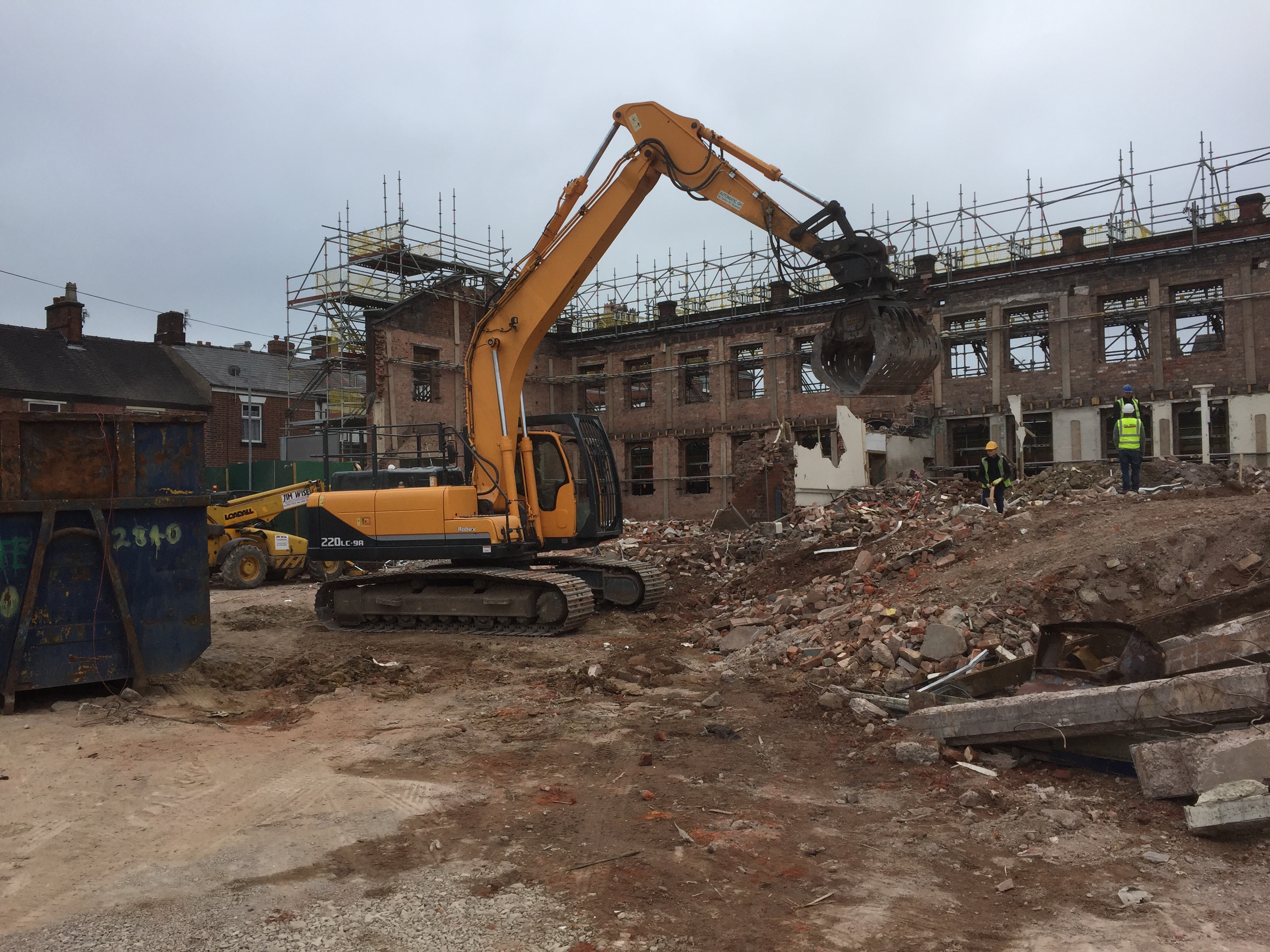
Most contractor guides to a city are written from the outside. This one isn't. Over the past year we've delivered three projects in and around Newcastle upon Tyne — the demolition of the former Ruskims Cash & Carry, a specialist high-bay racking strip out on a live industrial estate, and a rapid retail strip out for Carpetright up the coast in Berwick-upon-Tweed — and this guide is built on what those jobs actually involved. If you're commissioning demolition or strip out anywhere in the North East in 2026, here's what the region asks of a contractor, learned on its own ground.
The North East Market in 2026
Newcastle and the wider Tyneside economy are in a busy cycle. City-centre repositioning continues as older retail and office stock finds new uses; the industrial market along the Tyne corridor and the A1 keeps churning as logistics and manufacturing occupiers upgrade; and the region's big regeneration stories keep releasing complex brownfield plots. For demolition, that translates into three steady workstreams: retail and commercial demolition where buildings have reached end of life, industrial strip out where units are repositioned between occupiers, and site clearance on former industrial land.
What the region doesn't have in abundance is contractors who can deliver licensed asbestos removal, structural demolition and specialist strip out as one accountable package — which is precisely why national delivery into the North East is normal here, and why our own project record in the region keeps growing.
Three Newcastle-Area Projects, and What Each Taught
Former Ruskims Cash & Carry — retail demolition on a constrained plot
The Ruskims project is classic end-of-life retail: a large-footprint store whose trading days were done, on a site with value waiting behind it. Jobs like this follow the full sequence — survey, soft strip, structural demolition, slab and clearance — and the lesson they teach is about sequencing around neighbours: live premises, public routes and traffic that doesn't pause because a building is coming down. Every load out was managed, every boundary protected, and the site handed over clean and level.
High-bay racking strip out — precision work on a live estate
The racking strip out was a different discipline entirely: high-level structural racking dismantled in sequence inside an industrial unit, with the building itself staying. Racking looks simple and is anything but — it's a structure, it fails like a structure, and it comes down safely only in the reverse order it went up, with exclusion zones honestly sized. The metal all went for recycling; the unit went back to its landlord ready to relet. This is the daily bread of our warehouse strip out service, and the North East industrial market generates it constantly.
Carpetright, Berwick-upon-Tweed — speed done properly
The Berwick strip out proved the point about mobilisation: a retail unit stripped on a fast programme, waste fully segregated, at the far northern end of England. Speed in strip out isn't about rushing — it's about arriving with the right crew size, the right plant and a plan that wastes no day. That's how a Midlands-based contractor delivers in Northumberland without the programme noticing the postcode.
Newcastle's Building Stock: What You're Likely Dealing With
Tyneside's building generations each bring their own demolition profile, and knowing which one you own tells you most of what the project will involve:
| Building era | Structure | Typical hazards | Demolition approach |
|---|---|---|---|
| Victorian industrial & quayside | Heavy masonry, timber floors, deep foundations | Lead paint, oil-soaked timbers, hidden basements | Sequenced hand/mechanical mix, salvage value in brick and stone |
| Interwar & post-war commercial | Steel and early concrete frames | Asbestos throughout — AIB, lagging, sprayed coatings | Licensed removal first, then top-down reduction |
| 1960s–80s retail & office | Concrete frames, big footprints | Heavy asbestos load, services altered repeatedly | Full survey, strip, mechanical demolition, crush on site |
| Modern industrial (1990s+) | Portal frames, composite cladding | Minimal asbestos, occasional contamination | Fast dismantling, high metal recovery, strip-out-led |
The common thread is asbestos: anything pre-2000 needs a demolition and refurbishment survey under the Control of Asbestos Regulations 2012 before works are priced, let alone started. Our HSE licensed teams handle licensed and non-licensed removal in-house — one programme, no handover gap — as explained in our guide to asbestos removal before demolition.
How We Deliver in the North East
Distance is a logistics line, not a risk — our Berwick and Newcastle projects are the evidence. Here's what away-delivery actually looks like on the ground:
- Survey visit — we travel for surveys as readily as works; intrusive asbestos survey and structural appraisal fix the real scope before any price.
- Notifications — Section 80 notice to the council, HSE notification for licensed asbestos, utilities isolations booked early.
- Mobilisation — plant by low-loader, secure compound and welfare established, resident supervision on site before the first operative.
- Asbestos and soft strip — in-house licensed removal, then soft strip with source segregation.
- Structure — top-down reduction to BS 6187:2011 under a CDM 2015 phase plan.
- Clearance and handover — crushing on site where volumes justify, every load on a waste transfer note, full documentation pack delivered.
| Get a Free Quote → | 0800 222 9772 |
What Drives Cost on Tyneside Projects
| Cost factor | Impact | Why it matters |
|---|---|---|
| Asbestos scope | Highest | Fixed only by intrusive survey; licensed works add the HSE 14-day notice to the programme |
| Structure type | High | Concrete frames cost plant-hours; steel returns metal credits that offset |
| Site constraints | High | City-centre logistics, live-estate working and protected routes all shape method |
| Waste strategy | Medium | On-site crushing cuts haulage; segregation raises recovery and lowers disposal cost |
| Mobilisation | Low–medium | A visible, honest line for away projects — minor on anything beyond small works |
Our pricing rule in the North East is the same as everywhere: survey first, fixed price after, and the metal and aggregate value in the building credited honestly. Across our projects around 96% of demolition waste is diverted from landfill, and the documentation to prove it comes with the handover.
Newcastle upon Tyne: Quick Answers
Have you actually worked in Newcastle?
Yes — the former Ruskims Cash & Carry demolition and a specialist warehouse racking strip out in the city, plus the Carpetright strip out in Berwick-upon-Tweed. All three are written up on this site with the scope described.
Who handles emergencies on an away project?
We do — 24/7 arrangements, site security and escalation contacts are established at project start, before the first machine moves.
What consents does a Newcastle demolition need?
A Section 80 demolition notice to the council before works, plus planning or prior approval depending on the building and setting — conservation areas carry extra consents. We prepare notifications as standard.
Do you cover the wider North East?
Yes — Gateshead, Sunderland, North and South Tyneside, Durham and up the coast to Berwick, as part of the 125+ UK locations we've delivered in.
Can you do strip out without demolition?
Constantly — retail and warehouse strip out where the building stays is a core service, as both our Newcastle racking project and the Berwick job show.
The Compliance Framework Behind Every Tyneside Job
Demolition anywhere in England runs on the same legal spine, and it's worth understanding as a client because it's what separates professional bids from cheap ones. CDM 2015 makes demolition planned work by law: a written construction phase plan before anything starts, a principal contractor with the competence to deliver it, and welfare provision on site from day one. BS 6187:2011 is the code of practice the method statement lives by — exclusion zones, structural sequencing, protection of adjacent property. The Control of Asbestos Regulations 2012 govern the survey and removal chain, including the fourteen-day HSE notification for licensed works. And the waste framework — duty of care, transfer notes, consignment notes for hazardous streams, carrier licensing — turns every skip and wagon into a documented movement.
On our Newcastle projects that framework wasn't paperwork theatre; it was the delivery mechanism. The Ruskims phase plan sequenced a large structure down safely beside live surroundings; the racking job's method statement treated storage steel as the engineered structure it is; and every load off both sites left with documentation the client can produce years from now. HSG29 guidance shaped the safe dismantling on the racking project; HSG210 underpins how our asbestos and demolition interfaces are managed everywhere. Ask any bidder to show you these documents from a recent comparable job — the speed and quality of the answer tells you most of what you need to know.
Where North East Demolition Waste Actually Goes
Sustainability claims are cheap; weighbridge tickets aren't. Here's how material from a typical Tyneside project flows through our system:
| Stream | Handling | Destination | Recovery |
|---|---|---|---|
| Structural steel & racking | Processed and graded on site | Scrap metal recycling — smelter-bound | ~100% |
| Concrete & hardcore | Crushed — on site where volumes justify | Recycled aggregate for the next scheme | ~100% |
| Brick & masonry | Reclaimed where sound, crushed otherwise | Reuse or aggregate | High |
| Timber | Segregated at strip stage | Recycling / biomass | High |
| Mixed C&D residue | Minimised by source segregation | Licensed transfer station | Balance |
| Asbestos | Double-wrapped, consignment-noted | Licensed hazardous landfill only | Safe disposal |
That flow is how we hold roughly 96% landfill diversion across our project record — and on metal-heavy North East industrial jobs the recovery rate climbs higher still. The full documentation pack lands with the client at handover, which is what makes the number auditable rather than decorative. The wider philosophy is in our clean demolition guide.
The Full Service Set for North East Clients
Most Tyneside instructions draw on a familiar menu, and it helps to know which service your project actually needs. Commercial demolition covers end-of-life retail and office stock — the Ruskims class of job. Warehouse strip out handles racking, mezzanines and unit repositioning — the Newcastle racking class. Soft strip out takes buildings back to structure ahead of refurbishment. Site clearance deals with the whole plot — slabs, hardstandings, below-ground structures — on development land. Concrete crushing turns demolition arisings into usable aggregate without leaving the site. And emergency demolition answers the 2am phone call when fire or failure makes a building dangerous. On most real projects two or three of these combine into one programme — which is the point of using a contractor who self-delivers all of them.
Five Mistakes North East Clients Can Avoid
Pricing before surveying. A quote issued without an intrusive asbestos survey isn't a price, it's an opening bid — the variations arrive later. Treating racking as shelving. Storage steel is structure; the cheap gang who'll "pull it down" is how units get damaged and people get hurt. Ignoring the slab. Reletting value lives in an undamaged floor; strip out methods should protect it explicitly. Booking utilities late. Disconnection lead times pace more programmes than machines do — isolations belong at the top of the plan. Buying postcode over evidence. A local yard means nothing if the licence, references and method aren't there; our linked Newcastle projects are exactly the evidence standard we'd tell you to demand from anyone.
Where We Work Across Tyneside and the North East
| Area | Postcodes | Typical work |
|---|---|---|
| Newcastle city & quayside | NE1–NE7 | Commercial demolition, strip out, tight-site logistics |
| Gateshead & Team Valley | NE8–NE11 | Industrial strip out and unit clearance |
| North Tyneside | NE12, NE28–NE30 | Retail and commercial repositioning |
| South Tyneside & Sunderland | NE33–NE38, SR1–SR6 | Industrial and town-centre stock |
| Durham corridor | DH1–DH9 | Mixed commercial and former industrial |
| Northumberland to Berwick | NE22–NE24, NE46, TD15 | Retail strip out — Berwick delivered 2025 |
The pattern behind the table: the whole region sits inside one delivery model — mobilise once, run resident supervision, and treat Gateshead or Berwick with identical standards. Our three linked North East projects span exactly that spread, city centre to the Scottish border.
Realistic Timelines for Tyneside Projects
| Project type | Lead-in (surveys/notices) | On-site duration | What moves it |
|---|---|---|---|
| Retail/warehouse strip out | 1–2 weeks | 2–6 weeks | Crew size and segregation discipline set the pace |
| Commercial demolition (Ruskims class) | 2–4 weeks | 6–12 weeks | Asbestos findings and neighbour logistics dominate |
| Industrial clearance with slab | 2–4 weeks | 8–16 weeks | Crushing on site compresses the tail of the programme |
| Licensed asbestos phase (any job) | 14-day HSE notice | Scope-dependent | The notice is fixed by law — programme around it early |
Lead-in is where clients lose time without noticing: surveys, Section 80, HSE notification and utilities isolations all run before a machine arrives, and booking them the day you appoint is the single best programme decision available. On away projects our mobilisation runs inside that same lead-in window, so it costs the calendar nothing.
What Working With Us in the North East Looks Like
One point of contact from survey to handover. A resident supervisor you'll know by name. Daily briefings on site, weekly summaries to the client, and photographs of progress without being asked. Neighbours notified before we start and kept informed as phases change — the Ruskims job ran beside live premises precisely this way. And at the end: a handover pack with the phase plan, clearance certificates, waste documentation and as-left photographs, so the file is complete the day the site is. It's the same operating rhythm on Tyneside as in Stoke — distance changes the postcode on the transfer notes and nothing else.
Do you price strip out and demolition separately?
We price what the project needs — and where both apply, one combined programme is faster and cheaper than two contracts. The Ruskims job ran strip and structure as one seamless sequence.
Can you provide references for the North East work?
Yes — the three linked project write-ups are public, and client references are available on request for serious tenders.
What size of project is too small?
Very few — if mobilisation makes a small job uneconomic we'll say so plainly and suggest the right route instead. Honest scoping costs nothing.
Asbestos in Tyneside Stock: A Closer Look
The North East's industrial century used asbestos everywhere heat, noise or fire risk existed — which was most places. In practice, Tyneside surveys keep finding the same families of material: asbestos insulation board in ceiling tiles, partition linings, riser cupboards and soffits of anything commercial built or refitted between the 1950s and the early 1980s; lagging and sprayed coatings in plant rooms, boiler houses and around structural steel in older industrial buildings — the highest-risk, always-licensed end of the spectrum; asbestos cement in roof sheets, wall cladding, gutters and flues across near enough every industrial shed of a certain age; and the quieter carriers — floor tiles, bitumen adhesives, gaskets, rope seals and textured coatings — that turn up in buildings whose owners were certain they were clean.
Two practical consequences follow. First, the difference between licensed and non-licensed work is a programme question as much as a safety one: licensed removal carries the HSE's fourteen-day notification, enclosures, air monitoring and four-stage clearance, while non-licensed work proceeds faster under strict controls — so the survey's classification of what's present directly writes your timeline. Second, in-house capability matters: because our own teams hold the licence, a surprise find on a Newcastle site becomes a same-programme variation rather than a wait for a third party's availability. That single fact has saved more North East programme-days than any machine we own.
The First 48 Hours After You Appoint Us
Appointment starts a checklist, not a wait. Within the first two days: the survey visit is booked (or existing survey reviewed and gaps identified); the Section 80 notice is drafted for the council; utilities disconnection applications go in — these have the longest lead times of anything on the job; the HSE notification is prepared if licensed asbestos is already known; neighbour and estate notifications are drafted; and the construction phase plan moves from template to site-specific. On away projects, mobilisation logistics — plant movement, compound layout, welfare, security — are planned in the same window so they run inside the statutory lead-in rather than after it. By the time the fourteen-day clock and the disconnection queues have done their thing, everything else is ready, and the site phase starts at full speed on day one.
Choosing a Contractor for North East Work
Apply the tests that matter: a current HSE asbestos licence with removal done in-house; ConstructionLine or SSIP accreditation you can verify; project references in the region — ours are linked above; an intrusive survey before the price is fixed; and clear away-working arrangements for supervision and response. The full checklist is in our complete UK guide to choosing a demolition contractor.
We bring ConstructionLine Gold, SSIP Acclaim, NEBOSH and IOSH qualified management and a 2,489+ project record to every North East job, with zero prohibition notices in over a decade. Family-run since 1982: plan it properly, do it safely, leave the site clean.
Planning work on Tyneside or anywhere in the North East? Arrange a free site visit or call 0800 222 9772.
.svg)