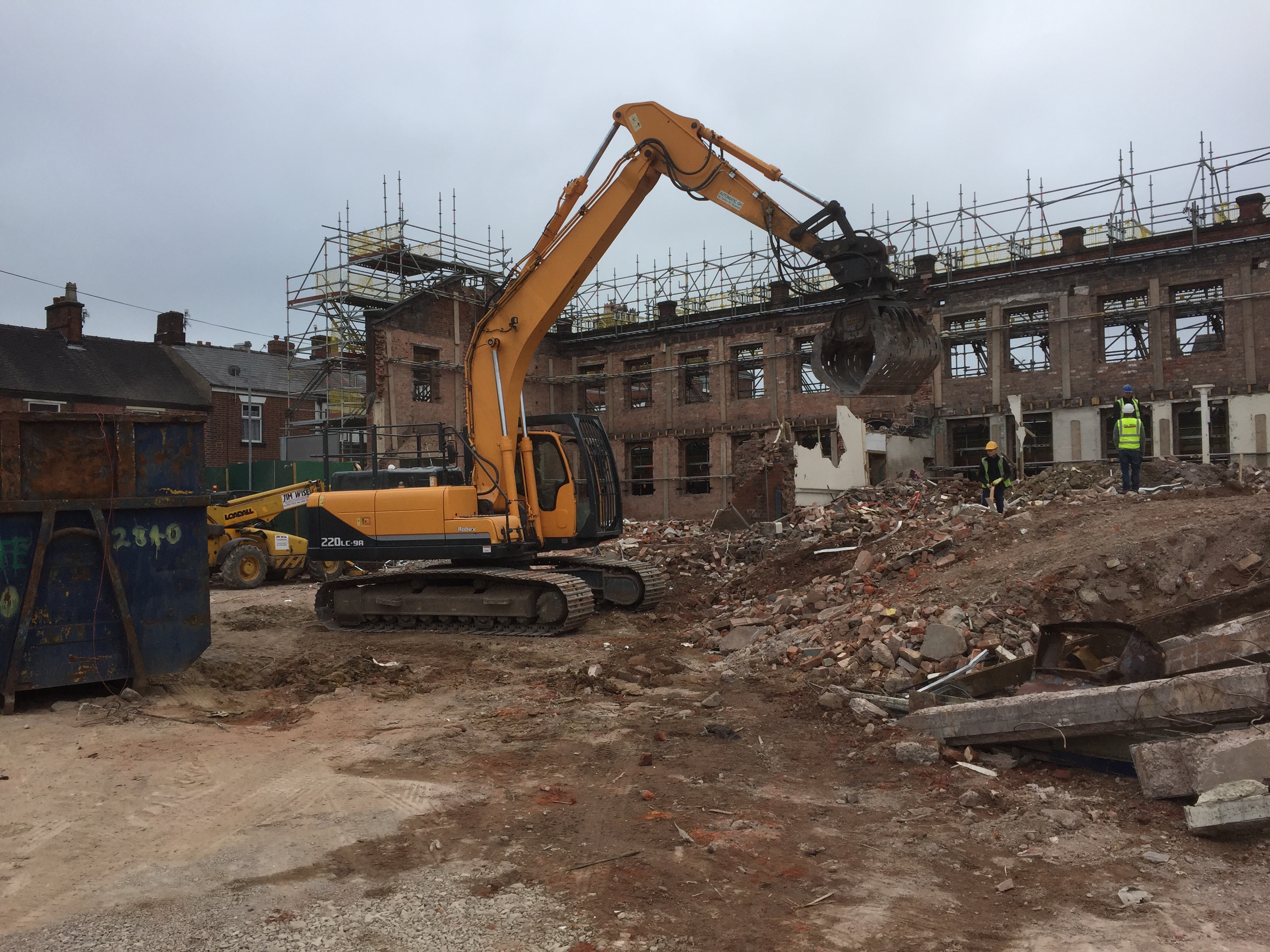
North Wales runs three economies side by side, and each generates its own demolition work. Along Deeside and Wrexham, a genuinely industrial corridor — one of the busiest manufacturing zones in Wales — keeps factories, sheds and works in constant evolution. Along the coast, from Prestatyn round to Llandudno, Conwy and Bangor, tourism-era building stock ages in the salt air. And across the rural interior, farms, quarry-era structures and village buildings retire steadily, many within or beside protected landscapes. We work across the region from our base an hour east — the A55 and A483 make North Wales practical, regular ground for our teams — alongside our established Cheshire coverage next door. Here's the complete 2026 picture.
What's Driving North Wales Demolition in 2026
The Deeside–Wrexham corridor leads the demand. Manufacturing and logistics occupiers keep upgrading, which means older units stripped or cleared for modern replacements, and industrial land recycled generation by generation. Wrexham's profile — city status, investment and no small amount of global attention — has kept its commercial property market moving, with the strip-and-reposition work that follows. On the coast, condition presses hardest: seafront and town-centre buildings age quickly in marine air, and every winter converts a few more from tired to unsafe, feeding both planned demolition and emergency response. Inland, agricultural change and quarry legacy keep the rural workload constant.
Two Welsh specifics shape delivery. Planning and building control sit with Welsh authorities under Welsh policy — the practical requirements (a Section 80 demolition notice before works, consents appropriate to the setting) will feel familiar, but conservation designations and national-park constraints are taken seriously and vary by county. And bilingual signage and community engagement are simply good practice here; sites that respect that work more smoothly.
The Region's Stock at a Glance
| Area | Typical stock | Key considerations | Approach |
|---|---|---|---|
| Deeside/Wrexham industrial | Steel portal and older mixed frames | Asbestos in pre-2000 units, process residues | Strip out or clearance; high metal recovery |
| Coastal commercial | Victorian/Edwardian and interwar | Marine corrosion, conservation settings, tight access | Protection-led methods, condition-honest appraisal |
| Rural and upland | Farm buildings, quarry-era structures | Asbestos cement roofs, ecology, lane access | Small-plant methods, seasonal programming |
| Slate and stone heritage | Traditional masonry | Protected landscapes and listings nearby | Salvage-first, hand work, reclaim value in slate |
The universal first step: a demolition and refurbishment survey under CAR 2012 on anything pre-2000. Industrial units, seafront hotels and hill farms alike carry asbestos from their eras, and our HSE licensed teams remove licensed and non-licensed materials in-house before strip or structure begins — one contractor, one programme, as our guide to asbestos removal before demolition explains.
Deeside and Wrexham: Industrial Work Done Properly
The corridor's work is classic industrial demolition and strip out: units taken back to shell between occupiers, older sheds cleared for bigger footprints, process plant removed under control, and yards and slabs recycled. Portal frames come down in engineered sections with high metal recovery; slabs and hardstandings feed our on-site crushing where volumes justify it, producing aggregate the replacement scheme uses on the spot. On former process sites, tanks, pits and interceptors are removed under control and every load leaves on a waste transfer note — documented clearance is what lets the next occupier and the regulator trust the ground.
The Coast: Salt Air and Honest Appraisal
Marine environments age buildings fast — corroded fixings, spalling render, saturated masonry — and coastal-town demolition is often condition-led rather than development-led. The discipline that matters most is honest early appraisal: knowing when a seafront structure can be stabilised and refurbished, and when it has genuinely reached the end. Conservation settings along the coast add method constraints we treat as standard — protection of neighbouring fabric, low-vibration techniques, tidy compact sites in towns that live on their appearance. Where reclaim value exists — and Welsh slate always has value — salvage is planned before demolition, not discovered in the rubble.
| Get a Free Quote → | 0800 222 9772 |
A North Wales Project, Step by Step
- Setting assessment — industrial, coastal or rural route mapped at first visit, with conservation and ecology likelihood flagged early.
- Surveys — intrusive asbestos survey under CAR 2012, structural appraisal, ecology screening where the building type suggests roosts.
- Consents and notifications — Section 80 notice to the local authority, setting-related consents, HSE notice for licensed removal.
- Mobilisation — an hour's run for most of the region; compound, welfare and supervision established before works.
- Asbestos and strip — in-house licensed removal, then soft strip with source segregation.
- Structure — sections and top-down methods to BS 6187:2011 under a CDM 2015 phase plan, tuned to the setting.
- Clearance and reinstatement — crushing where volumes justify, slate and stone reclaimed, waste documented load by load.
North Wales Cost Drivers
| Factor | How it moves the price |
|---|---|
| Asbestos scope | Survey-set across every stock type; licensed works add the HSE 14-day notice |
| Setting | Conservation coast and protected landscapes add method care and consents |
| Access | Upland lanes and seafront frontages size the plant and the programme |
| Reclaim and credits | Slate, stone and industrial steel all flow back into honest pricing |
| Mobilisation | Modest — the A55 makes the region near-neighbour ground for us |
Around 96% of our demolition waste is diverted from landfill across projects — segregation at source, reclaim planned early, and full documentation at handover.
North Wales: Quick Answers
Which areas do you cover?
The whole region — Wrexham, Deeside, Flint, Mold, Rhyl, Prestatyn, Colwyn Bay, Llandudno, Conwy, Bangor and the rural counties between, worked alongside our Cheshire and Shropshire coverage.
Is demolition consent different in Wales?
The framework sits under Welsh planning policy, but the practical steps will feel familiar: Section 80 notice before works, consents appropriate to the building and setting. We prepare notifications as standard and flag setting issues at survey.
Can you work in or near the national park?
Yes — with the quieter methods, tighter conduct and reinstatement standards those settings rightly demand.
Our barn roof is asbestos cement — is that licensed work?
Usually non-licensed but strictly controlled — safe removal, no breaking up, double-wrapped disposal with consignment documentation. We handle it routinely on rural jobs.
Do you salvage slate?
Always where condition allows — Welsh slate reclaims superbly and its value flows back into the project rather than into hardcore.
The Framework North Wales Projects Run On
The legal spine in Wales will feel familiar to anyone who's commissioned demolition in England, with Welsh administration on top. CDM 2015 applies exactly as over the border: written construction phase plan, competent principal contractor, welfare from day one. BS 6187:2011 remains the method-statement standard — sequencing, exclusion zones, protection of neighbours. CAR 2012 governs asbestos UK-wide: demolition and refurbishment survey first, licensed removal under HSE notification with its fourteen-day lead. The differences sit in administration: planning and building control run under Welsh policy through the local authorities, Natural Resources Wales takes the environmental-regulation role, and waste documentation follows the same duty-of-care logic with Welsh oversight. A Section 80 demolition notice to the council before works is required just as in England.
The practical Welsh layer is setting: national-park and AONB constraints, conservation areas in the coastal towns, and listings that protect the region's industrial and chapel heritage all shape method and consent. We treat those conditions as specification — and on community-visible sites, bilingual signage and genuine local communication are part of professional conduct, not garnish. The planning approach is covered in strategic demolition planning.
Where North Wales Material Goes
| Stream | Handling | Destination | Recovery |
|---|---|---|---|
| Welsh slate | Hand-stripped where sound, palletised | Reclamation — always in demand | Very high |
| Stone & traditional masonry | Reclaimed where viable | Reuse in repairs and new build | High |
| Industrial steel | Segregated and processed | Scrap recycling | ~100% |
| Concrete & hardcore | Crushed, on site where volumes justify | Recycled aggregate | ~100% |
| Timber | Own stream at strip stage | Recycling / biomass | High |
| Asbestos | Double-wrapped, consignment-noted | Licensed hazardous facility | Safe disposal |
Slate is the regional headline: it reclaims superbly, sells reliably and belongs on roofs, not in hardcore — so it comes off first, by hand, on every job where condition allows. Across our record roughly 96% of demolition waste avoids landfill, documented load by load with the pack handed over at completion; the philosophy is in clean demolition.
The Service Set Across the Region
North Wales' three economies map onto the full menu. Deeside and Wrexham: industrial demolition, warehouse strip out and site clearance as units and works recycle between occupiers. The coast: commercial demolition of end-of-life town stock, soft strip out where buildings reposition, and emergency demolition when marine-aged structures fail. The rural interior: residential demolition for replacement dwellings and farm buildings with ecology programmed first. Heavy slabs anywhere feed on-site crushing. One contractor across all of it means one programme and one documentation trail — the delivery model our whole 125-plus-location record is built on.
Five Mistakes North Wales Clients Can Avoid
Assuming English paperwork transfers unchanged. The spine is the same; the administration is Welsh — use a contractor who knows both. Crushing slate. It's the region's most reclaimable asset; destroying it is spending money to lose money. Ignoring the sea. Marine corrosion makes coastal structures less predictable than they look — condition appraisal first, always. Programming around ecology last. Barns and chapels are roost country; survey before you schedule. Buying cheap on asbestos. Every stock type here carries it somewhere; the licence and the survey are non-negotiable.
Coverage Across the Region
| Area | Postcodes | Typical work |
|---|---|---|
| Wrexham | LL11–LL14 | Industrial strip out, commercial renewal |
| Deeside & Flintshire | CH5–CH8 | Manufacturing-corridor clearance and strip out |
| Mold & Denbigh | CH7, LL16 | Mixed commercial and rural work |
| Rhyl & Prestatyn | LL18, LL19 | Coastal commercial, emergency response |
| Colwyn Bay & Llandudno | LL28–LL30 | Conservation-sensitive seafront stock |
| Conwy & Bangor | LL31–LL57 | Heritage-adjacent and rural projects |
The A55 threads the whole table together — an hour's run reaches Deeside, and the coast follows naturally. The region is worked alongside our Cheshire and Shropshire coverage, same teams, same standards.
Realistic Timelines for North Wales Projects
| Project type | Lead-in | On-site duration | What moves it |
|---|---|---|---|
| Industrial strip out (Deeside class) | 1–3 weeks | 2–6 weeks | Unit size and metal volumes |
| Coastal commercial demolition | 3–6 weeks | 6–12 weeks | Condition, conservation consents, access |
| Rural building removal | 2–6 weeks (ecology may extend) | Days–2 weeks | Bat surveys and lane access lead |
| Licensed asbestos phase | 14-day HSE notice | Scope-dependent | Statutory across the UK — plan around it |
Welsh administration doesn't slow a well-prepared project — but it punishes late paperwork the same as anywhere. Consents, notices and ecology screening booked at appointment keep the on-site phase clean.
What Working With Us in North Wales Looks Like
One contractor, one programme, resident supervision throughout — with the regional touches that matter: bilingual site signage as standard on community-visible jobs, genuine communication with neighbours and community councils, and salvage handled with the respect Welsh materials deserve. Weekly client reporting with photographs, waste documentation accumulated live, and the complete handover pack at the end. The A55 means response times that feel local because, operationally, they are.
Do you understand Welsh planning administration?
Yes — the framework's differences are administrative rather than fundamental, and our notifications and consents are prepared accordingly on every Welsh job.
Can you handle chapel and heritage buildings?
With the care they warrant — salvage-first methods, hand work at sensitive fabric, and honest early appraisal of what can genuinely be saved. Our Eccles church project shows the discipline applied.
How quickly can you get to site?
Deeside and Wrexham same-week as standard; the coast follows close behind. Call 0800 222 9772.
Asbestos in North Wales Stock: A Closer Look
Each of the region's three economies hides the mineral its own way. The Deeside–Wrexham industrial corridor carries the classic factory set: cement roof and wall sheets across the shed stock, AIB in offices and welfare blocks, lagging around heating and process plant in anything pre-1980, gaskets and seals through the services. The coastal towns carry the hospitality century's refits: textured ceilings, floor tiles, boiler-room board, cement flues and panels threaded through Victorian and interwar shells by generations of modernisation. The rural interior carries it agriculturally — cement roofing on almost every post-war farm building — plus the chapel-and-institution stock whose twentieth-century heating systems brought lagging into nineteenth-century buildings.
The rules are UK-wide: demolition and refurbishment survey under CAR 2012 before pricing, licensed removal under HSE notification with its fourteen-day lead where the findings demand it, controlled non-licensed work where they don't. The practical Welsh note is logistical — licensed disposal routes are fewer and further, which rewards a contractor whose waste planning is done in the lead-in, not improvised from a skip queue. Our in-house licence and established Welsh disposal routes keep both halves inside one programme.
The First 48 Hours After You Appoint Us
Welsh projects start the same clock. Within two days of appointment: survey visit booked — Deeside and Wrexham are same-week ground; Section 80 notice drafted for the local authority; utilities disconnections applied for; conservation or national-park consent requirements confirmed and contact opened where settings demand it; ecology screening commissioned on rural and chapel stock before it can surprise the calendar; bilingual site-communication materials prepared for community-visible jobs; and mobilisation planned to run inside the statutory window. The lead-in absorbs the paperwork so the site phase runs clean — the same discipline whichever side of the border the postcode sits.
Three More Questions North Wales Clients Ask
Can you demolish a building attached to one that stays?
Yes — hand and small-plant separation at the party line, temporary support designed first, and the retained building weather-protected and made good. It's slower than open demolition and priced honestly for what it is.
Do you work through the tourist season on the coast?
Where consents and neighbours allow — with methods, hours and logistics tuned so a seafront town's trading summer and a demolition programme can coexist. Sometimes the honest answer is to sequence the noisy phase for the shoulder months, and we'll say so.
Is a structural survey included?
A structural appraisal is part of our survey stage on anything where condition or sequencing demands it — the method is engineered from evidence, not assumption.
Can you provide references for Welsh or border projects?
Yes — comparable project references and client contacts are available on request for serious tenders, alongside the public project write-ups across this site covering the same building types the region presents.
Choosing a Contractor for North Wales
The tests don't change at the border: current HSE asbestos licence with in-house removal; verifiable ConstructionLine Gold and SSIP accreditation; references from comparable settings — industrial, coastal or rural as your project demands; an intrusive survey before the price; and a complete waste paper trail. Our complete UK guide to choosing a demolition contractor covers the lot.
We bring 2,489+ projects, NEBOSH and IOSH qualified management and zero prohibition notices in over a decade to every North Wales job. Family-run since 1982: plan it properly, do it safely, leave the site clean.
From Deeside to the coast: arrange a free site visit or call 0800 222 9772.
.svg)