Sheffield built its name on steel, and steel built most of the city's industrial fabric. The works, forges, rolling mills and tool factories that once filled the Don Valley from Attercliffe out to Rotherham didn't disappear when the industry contracted — a remarkable amount of that building stock is still standing, still part-occupied, and increasingly the subject of redevelopment plans. For anyone commissioning demolition in Sheffield, that legacy is the single most important thing about the job.
We've been taking down industrial buildings across the north of England for more than forty years, and Sheffield's stock has a character all of its own. This guide covers what makes the city's buildings different, the hazards that experienced contractors plan for as standard, and what a properly run Sheffield demolition project looks like in 2026.
A City Built for Heavy Industry
Sheffield's industrial buildings were engineered for loads most modern structures never see. Crane rails, heavy steel frames, massive foundations, deep machine pits and thick reinforced floors are all common in Don Valley stock — and every one of them changes how a building comes down. A frame designed to carry a travelling crane doesn't behave like a portal-framed shed when you start cutting it, and machine pits and cellars have a habit of appearing exactly where the drawings say there's solid ground.
That's why the survey phase matters more in Sheffield than almost anywhere else we work. Before pricing, we want to understand the frame, the foundations, and what eighty years of heavy use has left behind — because the difference between a clean programme and an expensive surprise usually sits below the slab.
The city's redevelopment history also tells you what's possible. Meadowhall rose on former steelworks land, and Kelham Island's mills and workshops have become one of the most celebrated regeneration stories in the country. Some buildings deserve retention and conversion; plenty of others have reached the end of their useful life and are holding good land back. Making that call early — and honestly — is something we wrote about in our guide to balancing demolition and conservation.
Asbestos: The Steel Industry's Long Shadow
Heat was everywhere in Sheffield's industry, and for most of the twentieth century the answer to heat was asbestos. Furnace and boiler insulation, lagged pipework, sprayed coatings to structural steel, asbestos cement roofing and wall cladding — industrial buildings of this era frequently contain the full range, from low-risk cement sheets to the licensed-work materials that demand full enclosures and air monitoring.
Two things matter here. First, a demolition and refurbishment survey — not a management survey — is the legal and practical starting point for any demolition project under the Control of Asbestos Regulations 2012. It's intrusive by design, because the dangerous materials in industrial buildings are usually the hidden ones. Second, who does the removal matters. We hold a current HSE asbestos licence and carry out licensed and non-licensed removal in-house, which means one contractor, one programme and no gap between the asbestos clearance and the demolition that follows. We've covered how that works in detail in can demolition contractors remove asbestos prior to demolition.
Contaminated Ground and What It Means for Clearance
A century of steelmaking leaves more than buildings behind. Fuel oils, cutting fluids, heavy metals and made ground are common across former works sites, and while remediation is usually a specialist package beyond the demolition contract, the demolition contractor's job is to avoid making it worse. That means controlled removal of tanks and interceptors, careful handling of slabs over suspect ground, and segregating arisings so clean crushed material isn't cross-contaminated by the ground it sits on.
Done properly, site clearance on former industrial land hands the next contractor a level, well-documented plot with waste transfer notes for every load — and doesn't hand the client a contamination problem that was avoidable.
How Sheffield's Industrial Buildings Come Down
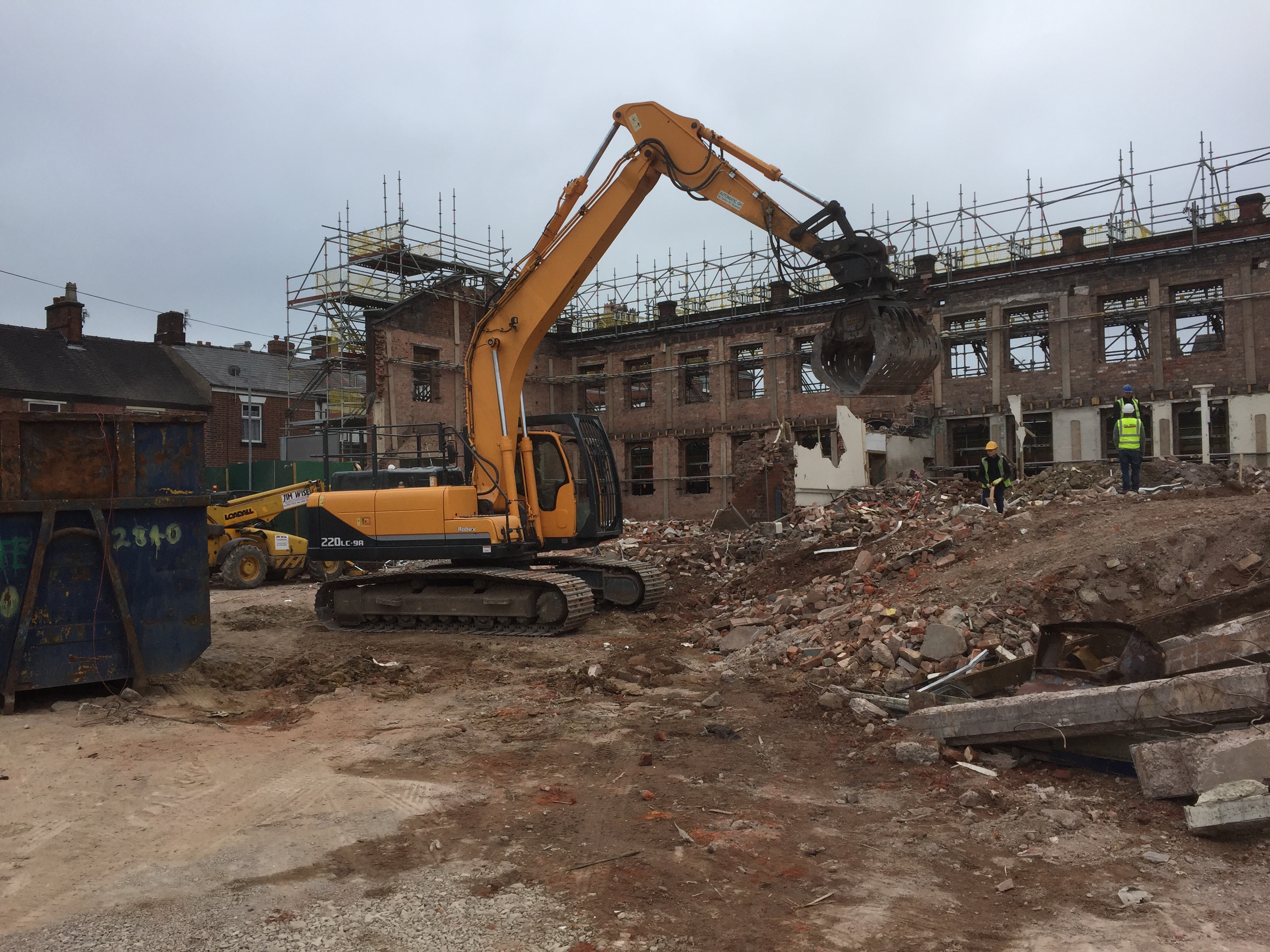
Once the asbestos is cleared and the soft strip complete, heavy industrial structures are typically reduced mechanically — excavators with shears and grabs working top-down, structure into its own footprint, in line with BS 6187:2011 and a site-specific demolition phase plan under CDM 2015. Steel frames are cut and processed for recycling; Sheffield steel has been melted down and remade for two centuries, and there's something right about the frame of a former works going straight back into the furnace circuit.
The concrete matters just as much. Heavy industrial slabs and foundations produce enormous tonnages of material, and on larger sites our on-site concrete crushing turns that into graded recycled aggregate that stays on the plot — cutting wagon movements through residential streets and the cost of importing virgin stone. Across our projects we consistently divert around 96% of demolition waste from landfill, and industrial sites are where source segregation pays off most.
| Get a Free Quote → | 0800 222 9772 |
Working in a City That's Rebuilding Itself
Sheffield's demolition sites are rarely isolated. The Don Valley corridor mixes live businesses with redevelopment plots; city-centre projects sit beside tram routes, student accommodation and offices; and former works sites often share boundaries with housing that arrived long after the industry did. The controls are the same ones we apply everywhere — agreed working hours, dust suppression at source, noise and vibration monitoring against agreed levels, banksman-controlled vehicle movements and a clean highway policy — but the planning behind them has to reflect each site's neighbours from day one.
It's the same discipline we bring to every project across Yorkshire, from Leeds down through Rotherham and Barnsley to Chesterfield, and it's the reason main contractors and developers use us repeatedly rather than once.
A Sheffield Industrial Project, Step by Step
- Site visit and desktop study — frame type, crane history, below-ground risk and neighbours assessed before anything is priced.
- Demolition and refurbishment survey — intrusive asbestos survey under CAR 2012, plus structural appraisal of the frame and foundations.
- Notifications and consents — Section 80 notice to the council, HSE notification for licensed asbestos, utilities isolated and proved dead.
- Asbestos removal — licensed and non-licensed materials cleared by our in-house teams, with air monitoring and four-stage clearance.
- Soft strip — fixtures, services and non-structural elements out, segregated at source.
- Structural demolition — top-down mechanical reduction to BS 6187:2011, steel processed for recycling as it comes down.
- Slab, foundations and clearance — machine bases and pits dealt with under control, concrete crushed, site left level and documented.
Every stage sits inside a construction phase plan under CDM 2015, with RAMS briefed to every operative before work starts — the paperwork discipline matters as much on a Don Valley shed as on a city tower, and it's why our record across 2,489+ projects includes zero prohibition notices. If your project needs asbestos and demolition priced as one package, that's precisely how we're built: one survey, one programme, one accountable contractor from first visit to final handover.
What Drives the Cost of Demolition in Sheffield
Every honest demolition price is built from the same ingredients, and on Sheffield's industrial stock a few of them dominate. Asbestos scope is the biggest variable by far — the difference between a building with some cement roofing and one with sprayed coatings to a steel frame can be the difference between days and months of licensed work. Structure comes next: heavy frames, machine bases and thick slabs take plant time to process, though the metal value of a steel-framed works flows back into the price as a credit. Access and neighbours shape the method — a constrained Attercliffe frontage costs more per cubic metre than an open yard — and ground risk determines how carefully the slab and below-ground structures must be handled.
Timeline follows the same logic. A straightforward shed can be surveyed, notified and cleared inside a few weeks; a large works with licensed asbestos throughout runs to months, with the HSE's fourteen-day notification period for licensed work built into the programme. What compresses timelines safely is one contractor holding the whole sequence — survey, asbestos, strip, structure, clearance — with no handovers in between, which is exactly how we run it.
Sheffield Demolition: Quick Answers
Do I need planning permission to demolish in Sheffield?
Usually you need prior approval or planning consent depending on the building and its setting, and always a Section 80 demolition notice to the council before works start. Conservation areas and listed structures carry extra consents. We handle notifications as standard and flag consent issues at survey stage.
How do you deal with asbestos found mid-demolition?
Work stops, the area is sealed, and nothing restarts until the material is tested and cleared. Unexpected finds are common in industrial stock even after a good survey — the discipline is in the response, and ours is non-negotiable.
Can materials from my site be recycled?
Almost all of them. Steel goes to scrap, brick and concrete are crushed for aggregate — on site where volumes justify it — and timber and metals travel in their own streams. Across our projects around 96% of demolition waste avoids landfill.
Do you cover the wider region as well as Sheffield?
Yes — Rotherham, Barnsley, Doncaster, Chesterfield and the whole of South Yorkshire, plus West Yorkshire from the same teams.
Choosing a Demolition Contractor in Sheffield
Whoever you appoint for a Sheffield project, the checklist is the same one we'd give you anywhere: a current HSE asbestos licence if the building predates 2000, ConstructionLine or SSIP accreditation you can verify, evidence of comparable industrial projects, a demolition and refurbishment survey before any price is fixed, and a waste carriers licence with a paper trail to licensed transfer stations. Our complete guide to choosing a demolition contractor walks through each of these in plain English.
We're ConstructionLine Gold and SSIP Acclaim accredited, with NEBOSH and IOSH qualified management, our own plant and a directly employed workforce — and in over a decade we've never had a prohibition notice served on us. Family-run since 1982: plan it properly, do it safely, leave the site clean.
Planning a project in the Steel City? Visit our Sheffield demolition contractors page, get in touch for a free site visit, or call 0800 222 9772.
.svg)