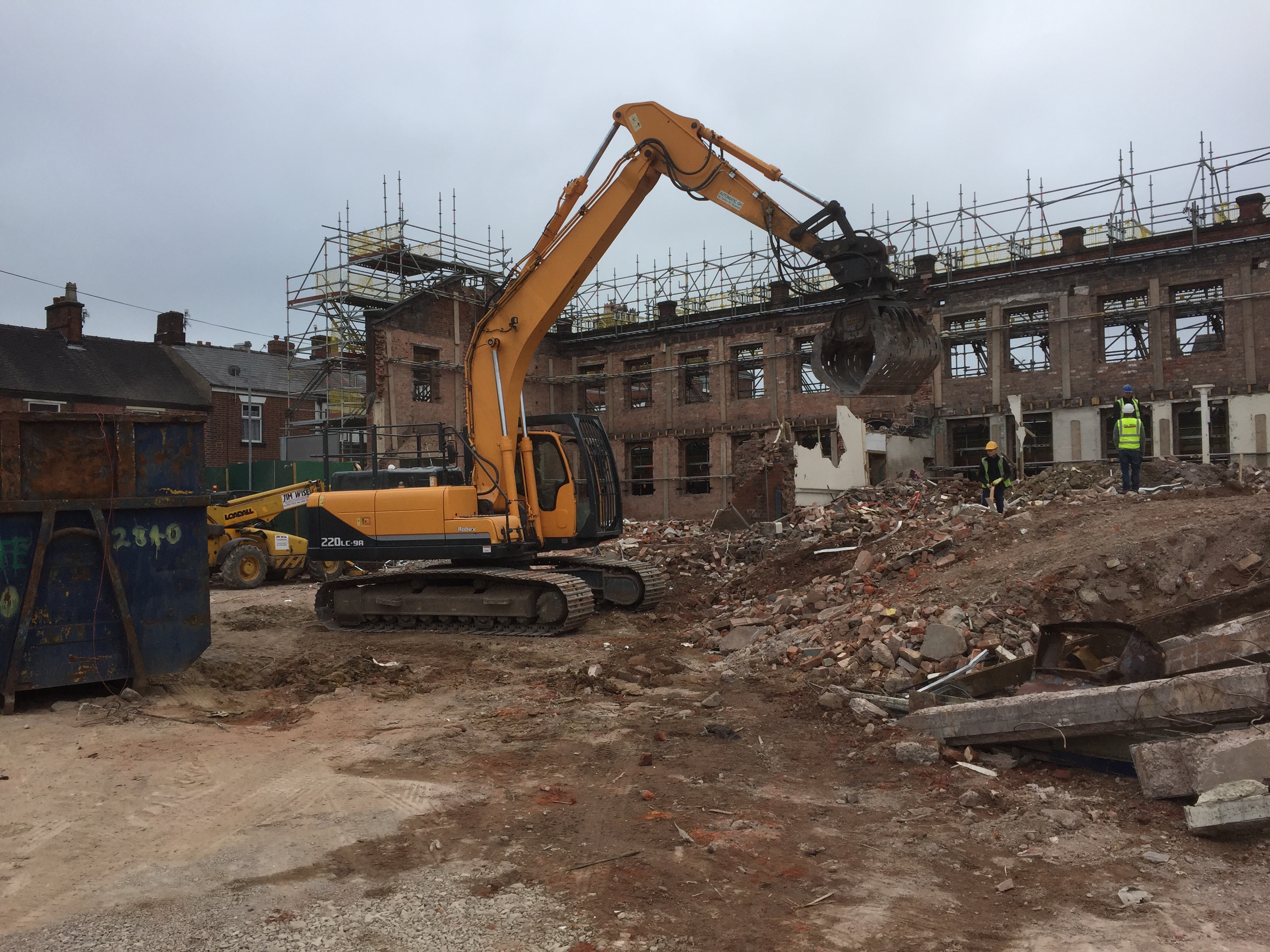
Worcester is a cathedral city with a working county around it, and its demolition market reflects both halves. In the city: conservation-sensitive plots, riverside sites with flood considerations, and post-war commercial stock reaching end of life. Across Worcestershire — Kidderminster, Redditch, Bromsgrove, Droitwich, Malvern, Evesham — carpet-industry heritage, new-town-era buildings and a constant rural workload. We deliver across the county from our Midlands base within easy reach, and this is the complete 2026 guide to what demolition here involves.
Worcestershire in 2026: What's Driving the Work
Three currents shape the county's demolition demand. First, town-centre repositioning: Worcester, Kidderminster and Redditch all carry mid-century commercial stock that can't meet modern energy expectations, and strip-or-clear decisions are being made building by building. Second, Redditch's new-town inheritance — like every designated town, its first-generation stock is reaching renewal age together. Third, the rural cycle that never stops: agricultural change retires farm buildings steadily across the Vale of Evesham and the Malvern fringe, each one a small project with the full set of rules attached.
Kidderminster deserves its own mention. The carpet industry left the town a stock of mills and works — some superbly converted, others long past viability — and that industrial inheritance behaves exactly like textile-era stock everywhere: oil-soaked floors, layered extensions, and asbestos through every refit era.
The County's Building Stock at a Glance
| Area | Typical stock | Key considerations | Approach |
|---|---|---|---|
| Worcester city centre | Georgian/Victorian commercial, post-war infill | Conservation settings, riverside flood zones | Facade-sensitive methods, hand work at interfaces |
| Kidderminster | Carpet mills and works | Oil-soaked timbers, asbestos, layered structures | Survey-led sequencing, salvage where viable |
| Redditch | New-town commercial and industrial, 1960s–80s | Heavy asbestos load typical of the era | Licensed removal first, then mechanical reduction |
| Rural county | Farm buildings, village works, estate stock | Asbestos cement roofs, ecology, lane access | Small-plant methods, seasonal programming |
Whatever the building, the sequence starts the same way: a demolition and refurbishment survey under CAR 2012, because pre-2000 stock across every one of these categories carries asbestos somewhere, and the survey is what turns a guess into a price. Our HSE licensed teams then remove licensed and non-licensed materials in-house before anything structural moves.
Working in a Cathedral City
Worcester's historic core concentrates everything that makes urban demolition demanding: conservation areas, listed neighbours, narrow access and a public that watches. Methods here are chosen for protection first — scaffold fans and crash decks over footways, monitored party walls, low-vibration techniques near sensitive fabric, and hand demolition at interfaces where machines would be crude. The riverside adds its own discipline: Severn-side sites need flood-aware programming and ground protection, because the river's habits are not a surprise to anyone who works beside it.
Our judgement on heritage is the same here as everywhere: not every old building can be saved, but the decision must be made early, honestly and on evidence — structural appraisal and viability, not sentiment in either direction. We set out that thinking in balancing demolition and conservation, and we've delivered it in practice at the Grade II* listed Wedgwood Institute.
The Services Worcestershire Projects Call On
Most county projects draw on a familiar set: commercial demolition for end-of-life town stock; industrial demolition for mills and works; soft strip out where buildings are repositioning rather than disappearing; site clearance on development plots; on-site concrete crushing where slab volumes justify it; and emergency demolition when fire or failure turns a building into a hazard overnight. On rural jobs, residential demolition rounds out the set for cottages and farmhouses making way for replacement dwellings.
| Get a Free Quote → | 0800 222 9772 |
A Worcestershire Project, Step by Step
- Setting assessment — conservation context, flood zone, ecology likelihood and access geometry mapped at the first visit.
- Surveys — intrusive asbestos survey under CAR 2012, structural appraisal, ecology screening on rural buildings.
- Consents and notifications — Section 80 notice to the district council, planning or prior approval as required, HSE notice for licensed asbestos.
- Protection — scaffold, party-wall monitoring and footway management wherever the public realm touches the site.
- Asbestos and strip — in-house licensed removal, then strip out with source segregation.
- Structure — hand work at sensitive interfaces, mechanical top-down elsewhere, to BS 6187:2011 under a CDM 2015 phase plan.
- Clearance and handover — crushing where volumes justify, complete waste documentation, reinstatement done properly.
Cost Drivers on Worcestershire Projects
| Factor | How it moves the price |
|---|---|
| Asbestos scope | Set by intrusive survey; mills and new-town stock rarely come back quiet |
| Setting | Conservation and riverside constraints add protection and slow skilled work |
| Retention | Facade and partial schemes cost more per cubic metre than clearance |
| Access and ecology | Rural lanes size the plant; bats set the calendar |
| Material credits | Reclaimable brick, slate and metals flow back into honest pricing |
Across our projects around 96% of demolition waste is diverted from landfill — segregation at source, crushing for reuse, and a waste transfer note on every load, with the full pack handed over at completion.
Worcester & Worcestershire: Quick Answers
Do you cover the whole county?
Yes — Worcester, Kidderminster, Redditch, Bromsgrove, Droitwich, Malvern, Evesham and Pershore, all within easy reach of our Midlands base alongside neighbouring Birmingham and the Black Country.
Our building is near the cathedral — is demolition even possible?
Usually, with the right consents and methods: low vibration, hand work at interfaces, and full protection of neighbouring fabric. Setting shapes the method far more often than it prevents the project.
Who deals with bats in our barn?
A preliminary ecology survey before anything else; if roosts are present, works are programmed around licensing and mitigation. Surveying first keeps the project legal and the calendar intact.
What notice does the council need?
A Section 80 demolition notice before works begin, plus any planning consents the site requires — we prepare notifications as standard.
Can materials from our site be reused?
Most of them — Worcestershire brick and slate reclaim well, metals recycle fully, and concrete crushes into aggregate the next scheme can use.
The Rules Every Worcestershire Project Runs On
Whatever the building — cathedral-quarter commercial, Kidderminster mill or Vale farm — the legal spine is identical, and clients benefit from knowing it. CDM 2015 requires a written construction phase plan and a competent principal contractor before any demolition begins, however small the structure. BS 6187:2011 governs the method itself: sequencing, exclusion zones, protection of neighbouring property — the difference between engineering and hope. The Control of Asbestos Regulations 2012 mandate the demolition and refurbishment survey and control the removal chain, including the fourteen-day HSE notification for licensed works. And the waste duty-of-care framework documents every load: transfer notes for general streams, consignment notes for hazardous ones, licensed carriers throughout.
Two Worcestershire-specific layers sit on top. Conservation and listed-building consents bite across the county's historic cores — Worcester's centre especially — and the method must honour their conditions, not fight them. And the Severn adds environmental duties on riverside plots: silt and runoff control, flood-aware programming, and care with anything below slab. A contractor fluent in all of this delivers consent-compliant projects without drama; one who isn't delivers letters from the council. Our guide to strategic demolition planning covers how these constraints become a programme rather than a problem.
Where Worcestershire Demolition Material Goes
| Stream | Handling | Destination | Recovery |
|---|---|---|---|
| Reclaimable brick, slate & stone | Palletised at strip stage | Reclamation and reuse — county materials sell well | High |
| Structural steel & metals | Segregated and processed | Scrap recycling | ~100% |
| Concrete & hardcore | Crushed, on site where volumes justify | Recycled aggregate | ~100% |
| Timber | Separated at source | Recycling / biomass | High |
| Asbestos | Double-wrapped, consignment-noted | Licensed hazardous facility only | Safe disposal |
| Mixed residue | Minimised by segregation discipline | Licensed transfer station | Balance |
Across our projects roughly 96% of demolition waste avoids landfill, and on heritage-adjacent Worcestershire jobs the reclaim percentages push higher — county brick and Welsh slate roofs have genuine second lives. Every movement is documented and the pack is handed over at completion; the approach is set out in clean demolition.
Matching the Service to the Worcestershire Project
Knowing which service your building actually needs saves tender confusion. End-of-life town-centre stock is commercial demolition; mills and works are industrial demolition; buildings being repositioned rather than removed need soft strip out; development plots need site clearance including slabs and below-ground structures; heavy slab volumes justify on-site concrete crushing; cottages and farmhouses making way for replacements are residential demolition; and fire or structural failure calls on emergency demolition at any hour. Most real projects combine two or three — a Kidderminster mill job is typically asbestos removal, soft strip, structural demolition and crushing in one programme — which is why single-contractor delivery matters: no handover gaps, one accountable party, one documentation trail.
Five Mistakes Worcestershire Clients Can Avoid
Fixing a price before the intrusive survey. Pre-2000 stock priced without a CAR 2012 survey is a variation claim waiting to happen. Assuming the conservation officer is an obstacle. Early, evidence-led engagement usually finds a consentable route; late surprises don't. Forgetting the river. Severn-side programming that ignores flood behaviour loses weeks; planning for it loses nothing. Leaving ecology to the end. Bats in a Vale barn discovered mid-works stop the job; a preliminary survey at the start protects the calendar. Crushing what should be reclaimed. County brick and slate carry real value — a contractor who buries them in hardcore is spending your money to destroy your asset.
Coverage Across the County
| Area | Postcodes | Typical work |
|---|---|---|
| Worcester city | WR1–WR5 | Cathedral-quarter care, riverside programming |
| Kidderminster | DY10, DY11 | Carpet-mill stock, industrial clearance |
| Redditch | B97, B98 | New-town renewal, commercial strip out |
| Bromsgrove & Droitwich | B60, B61, WR9 | Commercial and residential demolition |
| Malvern | WR13, WR14 | Conservation-sensitive and institutional sites |
| Evesham & Pershore | WR10–WR12 | Rural and agricultural stock, Vale farms |
Everything in the table sits inside comfortable reach of our Midlands base — same-week site visits are the norm, and the county is worked alongside our established Birmingham and Black Country coverage with the same teams and standards.
Realistic Timelines for Worcestershire Projects
| Project type | Lead-in | On-site duration | What moves it |
|---|---|---|---|
| Rural building removal | 2–4 weeks (ecology may extend) | Days–2 weeks | Ecology windows and access set the calendar |
| Commercial strip out | 1–3 weeks | 2–5 weeks | Survey findings and what's being protected |
| Mill/works demolition | 3–5 weeks | 6–14 weeks | Asbestos scope and layered structure |
| Conservation-adjacent schemes | 4–8 weeks | Setting-dependent | Consents lead; method follows the fabric |
The county's recurring lesson: the calendar is won or lost in the lead-in. Ecology screening on rural jobs and conservation consents in the historic cores both reward clients who start the paperwork at appointment rather than at mobilisation.
What Working With Us Looks Like in Worcestershire
One accountable contractor from survey to handover, a named supervisor on every site, and communication as standard practice: neighbours letter-dropped before works, the conservation officer engaged early where settings demand it, and the client updated weekly with photographs. Riverside jobs get flood-aware programming from day one; village jobs get conduct that respects the fact people live ten metres from the hoarding. At completion, the full documentation pack — phase plan, clearances, waste trail, as-left record — arrives without being chased.
Do you work for private householders as well as developers?
Yes — replacement-dwelling and barn projects across the Vale and the Malvern fringe are regular work, delivered with the same paperwork standards as commercial jobs.
Can you liaise with the conservation officer for us?
We routinely support that engagement with method statements and evidence — early, constructive contact is how consentable routes get found.
How soon can you survey?
Typically same-week anywhere in the county — call 0800 222 9772 and we'll get a visit booked.
Asbestos in Worcestershire's Stock: A Closer Look
The county's building generations each hide the mineral differently. The carpet mills and works carry it industrially — lagged steam pipework, boiler-house insulation, AIB linings added through a century of refits, cement roofing over weaving sheds. Redditch's new-town stock carries it by design: AIB ceilings and partitions, column casings, textured coatings and cement panels were simply how the 1960s and 70s built. Rural Worcestershire carries it agriculturally — cement roof sheets on almost every post-war farm building, plus the occasional lagged pipe run in dairies and packing sheds. Even the Georgian and Victorian city core isn't exempt: twentieth-century heating systems and refits threaded asbestos through buildings two centuries older than the material's industrial heyday.
What this means for clients is simple: the walk-round tells you nothing reliable, and the demolition and refurbishment survey tells you almost everything — scope, licensed-versus-non-licensed classification, and therefore both price and programme. Licensed findings add the HSE's fourteen-day notification and controlled removal with clearances; non-licensed work proceeds faster under strict method. Because our teams hold the licence in-house, findings of either kind stay inside one programme — no handover gap, no waiting on a subcontractor's diary, no dispute about whose method statement governs the interface.
The First 48 Hours After You Appoint Us
Worcestershire projects start moving the day the appointment lands. Within 48 hours: survey visit booked or existing survey audited; Section 80 notice drafted for the relevant district council; utilities disconnections applied for — the longest lead item on most county jobs; conservation-officer contact opened where the setting requires it; ecology screening commissioned on rural buildings so any bat constraint is known before it can ambush the calendar; and the construction phase plan made site-specific. Riverside jobs get their flood-awareness check in the same window. The aim is always the same: spend the statutory and administrative lead-in doing everything else, so the site phase begins complete and runs clean.
Three More Questions Worcestershire Clients Ask
Can you demolish part of a building and leave the rest trading?
Yes — phased and partial demolition with the retained portion protected, weather-tight and structurally supported is a standard configuration. Temporary works are designed before anything is cut, and the trading half's operations shape the working hours and sequence.
Do you handle the party wall side of things?
Party wall agreements sit between the owners and their surveyors, but our method statements, monitoring and condition surveys are built to support the process — and our conduct on site is what keeps awards uneventful.
What happens to the site between demolition and construction?
We hand over level, secure and documented: fencing to specification, drainage capped and recorded, and the waste and clearance pack complete so your principal contractor starts with answers rather than questions.
Choosing a Contractor in Worcestershire
The checklist doesn't change: current HSE asbestos licence with in-house removal; verifiable ConstructionLine and SSIP accreditation; references from comparable settings — heritage-adjacent, industrial or rural as your project demands; an intrusive survey before the price; and a complete waste paper trail. Our complete UK guide to choosing a demolition contractor covers every check in plain English.
We bring ConstructionLine Gold, SSIP Acclaim, NEBOSH and IOSH qualified management and forty-plus years across 2,489+ projects to every Worcestershire job — with zero prohibition notices in over a decade. Family-run since 1982: plan it properly, do it safely, leave the site clean.
From the cathedral city to the Vale: arrange a free site visit or call 0800 222 9772.
.svg)