When Alleyne's Academy in Stone, Staffordshire commissioned the demolition of their ageing sports centre and swimming pool, they needed a contractor with the expertise, credentials and safety culture to deliver a complex, multi-phase project on a live school campus. Jim Wise Demolition was appointed as Principal Contractor, working directly for the school with Surveyors to Education overseeing the commission.
Client
Alleyne's Academy
Date
March 6, 2026
Services
Sports Centre Demolition
Location
Oulton Road, Stone, ST15 8DT
When Alleyne's Academy in Stone, Staffordshire commissioned the demolition of their ageing sports centre and swimming pool, they needed a contractor with the expertise, credentials and safety culture to deliver a complex, multi-phase project on a live school campus. Jim Wise Demolition was appointed as Principal Contractor, working directly for the school with Surveyors to Education overseeing the commission.
This case study documents the full scope of works — from initial site establishment through to mechanical demolition, slab grubbing and final site clearance — and explains how our team managed every challenge the project presented.
Why This Project Matters
Demolishing a swimming pool and sports centre on a live school site is one of the most demanding environments in the demolition industry. Proximity to pupils and staff, and the structural complexity of a steel-framed pool building all demand meticulous planning, first-class operatives and an unwavering commitment to health and safety.
The project required the safe removal and mechanical demolition of Alleyne's Sports Centre — comprising the swimming pool hall, office buildings, boiler room and associated changing facilities. Works were carried out under CDM Regulations 2015, in full accordance with BS6187:2011.
1. Site establishment — erecting Heras fencing exclusion zones, welfare facilities and site signage
2. Plant delivery — 22-tonne excavator, scissor lift, telehandler and all attachments delivered to site
3. Soft strip — removal of doors, ceilings, false walls and all fittings that could contaminate demolition arisings
4. Dust suppression setup — petrol-powered jet wash with IBC bowser and directional high-pressure lance
5. Mechanical demolition — steel-framed pool building brought down in a controlled top-down sequence
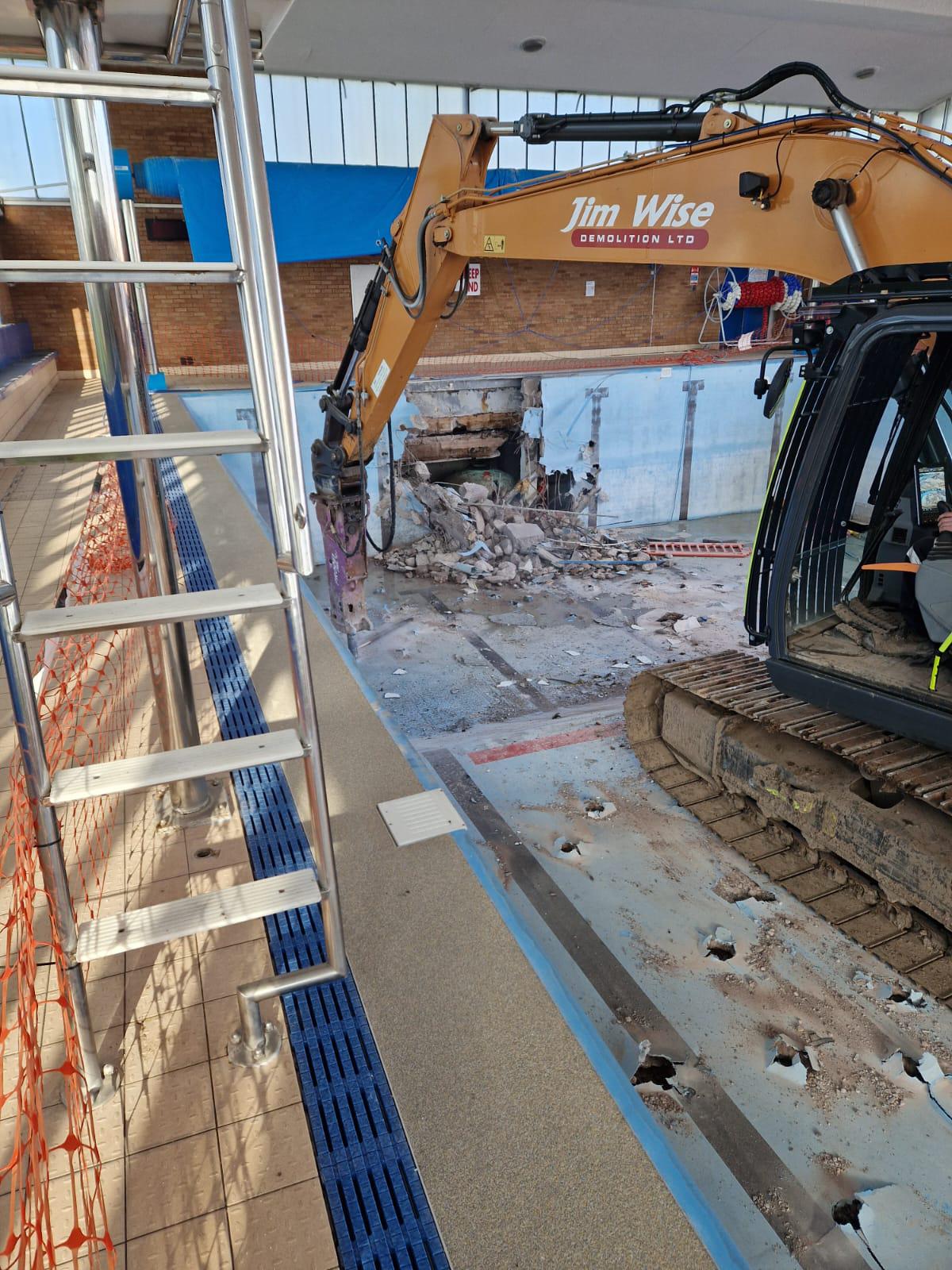
6. Slab grubbing — systematic breaking of foundations, backfilling the vacant pool void to near car park level
7. Site clearance and handover — final inspection with client representatives confirming site ready for handover
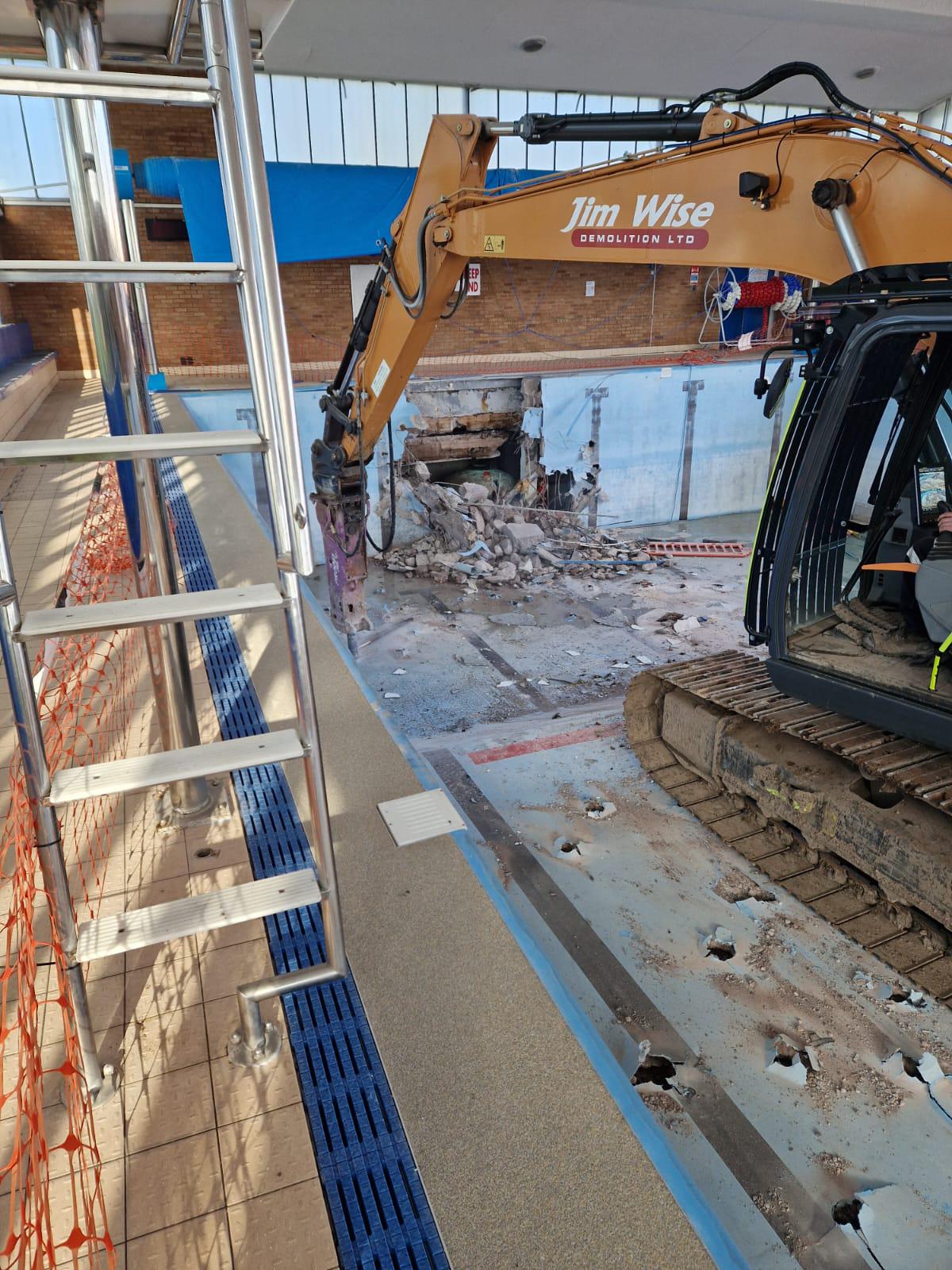
One of the most site-specific hazards on this project was the open swimming pool void. During both the MEWP access phase and the mechanical demolition phase, the exposed pool edges created a genuine falling-from-height risk requiring a dedicated control regime.
Our approach was systematic. Before any elevated working or demolition near the pool commenced, the following controls were put in place:
– The site manager physically marked out the complete perimeter of the pool
– Chapter 8 interlocking traffic management barriers were deployed around the entire pool edge
– Clear LEADING EDGE — KEEP CLEAR signage was erected at all points
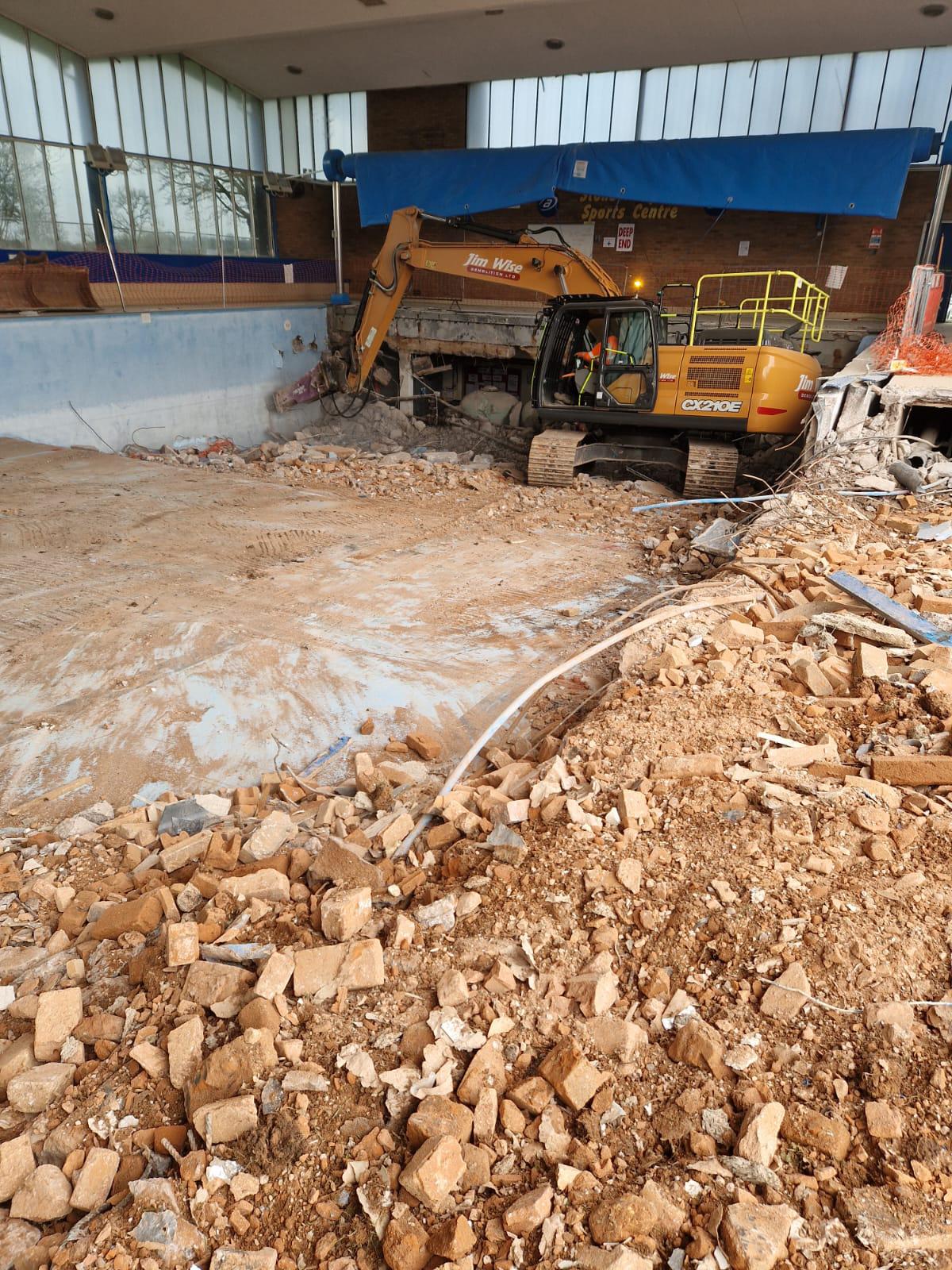
– Hardcore from the demolished office buildings and boiler room was used to backfill the pool void, raising the working floor to match the surrounding deck level and allowing MEWPs to manoeuvre safely
– A dedicated toolbox talk was delivered to the entire site team, specifically addressing the pool edge risk and barrier management protocols
– Any movement of Chapter 8 barriers — to allow plant or MEWPs into the pool area — was controlled by a named operative, and barriers were closed immediately after access was granted
– Where the pool depth was insufficient using on-site arisings, additional hardcore was imported to ensure a consistently safe and stable working surface
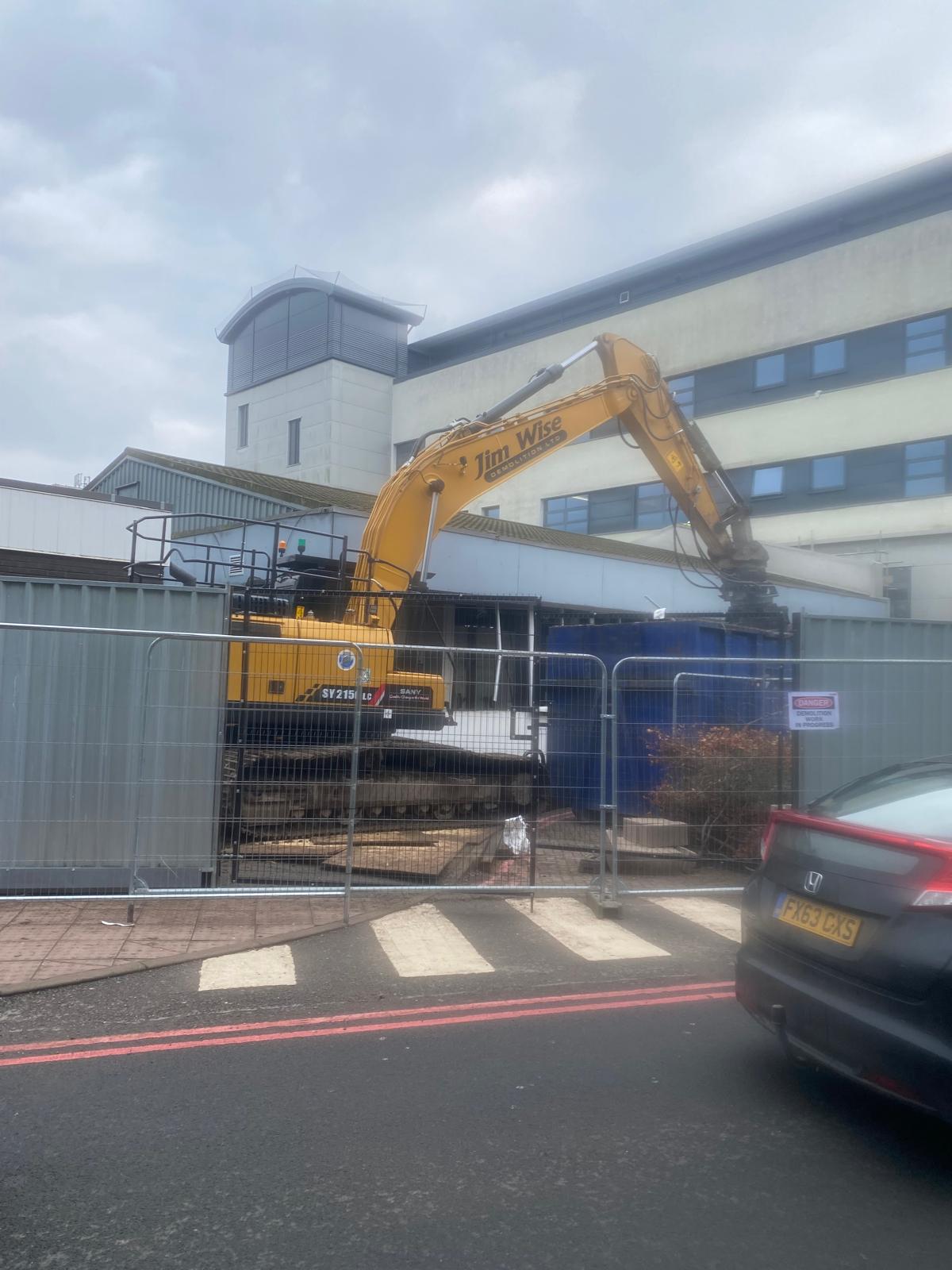
Once all ACMs had been cleared and signed off, mechanical demolition of the steel-framed pool building began. The 22-tonne excavator — fitted first with a 360° rotating demolition grab, then a 360° rotating hydraulic shear — worked in a carefully planned sequence to maintain structural stability throughout.
– Demolition commenced on the east elevation, closest to the skip compound, working in a westerly direction bay by bay
– Each purlin and A-frame was sheared individually, preserving the structural integrity of the remaining bays as work progressed
– The last bay — adjacent to the retained flat-roofed changing rooms — was left standing until all earlier bays were fully demolished
– Before the final bay was demolished, broken glazing was removed by hand from beneath the steel and 8×4 ply sheets were placed on the flat roof to protect against debris fall
– Steel stanchions were removed using the telehandler under LOLER-compliant lifting arrangements: straps wrapped around each stanchion, forks raised above, the shear cutting flush with flat roof level while the telehandler controlled the descent onto the deck
– All steel was cut to fit 40-yard RORO scrap bins, exchanged on a rolling basis throughout the works
– At the end of each working day, the excavator operator confirmed no partially sheared or unstable material was left hanging from the remaining structure
Structural Safety Requirement
All walls and structural elements of the buildings being retained were left fully in place throughout the demolition. No wall was exposed at an unsafe height at any stage. The demolition sequence strictly mirrored the reverse order of construction — ensuring no element was left in an unstable condition overnight or between shifts.
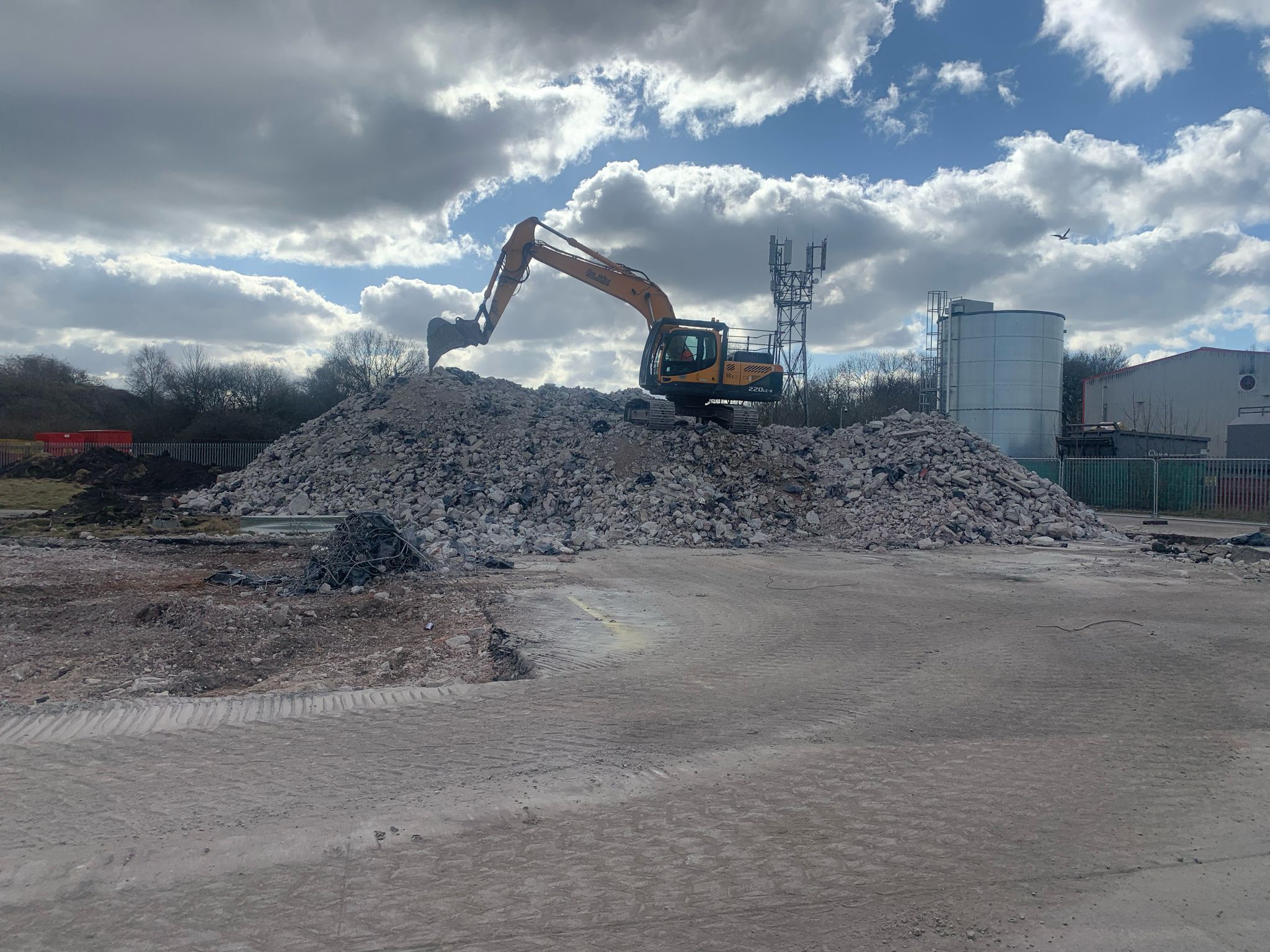
With the superstructure fully removed, the excavator was fitted with its ditching bucket to consolidate all surface materials before the foundation and slab removal phase began. The pool backfill was carried out methodically to ensure long-term ground stability.
– Hardcore previously placed into the pool void was extracted and stockpiled clear of the building footprint
– The pecker attachment worked in a systematic 1-metre-apart grid pattern across both the pool surround walkways and the pool base
– The slab around the pool was taken down 200–300mm, with a further 600mm removed against the pool walls to ensure adequate drainage paths
– The pool base slab was left in situ — only the perimeter and wall sections were broken
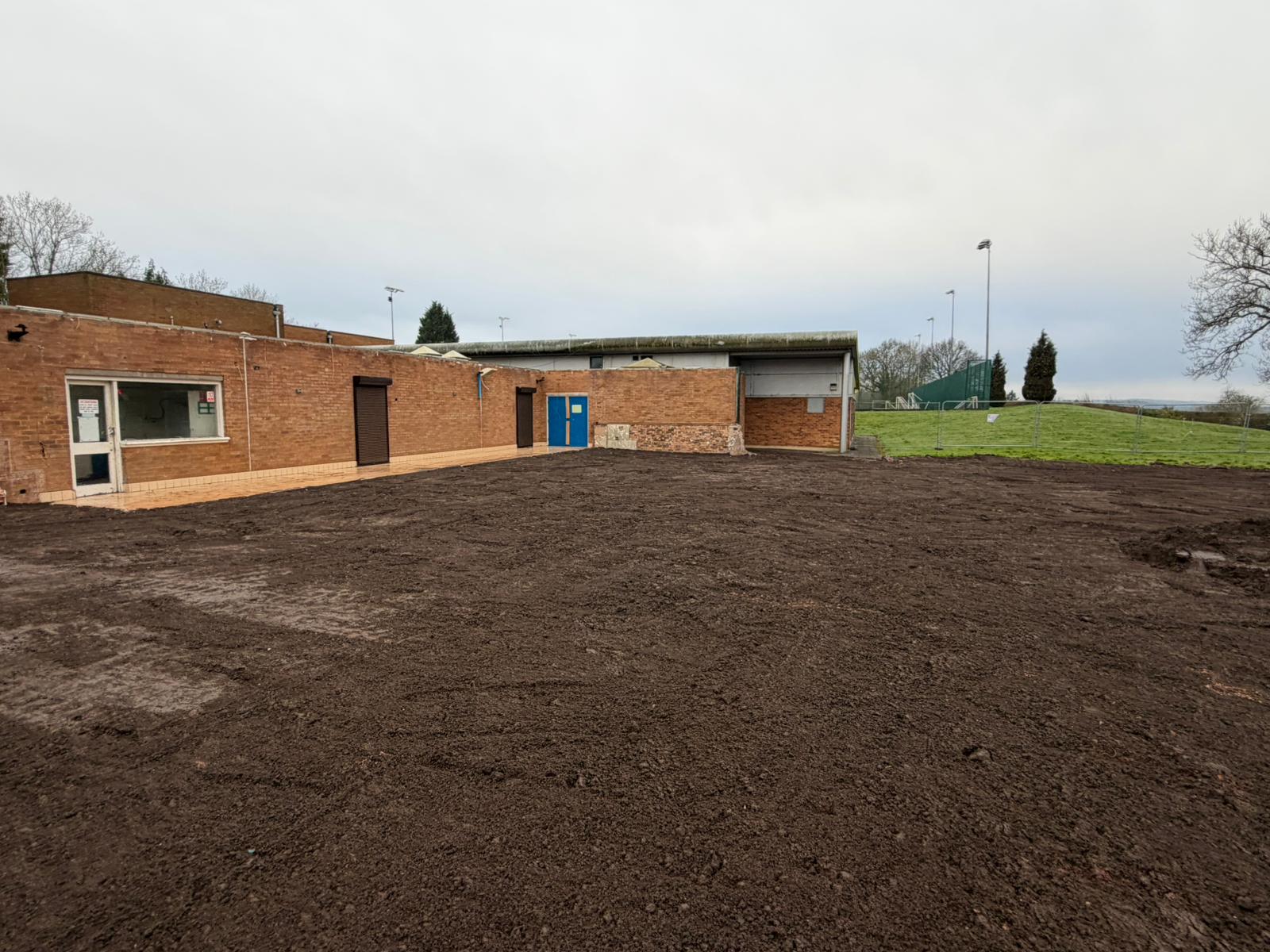
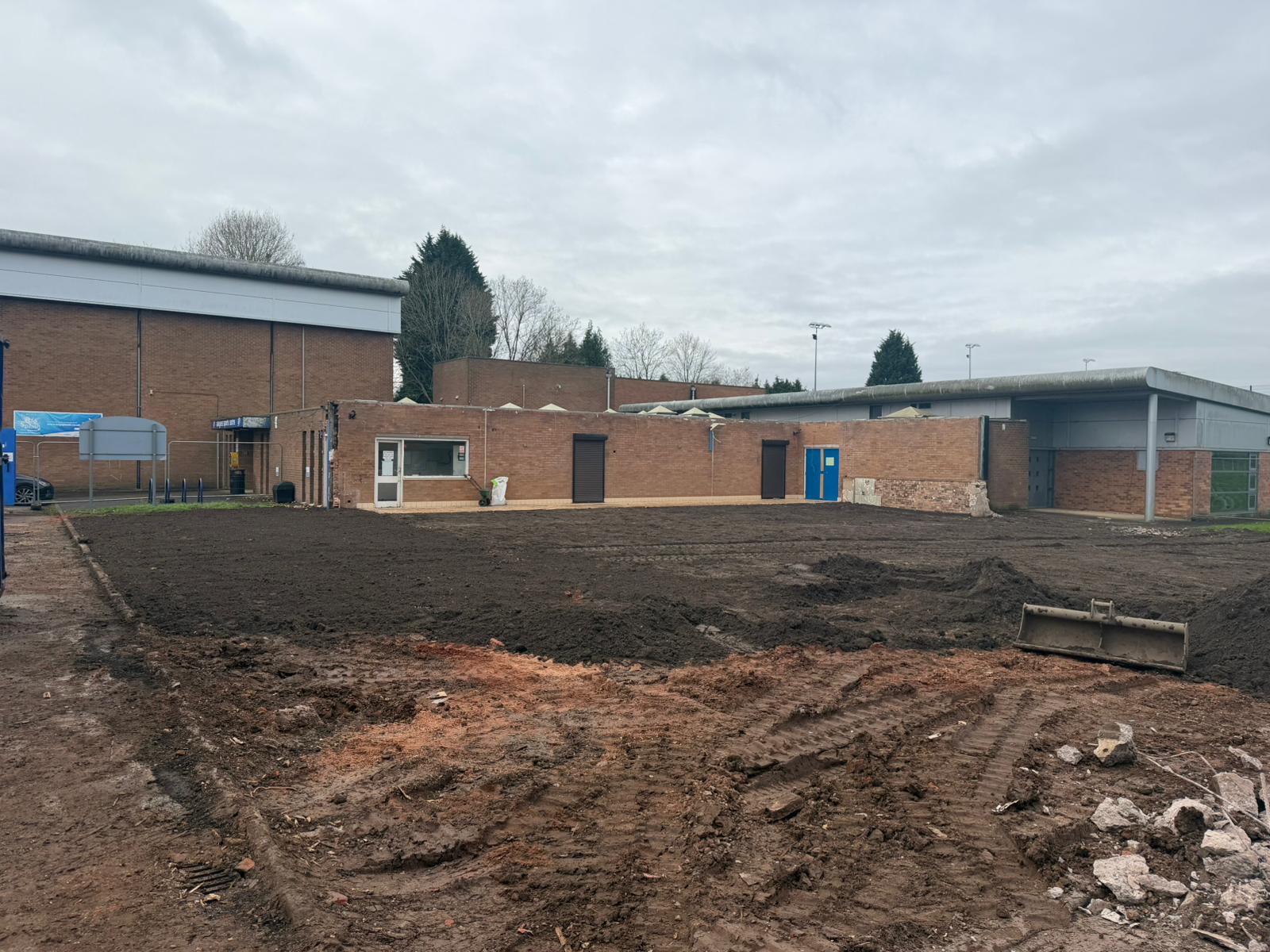
– All arisings were consolidated and used to backfill the vacant pool void, with the hardcore level brought just short of the surrounding car park level
– Topsoil was laid over the compacted hardcore to provide a clean, level surface finish for handover
| Name | Role | Qualifications & Tickets |
|---|---|---|
| Karl Marsh | Site Manager | CCDO Manager · CPCS Excavator Operative · SMSTS |
| Doulton Marsh | Site Operative | CCDO · IPAF |
| Bailey Marsh | Site Operative | CSCS Operative |
| Jim Wise | Managing Director / HSEQ | Overseeing Director · HSEQ Manager · Approved RAMS |
| Callum Wise | Contracts & Demolition Manager | Demolition Manager · Prepared Method Statement & RAMS |
| Control | Measure |
|---|---|
| Dust Suppression | Petrol-powered jet wash with IBC bowser and high-pressure directional lance, repositioned continuously to suit weather and wind conditions |
| Noise | All works within agreed hours (Monday–Friday 07:30–16:00, Saturday 09:00–13:00, no Sunday working) with muffled plant where practicable |
| Vibration | Constant monitoring regime with proactive management to protect neighbouring residential properties |
| Waste | Segregated waste streams, waste transfer notes for all loads, individual Hazardous Waste Consignment Notes where required, 40-yard RORO bins for scrap steel and inert materials |
– Section 80 Notice issued to the local authority by the client prior to commencement
– All works in full accordance with BS6187:2011, CDM 2015 and PUWER 1998
– Daily plant pre-use inspections documented throughout
– Emergency hospital route pre-planned: Royal Stoke University Hospital, Newcastle Road, ST4 6QG (01782 715444)
The education sector presents unique demands. A live school campus requires exemplary community relations, reliable scheduling and a contractor trusted to maintain complete separation between demolition operations and pupils or staff at all times.
Jim Wise Demolition was appointed by Surveyors to Education following a competitive selection process. Our track record in education and public sector demolition and our reputation for health and safety excellence across the Midlands and beyond made us the right choice for this complex, sensitive project.
Our Education Sector Track Record
Jim Wise Demolition operates a dedicated education sector demolition service. We understand the strict welfare, working hours and community communication requirements that school and college sites demand — and we deliver projects that protect pupils, staff and the public without exception. See our recent work at Stowupland High School for a further example.
This project draws on the full breadth of our specialist capabilities. Explore the most relevant sections of our website below.
Services
Relevant Case Studies
Blog Posts
The Alleyne's Academy project demonstrates our ability to plan and deliver complex, multi-hazard demolitions in sensitive environments — safely, on programme and in full regulatory compliance.
01782 790576
About Jim Wise Demolition Ltd
Jim Wise Demolition Ltd is a leading UK demolition contractor based in Burslem, Stoke-on-Trent, with over 30 years of industry experience. We deliver safe, compliant and sustainable commercial demolition, soft strip, site clearance and concrete crushing services for clients across England and Wales. All works are carried out in strict accordance with BS6187:2011, CDM 2015 and all relevant UK health and safety legislation. Hot Lane, Burslem, S

If you would like to arrange an appointment with us to discuss a potential project, or if you have a question about what we do, please get in touch with us today and we’ll be more than happy to help you.
Hot Lane Industrial Estate, Stoke-on-Trent ST6 2BN.
Subscribe to our news and get a discount on the first service.
.jpeg)
.jpeg)
.jpeg)
.jpeg)
.jpeg)


.png)

%20(1).jpeg)
.jpeg)

.jpeg)
.jpeg)
.jpeg)

.jpeg)