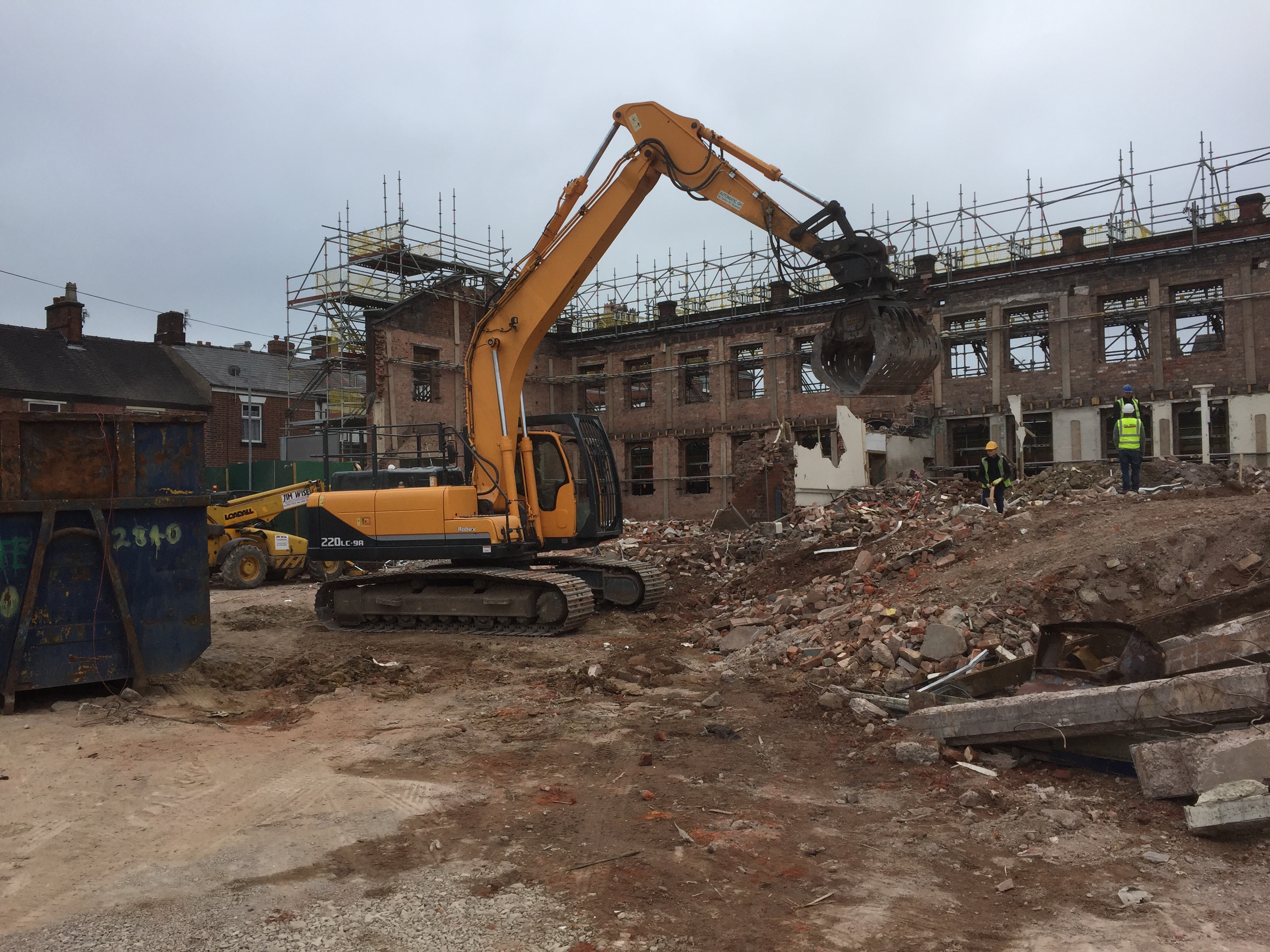
Surrey's demolition market has a distinctive character: high-value sites, exacting clients, tight planning settings and a building stock that runs from Victorian institutions through interwar suburbia to some of the country's densest concentrations of 1980s business-park stock. Add the green belt wrapped around every town and you have a county where demolition is rarely about brute force and almost always about method, documentation and conduct. Here's how projects in Surrey and the wider South East actually get delivered in 2026 — including the honest answer on how a Midlands contractor serves the region, evidenced by our own southern project record.
Why Surrey Generates Steady Demolition Work
Three engines drive the county's demand. The office repositioning cycle leads: Surrey's towns — Guildford, Woking, Redhill, Staines, Leatherhead — carry enormous stocks of 1970s–90s office and business-park buildings, and tightening energy standards for lettable space have turned marginal buildings into strip-or-clear decisions across the county. Residential value comes second: replacement dwellings and small-site redevelopment keep residential demolition constantly busy in a county where the land under a tired house is worth multiples of the house. And town-centre renewal continues in most of the county's centres as retail-era stock finds new uses.
What Surrey clients consistently demand — more explicitly than almost anywhere — is documentation: pre-demolition audits, waste evidence, considerate-conduct credentials and a paper trail that survives scrutiny. That suits us fine; it's how we run every site anyway.
The County's Stock and What Each Type Involves
| Stock type | Structure | Considerations | Typical approach |
|---|---|---|---|
| Business-park offices (1970s–90s) | Steel/concrete frames, curtain walling | Asbestos in older phases, extensive M&E | Strip out or full clearance; high recovery rates |
| Town-centre commercial | Mixed-era, party-wall dense | Conservation settings, live neighbours | Protection-led methods, hand work at interfaces |
| Residential replacement | Interwar and post-war houses | Asbestos in soffits, floors, garages | Fast, tidy small-site demolition with full segregation |
| Institutional and school stock | Large sites, phased occupancy | Live-site working, term-time constraints | Phased programmes, exemplary site conduct |
The constant is the survey: anything pre-2000 needs a demolition and refurbishment survey under CAR 2012 before pricing, and Surrey's office generations rarely come back clean. Our HSE licensed teams remove licensed and non-licensed asbestos in-house, then move straight into soft strip or structure on one programme.
The Southern Evidence: We Already Deliver Here
The fair question for any non-local contractor is "have you actually worked down here?" — and our answer is on this site. At West Quay in Southampton we removed a mezzanine steel floor and escalators inside a live retail environment — complex structural strip out with the public metres away. In Kent we delivered a full warehouse strip out with complete waste segregation. And at Stowupland in Suffolk we've taken on school-site demolition alongside live education. Surrey sits comfortably inside a delivery footprint that already runs from Southampton to Newcastle upon Tyne — the 125+ locations page tells the wider story.
Away delivery follows a fixed pattern: plant by low-loader, secure compound and welfare established first, resident supervision throughout, and 24/7 response arrangements set up before works start. Mobilisation appears as an honest, visible line in the price — and on anything beyond small works it's a minor share of the total.
Green Belt, Ecology and the Surrey Planning Context
Much of the county's land is green belt, and demolition there often serves replacement or restoration schemes with conditions attached — which makes conduct and documentation part of the consent, not a nicety. Ecology runs on the same logic: mature gardens, outbuildings and institutional grounds are exactly where bats and nesting birds live, so preliminary ecology screening belongs at the start of programming, not the end. A contractor who surveys first and sequences around the findings protects both the client's consent and the calendar.
| Get a Free Quote → | 0800 222 9772 |
A Surrey Project, Step by Step
- Site visit and constraints — setting, access, neighbours and ecology likelihood mapped on day one; we travel for surveys as readily as for works.
- Intrusive surveys — asbestos under CAR 2012 and structural appraisal, fixing real scope before price.
- Consents and notifications — Section 80 notice, planning conditions checked, HSE notice for licensed removal.
- Mobilisation and protection — compound, welfare, resident supervision, and full boundary protection established.
- Asbestos and strip — in-house licensed removal, then strip out with source segregation.
- Structure — top-down to BS 6187:2011 under a CDM 2015 phase plan, methods tuned to the setting.
- Clearance and handover — crushing where volumes justify, every load documented, site left ready and tidy.
What Moves the Price in Surrey
| Factor | How it moves the price |
|---|---|
| Asbestos scope | The survey sets it; office stock of the 70s–80s rarely disappoints |
| Setting and conduct | Conservation, green belt and neighbour expectations add protection and management |
| Retention | Strip out and facade schemes cost more per cubic metre than clearance |
| Waste strategy | Segregation and crushing raise recovery — around 96% diversion across our projects |
| Mobilisation | Visible and honest; minor beyond small works |
Surrey & the South East: Quick Answers
Does using a Midlands contractor slow the programme?
No — mobilisation is planned logistics, teams work away as standard with resident supervision, and our southern projects from Southampton to Kent are the evidence. Judge contractors on survey quality, licence and references, not postcode.
Our office building dates from 1985 — what should we expect?
An intrusive survey first, and realistically some asbestos findings in the older plant areas and finishes. All removed in-house under our HSE licence before strip or demolition.
Can you work next to occupied buildings?
Constantly — West Quay was delivered inside a live shopping centre. Protection, monitoring and communication are the method, not an extra.
What consents do we need?
A Section 80 demolition notice before works, plus planning or prior approval as the site requires; green-belt and conservation settings carry conditions we build into the method.
Which Surrey towns do you cover?
All of them — Guildford, Woking, Redhill, Reigate, Staines, Epsom, Leatherhead, Camberley, Farnham — and the wider South East beyond.
The Framework Surrey Clients Should Expect to See
Surrey's professional client base — funds, developers, institutions, well-advised private owners — tends to procure demolition properly, and the framework they should expect any bidder to evidence is standard national law applied without shortcuts. CDM 2015: a written construction phase plan, a principal contractor with demonstrable competence, welfare from day one. BS 6187:2011: the method statement's backbone — sequencing, exclusion zones, protection of adjacent property, temporary works where structures are opened up. CAR 2012: the demolition and refurbishment survey before pricing, licensed removal under HSE notification with its fourteen-day lead, four-stage clearances and air monitoring on licensed works. Waste duty of care: licensed carriers, transfer and consignment notes, an auditable trail per load.
The Surrey layer on top is conditions: green-belt consents, conservation settings, considerate-working requirements and ecology obligations arrive attached to the planning permission, and the demolition method must deliver them, not negotiate with them. We treat consent conditions as specification — read at tender, built into the phase plan, evidenced at handover — which is precisely what a well-advised client's monitoring surveyor wants to see. The thinking is covered in strategic demolition planning.
The Material Story on a Surrey Project
| Stream | Handling | Destination | Recovery |
|---|---|---|---|
| Office strip arisings (M&E, metals) | Segregated by stream at source | Metal recycling; WEEE routes for equipment | High |
| Concrete frames & slabs | Crushed — on site where volumes justify | Recycled aggregate, often reused on plot | ~100% |
| Structural steel | Processed and graded | Scrap recycling | ~100% |
| Timber & joinery | Separated at strip stage | Recycling / biomass | High |
| Plasterboard | Dedicated stream — never mixed | Gypsum recycling | High |
| Asbestos | Double-wrapped, consignment-noted | Licensed hazardous facility | Safe disposal |
Surrey clients increasingly ask for pre-demolition audits and material evidence in the tender itself, and we welcome it: roughly 96% landfill diversion across our record, weighbridge-ticketed and handed over in the completion pack. Where a scheme pursues credits or carbon reporting, the same documentation feeds it directly — see clean demolition for the approach.
The Service Set, Matched to Surrey's Workload
The county's demand maps cleanly onto our services. Tired business-park stock: soft strip out for repositioning or commercial demolition for clearance. Replacement-dwelling plots: residential demolition, fast and tidy, with garden and boundary protection that matters on high-value sites. Development assembly: site clearance including slabs, hardstandings and below-ground structures. Heavy concrete: on-site crushing that keeps aggregate on the plot and wagons off Surrey's lanes. Institutional and school sites: phased programmes with live-environment conduct — the discipline our West Quay project demonstrates at retail intensity. And emergency demolition around the clock when failure or fire demands it.
Five Mistakes South East Clients Can Avoid
Letting postcode outweigh evidence. The nearest yard is not the best bid; licence, references and survey quality are. Pricing without the intrusive survey. 1980s office stock especially punishes it. Reading consent conditions after appointment. They're the specification; tender against them. Programming ecology last. Mature Surrey grounds are bat country; screen first, sequence around findings. Accepting vague waste answers. "It all gets recycled" without tickets is a claim, not a fact — demand the documentation standard we've described, from us or anyone.
Coverage Across Surrey and the Borders
| Area | Postcodes | Typical work |
|---|---|---|
| Guildford & Godalming | GU1–GU8 | Office repositioning, residential replacement |
| Woking & Camberley | GU15–GU22 | Business-park strip out and clearance |
| Redhill, Reigate & Dorking | RH1–RH5 | Town-centre commercial, conservation-adjacent |
| Epsom & Leatherhead | KT17–KT22 | Institutional sites, office stock |
| Staines & Weybridge | TW18, KT13–KT15 | Commercial demolition, riverside settings |
| Farnham & the borders | GU9, GU10 | Rural and green-belt projects |
The county is served on the away-delivery model our southern projects prove out: mobilise once, resident supervision throughout, and the same documentation standard in Guildford as in Stoke. Hampshire, Sussex and Berkshire borders are covered from the same programmes.
Realistic Timelines for Surrey Projects
| Project type | Lead-in | On-site duration | What moves it |
|---|---|---|---|
| Residential replacement demolition | 2–4 weeks (ecology may extend) | 1–2 weeks | Bat screening and services isolation lead |
| Office strip out | 2–3 weeks | 3–8 weeks | Survey findings and M&E complexity |
| Full commercial demolition | 3–6 weeks | 6–14 weeks | Asbestos scope, setting constraints |
| Licensed asbestos phase | 14-day HSE notice | Scope-dependent | Fixed by law — programme it first |
Surrey's planning conditions often add their own pre-commencement items — surveys to discharge, method approvals, ecology sign-offs — and those belong in the lead-in plan from the day of appointment. Handled that way, they cost nothing; discovered late, they cost weeks.
What Working With Us in the South East Looks Like
The delivery model is the one behind our West Quay, Kent and Suffolk projects: proper mobilisation, a resident supervisor your team knows by name, daily site briefings, weekly client reporting with photographs, and neighbour communication run proactively — on high-value Surrey streets especially, the site's conduct is part of the client's reputation and we treat it accordingly. Monitoring surveyors get the documentation they ask for before they ask twice. And the handover pack — phase plan, clearances, waste trail, as-left record — closes the file completely.
Can you meet considerate-conduct scheme requirements?
Yes — our standard site operating rhythm aligns with those expectations, and specific scheme registrations are accommodated where the contract requires them.
Do you handle the pre-commencement condition surveys?
We deliver or coordinate them as the conditions demand — asbestos and structural in-house, ecology through established partners, all sequenced into the lead-in.
How quickly can you survey in Surrey?
We travel for surveys as readily as works — typically within the week. Call 0800 222 9772.
Asbestos in Surrey's Stock: A Closer Look
Surrey's dominant demolition generation — the 1970s–90s business-park and office stock — sits astride the asbestos ban years, which makes surveys unusually decisive here. Earlier-phase buildings routinely carry AIB in ceiling tiles, partitions, riser linings and window panels, lagging in plant rooms, and textured coatings throughout; later-phase buildings may be substantially clean, but "may" is doing heavy lifting — refits, extensions and plant replacements blurred every boundary, and the mineral turns up in gaskets, adhesives and floor tiles long after its supposed exit. Interwar and post-war housing feeding the replacement-dwelling market brings its own set: cement soffits and garage roofs, floor tiles, boiler-cupboard board and textured ceilings. Institutional sites — schools especially — layer all the above across phased campuses.
The client consequence: on Surrey stock, the intrusive survey doesn't just inform the price, it frequently is the price — the spread between a clean later building and an AIB-heavy earlier one can dominate every other cost line. Licensed findings add the HSE fourteen-day notice and controlled removal with air monitoring and clearances; our in-house licence keeps either outcome inside one programme with no subcontractor interface to manage or dispute.
The First 48 Hours After You Appoint Us
Appointment triggers the lead-in immediately. Within two days: survey visit scheduled — we travel for surveys as readily as works; Section 80 drafted; utilities disconnection applications submitted, since their queues pace more Surrey programmes than any other factor; planning-condition review completed and pre-commencement items listed with owners and dates; ecology screening commissioned where mature grounds or outbuildings suggest it; and mobilisation logistics — compound, welfare, supervision cover — planned to run inside the statutory window. Monitoring surveyors get the phase plan draft early, not at the gate. By the time notices and disconnections clear, the project is ready to run at full speed from the first morning on site.
Three More Questions Surrey Clients Ask
Can you demolish with a basement or swimming pool involved?
Yes — below-ground structures are broken out under control, voids backfilled with certified material in compacted layers, and the works recorded so your engineer and warranty provider have the evidence they need.
How do you protect trees with preservation orders?
Root protection areas are fenced before mobilisation, methods and plant routes designed around them, and the arboricultural conditions treated as specification — TPO breaches are expensive and entirely avoidable.
Will the neighbours complain?
Our aim is that they have nothing to complain about: notified before we start, informed as phases change, dust and noise controlled at source and monitored. On high-value Surrey streets, the site's conduct is part of your reputation — we treat it that way.
Do you provide a single fixed price or a schedule of rates?
Either, to suit the procurement: a fixed lump sum against the surveyed scope is our standard offer, with a transparent schedule of rates governing any variation — so the number you sign is the number you pay unless the building genuinely changes the facts.
Choosing a Contractor for Surrey Work
Apply the full test: current HSE asbestos licence with in-house removal; verifiable ConstructionLine Gold and SSIP accreditation; comparable references — including live-environment work if your site demands it; an intrusive survey before the price is fixed; explicit away-working arrangements; and a waste documentation trail you'll receive at handover. Our complete UK guide to choosing a demolition contractor walks through each item.
We bring 2,489+ projects, NEBOSH and IOSH qualified management and zero prohibition notices in over a decade to every South East job. Family-run since 1982: plan it properly, do it safely, leave the site clean.
Planning a project in Surrey? Arrange a free site visit or call 0800 222 9772.
.svg)