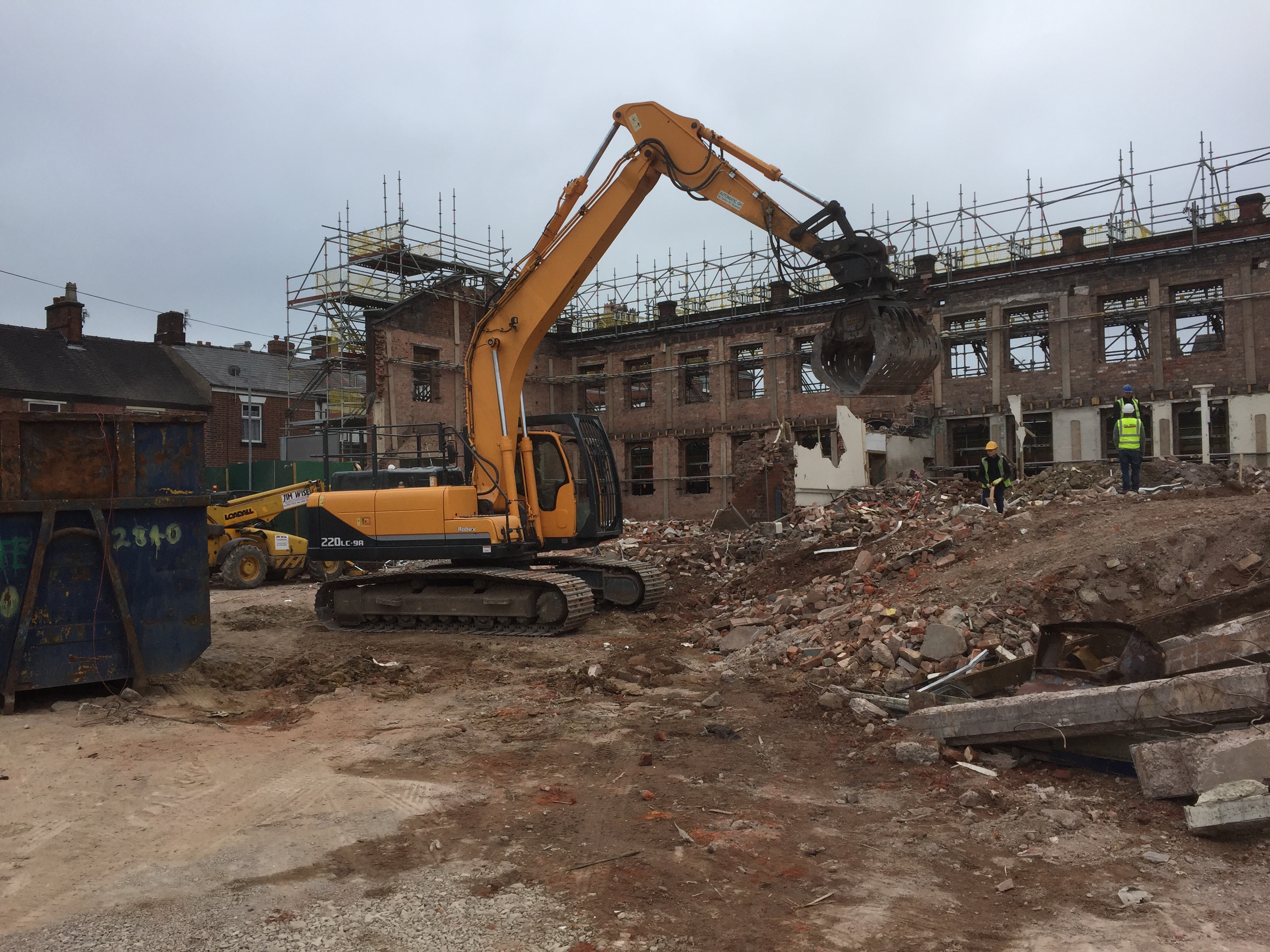
Northampton sits at the centre of two building stories a century apart. The first is leather and shoes: the industry that made the town left a distinctive stock of boot and shoe factories — handsome brick works threaded through the town's Victorian streets, some converted, some tired, some gone. The second is logistics: Northamptonshire sits squarely in the golden triangle, and the sheds along the M1 and A45 form one of the largest warehouse concentrations in Europe, in constant churn. Between those two — plus a town centre mid-renewal and a rural county around it — demolition work in Northampton spans the full range, and this is the complete 2026 guide.
Northamptonshire in 2026: What's Generating the Work
The logistics market leads by volume. Golden-triangle stock upgrades relentlessly — older units stripped between tenants, first-generation sheds cleared for modern replacements with higher eaves and better energy performance, yards reconfigured for bigger fleets. Every cycle produces strip out, demolition and slab-recycling work in quantity. Town-centre renewal comes second: Northampton's centre carries post-war commercial stock making way for new uses, alongside the careful question of what happens to the remaining shoe-industry buildings — a heritage stock the town increasingly values. And the rural county contributes its steady flow: farm buildings, village works and estate structures retiring year on year across a landscape of stone villages where setting matters.
The County's Stock and What Each Type Involves
| Stock type | Structure | Considerations | Approach |
|---|---|---|---|
| Boot & shoe factories | Victorian brick, timber floors, layered extensions | Oil-soaked timbers, asbestos from refits, heritage value | Survey-led; convert-or-clear decided on evidence; salvage planned |
| Golden-triangle logistics | Portal frames, composite cladding | Strip out between tenants; clearance for redevelopment | Fast, sequenced, high metal recovery, slab protection |
| Post-war town centre | Concrete and steel frames | Heavy asbestos load, live neighbours | Licensed removal, protection-led top-down reduction |
| Rural county | Stone farm buildings, village works | Asbestos cement roofs, ecology, conservation villages | Small-plant methods, reclaim of stone and slate |
As everywhere, anything pre-2000 starts with a demolition and refurbishment survey under CAR 2012. Shoe factories carry asbestos from a century of refits; post-war stock carries it by design; even modern sheds occasionally surprise in their oldest corners. Our HSE licensed teams remove licensed and non-licensed materials in-house, then run straight into strip or structure on one programme.
The Shoe Factories: Heritage Worth Deciding Properly
Northampton's boot and shoe buildings deserve the same honest treatment we give textile mills in Leicester or potworks in Stoke: early structural appraisal, evidence-based viability, and a decision made once — before machines are priced. Where conversion works, the soft strip phase doubles as investigation, feeding condition findings straight to the design team. Where demolition is the honest answer, method respects the building: hand and small-plant work at retained interfaces, reclaimable brick palletised rather than crushed, and neighbours in tight Victorian streets protected throughout. Our thinking on these calls is set out in balancing demolition and conservation, and we've delivered it at listed-building level at the Wedgwood Institute.
The Logistics Workload: Strip Out at Scale
Golden-triangle work is a discipline we deliver constantly — the same one behind our Kent warehouse strip out and the Newcastle racking project. High-bay racking dismantled in reverse-build sequence with honestly sized exclusion zones; mezzanines out in planned lifts with the slab protected; services isolated and removed safely; and every material stream segregated from the first bay. Where full clearance is the instruction, portal frames come down in engineered sections with high metal recovery, and slabs feed our on-site concrete crushing — aggregate for the replacement shed, made where it's needed. The strip-or-demolish decision itself is covered in soft strip versus full demolition.
| Get a Free Quote → | 0800 222 9772 |
A Northamptonshire Project, Step by Step
- Site visit — stock type, access, neighbours and setting mapped; Northampton is comfortable striking distance from our Midlands base.
- Surveys — intrusive asbestos survey under CAR 2012, structural appraisal, ecology screening on rural buildings.
- Notifications — Section 80 notice to the council, HSE notice for licensed works, utilities isolations booked early.
- Asbestos removal — in-house licensed teams, clearances and air monitoring included.
- Strip out — racking, mezzanines, fixtures and interiors in sequence, streams segregated at source.
- Structure (where required) — sections or top-down to BS 6187:2011 under a CDM 2015 phase plan.
- Clearance and handover — crushing where volumes justify, waste transfer notes on every load, site or unit handed back ready.
Northampton Cost Drivers
| Factor | How it moves the price |
|---|---|
| Asbestos scope | Survey-set; factory refits and post-war stock rarely come back clean |
| Programme pressure | Reletting and development dates reward proper crewing and planning |
| Heritage care | Factory-quarter interfaces and conservation villages add skilled slow work |
| Metal and aggregate | Racking steel and crushed slab flow back as credits and saved imports |
| Access | Victorian streets and rural lanes size plant and logistics |
Around 96% of our demolition waste is diverted from landfill across projects, with the documentation pack — weighbridge tickets, transfer notes, consignment notes — delivered at handover as standard.
Northampton & Northamptonshire: Quick Answers
Do you cover the whole county?
Yes — Northampton, Kettering, Corby, Wellingborough, Daventry, Towcester and the rural county, alongside our neighbouring Leicester, Warwickshire and Nottinghamshire coverage.
Can you strip a unit on a live estate without disrupting neighbours?
Constantly — managed movements, protected routes and agreed hours are standard practice on golden-triangle estates.
Our building is a former shoe factory — demolition or conversion?
Evidence decides: structural appraisal and survey findings first, viability honestly assessed, and the strip phase run as investigation if conversion is in play.
What consents do we need?
A Section 80 demolition notice before works, plus planning or prior approval as the building and setting require — conservation areas carry extra consents we flag at survey.
How quickly can you get to site?
Northampton sits an easy run down the M1/A5 from our base — site visits are typically same-week. Call 0800 222 9772.
The Framework Every Northamptonshire Project Runs On
From a Kettering factory to a golden-triangle shed, the legal spine is constant. CDM 2015: written construction phase plan before works, competent principal contractor, welfare from day one — demolition is planned work by law, whatever its size. BS 6187:2011: the method-statement standard governing sequence, exclusion zones and protection of adjacent property, and on strip out it's what makes racking dismantling engineering rather than improvisation. CAR 2012: demolition and refurbishment survey before pricing on anything pre-2000, licensed removal under HSE notification with its fourteen-day lead, clearances and air monitoring on licensed works. Waste duty of care: licensed carriers, transfer notes, consignment notes — every load documented and auditable.
Northamptonshire adds its own consent textures: conservation areas around the shoe quarter and the stone villages, and planning conditions on the big logistics plots that increasingly specify waste recovery and considerate conduct explicitly. We tender against conditions as specification and evidence them at handover — the approach set out in strategic demolition planning — which is what keeps monitoring surveyors comfortable and programmes unbothered.
Where Northamptonshire Material Goes
| Stream | Handling | Destination | Recovery |
|---|---|---|---|
| Racking & structural steel | Dismantled in sequence, graded | Scrap metal recycling | ~100% |
| Factory brick | Palletised where sound | Reclamation — Victorian brick sells | High |
| Concrete slabs | Crushed, on site where volumes justify | Recycled aggregate for the next shed | ~100% |
| Northamptonshire stone | Reclaimed where viable | Reuse in village repairs and new build | High |
| Timber | Own stream from strip stage | Recycling / biomass | High |
| Asbestos | Double-wrapped, consignment-noted | Licensed hazardous facility | Safe disposal |
Logistics-belt jobs are metal-rich and crush-heavy, which is exactly where our roughly 96% diversion record climbs highest; factory-quarter jobs add reclaim value in brick and stone that flows back into honest pricing. Documentation — weighbridge tickets, transfer notes, consignment notes — arrives with the handover pack as standard; see clean demolition for the approach.
Matching Service to Project Across the County
The county's twin economies call on the full set. Golden-triangle work: warehouse strip out between tenants, industrial demolition for first-generation sheds, site clearance and on-site crushing for redevelopment plots. Town and factory quarter: commercial demolition for end-of-life stock, soft strip out where conversion is in play — run as investigation, feeding condition evidence to the design team. The rural county: residential demolition and farm-building work with ecology programmed first. And emergency demolition around the clock when fire or failure demands it. Single-contractor delivery across the combination is the difference between one accountable programme and three contractors pointing at each other.
Five Mistakes Northamptonshire Clients Can Avoid
Pricing before surveying. Shoe-factory refit history and post-war stock both punish walk-round quotes. Treating racking casually. It's structure; sequence it down or pay for the consequences. Deciding convert-or-clear on sentiment. Evidence first — appraisal, survey, viability — then decide once. Damaging the slab you're trying to relet. Method should protect it explicitly. Booking utilities late. Isolation lead times, not machines, pace most programmes — put them first in the plan.
Coverage Across the County
| Area | Postcodes | Typical work |
|---|---|---|
| Northampton | NN1–NN5 | Town-centre renewal, factory-quarter work |
| Kettering & Corby | NN14–NN18 | Industrial clearance, growth-area plots |
| Wellingborough & Rushden | NN8–NN10 | Logistics strip out along the A45 |
| Daventry | NN11 | Golden-triangle unit repositioning |
| Towcester & Brackley | NN12, NN13 | Commercial and rural mixed work |
| Rural county | County-wide | Farm buildings, stone-village settings |
The M1 and A5 put the whole county an easy run from our Midlands base — same-week surveys are the norm — and Northamptonshire is worked alongside our established Leicester, Warwickshire and Nottinghamshire coverage.
Realistic Timelines for Northamptonshire Projects
| Project type | Lead-in | On-site duration | What moves it |
|---|---|---|---|
| Warehouse strip out | 1–2 weeks | 2–6 weeks | Racking volume and reletting dates |
| Shed clearance with slab | 2–4 weeks | 8–16 weeks | On-site crushing shortens the tail |
| Factory-quarter demolition | 3–5 weeks | 6–12 weeks | Asbestos scope and heritage interfaces |
| Licensed asbestos phase | 14-day HSE notice | Scope-dependent | Statutory — first item in the plan |
Golden-triangle programmes run to reletting and development dates, and those dates are protected in the lead-in: surveys, Section 80, HSE notices and utilities isolations booked at appointment let the on-site phase run flat out.
What Working With Us in Northamptonshire Looks Like
The same operating rhythm our linked Kent and Newcastle projects ran on: a named resident supervisor, daily briefings, weekly client reporting with photographs, estate and neighbour communication handled proactively, and waste documentation accumulated live so the handover pack is complete the day the site is. Factory-quarter jobs add heritage-interface care; shed jobs add slab protection and metal accounting; village jobs add the conduct that conservation settings deserve. One accountable contractor across the lot.
Can you meet a hard reletting date?
That's the job — proper crewing, a lead-in that clears the statutory items early, and a programme we report against weekly. Our Kent strip out hit exactly this shape of deadline.
Do you work with heritage officers on factory buildings?
Constructively and early — evidence-led engagement is how consentable routes get found, and our Wedgwood Institute work shows the standard.
How quickly can you survey?
Same-week across the county as standard — call 0800 222 9772.
Asbestos in Northamptonshire's Stock: A Closer Look
The county's two signature building types hide the mineral differently. The boot and shoe factories carry it by refit: a century of modernisation threaded lagged pipe runs, boiler-house insulation, AIB partitions and linings, floor tiles and textured coatings through Victorian shells that predate the material's industrial peak — which is why factory surveys keep finding asbestos in buildings older than asbestos's own heyday. The logistics stock splits by generation: first-wave sheds and their office pods carry cement sheets, AIB and lagged plant as standard, while modern units are largely clean but inherit surprises in legacy yard buildings, gatehouses and plant rooms. The post-war town-centre stock carries the era's full set, and rural Northamptonshire contributes the universal cement farm roof.
Classification writes the programme: licensed findings add the HSE's fourteen-day notification, enclosures, air monitoring and four-stage clearance; non-licensed cement work proceeds faster under strict method. With the licence held in-house, either outcome stays inside one programme — on reletting-driven shed work and phased factory-quarter schemes alike, that continuity is worth more than any single machine on site.
The First 48 Hours After You Appoint Us
Northamptonshire projects start moving immediately. Within two days: survey visit booked — the county is same-week ground from our base; Section 80 notice drafted; utilities disconnection applications in, since their queues pace most programmes; HSE notification prepared where licensed material is known; heritage-officer contact opened on factory-quarter and conservation-village jobs; estate and neighbour communications drafted for live-estate strip outs; and the phase plan made site-specific with the client's hard dates driving the sequence. The statutory fourteen days and the disconnection queues then run concurrently with preparation rather than ahead of it — which is how reletting dates get hit.
Four More Questions Northamptonshire Clients Ask
Can you clear a shed and leave the yard operational throughout?
Yes — phased clearance with segregated traffic routes, protected circulation and agreed movement windows keeps a live yard running beside the works. The logistics plan is designed with your operations team, not imposed on them.
Do you buy the steel, or do we?
Metal value is credited transparently in the price — weighbridge-ticketed, so the credit is evidence rather than estimate. Ask every bidder to show the same; opaque metal handling is where cheap quotes recover their margin.
What if the survey finds more asbestos than expected?
The variation is priced from the survey's findings at the rates in the contract, the HSE notification adjusted if classification demands it, and the programme replanned openly — no drama, because the framework anticipated exactly this.
Can you provide bonds or extended warranties for institutional clients?
Performance bonds, collateral warranties and enhanced insurance limits are all accommodated where the contract requires them — our accreditation set exists precisely to make that procurement straightforward.
Do you handle dilapidations strip outs for outgoing tenants?
Regularly — scope taken directly from the schedule of dilapidations, delivered with item-by-item photographic evidence so the exit negotiation closes with the handover pack. On lease-end deadlines the programme runs backwards from the date that matters, exactly as reletting-driven work does.
Can you work weekends to protect a deadline?
Where consents and the estate allow, yes — weekend phases are a standard programme-compression tool on the logistics belt, planned into the sequence and priced transparently from the outset rather than bolted on in a panic later.
Choosing a Contractor for Northamptonshire
Apply the standard tests strictly: current HSE asbestos licence with in-house removal; verifiable ConstructionLine Gold and SSIP accreditation; comparable references — industrial strip out and heritage-adjacent work especially; an intrusive survey before the price is fixed; and a complete waste paper trail at handover. The full checklist is in our complete UK guide to choosing a demolition contractor.
We bring 2,489+ projects, NEBOSH and IOSH qualified management and zero prohibition notices in over a decade to every Northamptonshire job. Family-run since 1982: plan it properly, do it safely, leave the site clean.
Factory, shed or farmyard: arrange a free site visit or call 0800 222 9772.
.svg)