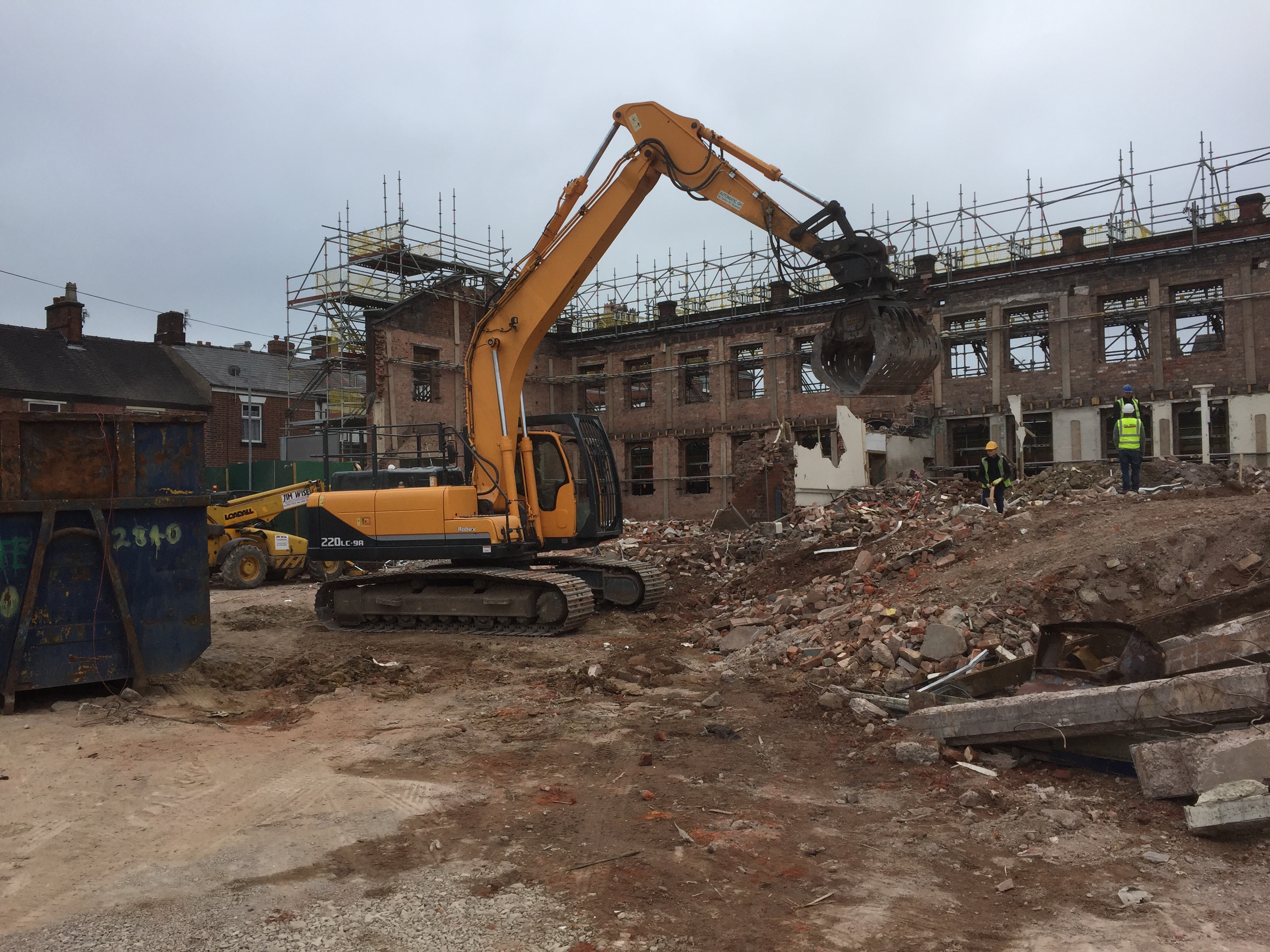
Shropshire holds a wonderful contradiction. It's the county where industry began — Ironbridge Gorge, the furnaces of Coalbrookdale — and simultaneously one of England's most rural counties, all market towns, farms and hills. In the middle sits Telford: a new town designated in the 1960s whose first-generation buildings are now sixty years old and, increasingly, due for renewal. Between those three worlds, demolition contractors in Shropshire see every kind of job the trade offers, and this guide covers what each one demands.
We deliver across the county — Shrewsbury, Telford, Wellington, Oswestry, Bridgnorth, Market Drayton, Ludlow and Whitchurch — from our Staffordshire base under an hour up the road, which makes Shropshire genuinely local ground for our teams.
Why Telford's Renewal Is Accelerating in 2026
New towns age in cohorts — everything built in the same decade reaches its decisions in the same decade — and Telford's first generation has arrived at that point together. Employment land is the visible front: 1960s–80s units that can't meet modern logistics or energy expectations are being cleared for stock that can, and the town's strong connectivity keeps demand for those plots healthy. District centres and civic buildings from the founding era face the same arithmetic, one scheme at a time.
Rural Shropshire moves to a different rhythm but the same direction: agricultural change retires buildings steadily, and condition presses on everything left empty. What ties the county together is the value of early surveys — asbestos scope on renewal-era stock and ecology windows on rural sites are the two factors that most often move programmes, and both reward clients who start the paperwork before the machine hire. That principle shapes everything that follows in this guide.
Telford at Sixty: When a New Town Needs Renewing
New towns were built fast, to their era's methods, and Telford's first-generation stock — industrial units, district centres, offices and civic buildings from the late 1960s through the 1980s — is reaching the age where refurbishment stops making sense for some of it. That generation of building has a known character: steel portal and concrete frames, asbestos used liberally until the bans began to bite, flat roofs with layered histories, and services that have been altered a dozen times since.
Renewal-era demolition here follows a rhythm we know well. The demolition and refurbishment survey under CAR 2012 comes first and usually finds plenty — AIB ceilings and linings, lagged services, cement roofing — all removed by our HSE licensed in-house teams. Then the soft strip, then top-down mechanical reduction under BS 6187:2011, with the frame processed for recycling and the slab crushed where the next scheme can use it. On employment land especially, that recycled aggregate often stays right where it's made.
The Gorge Next Door: Working Near World Heritage
Telford's southern edge runs into the Ironbridge Gorge World Heritage Site — the most historically significant industrial landscape in Britain. Nobody demolishes heritage of that rank, but plenty of ordinary buildings sit near it, and working adjacent to protected settings brings its own disciplines: methods chosen for low vibration, salvage over smashing where materials have value, settings respected in everything from hoarding lines to wagon routes, and early honest conversations about what any nearby building's loss or retention means. Our approach to those judgements is set out in balancing demolition and conservation — and it's the same thinking we applied at the Grade II* Wedgwood Institute.
Rural Shropshire: The County's Quiet Workload
Away from Telford, Shropshire's demolition work is rural and steady: redundant farm buildings, former dairies and mills, village garages, wartime structures and estate buildings that have finally run out of purpose. Asbestos cement roofing is near-universal on post-war agricultural stock; fuel and chemical stores need controlled removal; ecology surveys — bats above all, in a county this green — must be programmed before works; and access along Shropshire lanes decides what plant can even reach the site.
The standard doesn't shrink with the building. CDM 2015 planning, safe isolation of services, documented waste and a clean handover apply to a barn exactly as to a factory — and rural clients, who often live next to the site, appreciate that more than anyone.
| Get a Free Quote → | 0800 222 9772 |
Materials: From the First Industrial County, Back Into Use
It would be poor form to landfill carelessly in the county where industrial recycling of materials effectively began. We segregate at source on every Shropshire site — reclaimable brick, stone and slate kept apart from day one, timber and metals in their own streams, concrete and hardcore crushed for reuse through our concrete crushing service where volumes justify it. Around 96% of our demolition waste is diverted from landfill across projects, with a transfer note for every load and the full pack handed to the client at completion. The wider philosophy is in our clean demolition post.
Emergency Response Across Shropshire
Rural counties with old buildings produce urgent work reliably: fires in redundant farm structures, storm-damaged roofs, walls that move after a wet spell, and the occasional vehicle impact on a roadside building. Our emergency demolition service covers Shropshire 24 hours a day — attend, assess, make safe alongside the fire service and building control where they're in attendance, then plan the permanent works once the danger has passed.
Being based under an hour from most of the county matters more here than anywhere. Response time is the whole point of an emergency service, and a contractor three hours away is offering something different from what the situation needs. Equally important is judgement on arrival: stabilise where stabilising is possible, remove only what must go, and resist the urge to over-demolish in the dark. A building made safe overnight can still be surveyed properly in the morning and, sometimes, substantially saved.
A Shropshire or Telford Project, Step by Step
- Site and setting review — new-town commercial, heritage-adjacent or rural, each route mapped from the first visit.
- Surveys — intrusive asbestos survey under CAR 2012 (rarely quiet on 1960s–80s stock), structural appraisal, ecology screening on rural buildings.
- Consents and notifications — Section 80 notice, any setting-related consents, HSE notification for licensed removal.
- Asbestos removal — AIB, lagging and cement roofing handled in-house under our HSE licence.
- Soft strip — interiors and services out, materials segregated at source.
- Structure — portal frames down in sections, concrete frames top-down, all to BS 6187:2011, low-vibration methods near sensitive settings.
- Crush, clear, reinstate — aggregate produced on site where the next scheme can use it, waste documented, rural plots left tidy.
Every stage sits inside a CDM 2015 phase plan. Telford's renewal generation was built quickly and can be renewed just as efficiently — the difference this time is that the materials go round again rather than away, which feels like the right lesson for the county that taught the world industry in the first place.
What Drives Cost and Programme in Shropshire and Telford
Telford's renewal-era stock prices on asbestos scope above all — 1960s–80s buildings carry it as standard, and the intrusive survey sets the real number, with the fourteen-day HSE notice programmed where licensed work applies. Frame and slab volumes follow, softened by metal credits and by crushing concrete for reuse on site. Rural Shropshire prices on access, ecology and roofing — lanes, bats and asbestos cement respectively — while anything near sensitive settings adds the cost of gentler methods and salvage. Nothing exotic; just factors an experienced estimator prices honestly up front rather than discovering later.
Programme rhythms: a Telford unit clears in weeks once notices are in; larger complexes run months with asbestos pacing the job; rural buildings move fast once ecology windows are satisfied — and those windows are seasonal, so early surveys protect the calendar. Our base under an hour away means mobilisation never drives the programme.
Shropshire & Telford: Quick Answers
Our Telford unit dates from the 1970s — what should we expect?
A demolition and refurbishment survey first, and realistically some asbestos findings — AIB, lagged services or cement roofing are typical for the era. All handled in-house under our HSE licence before strip and structure.
Can you work near the Ironbridge Gorge?
Yes — adjacent to protected settings, with low-vibration methods, salvage-first thinking and full respect for consents. Nobody touches the heritage itself; plenty of ordinary buildings near it still need careful renewal.
Do you handle farm buildings and rural sites?
Constantly — asbestos cement roofs, fuel stores, ecology programming and lane access are everyday work for our teams, delivered to the same standards as any industrial job.
How quickly can you visit a Shropshire site?
Usually same-week — Shrewsbury, Telford, Oswestry, Bridgnorth, Ludlow and everywhere between are under an hour from our base. Call 0800 222 9772.
Choosing a Contractor for Shropshire and Telford
Apply the same tests whatever the site: current HSE asbestos licence and in-house removal capability; ConstructionLine or SSIP accreditation you can verify; comparable references — new-town commercial, heritage-adjacent, or rural as your project demands; an intrusive survey before the price; and a complete waste paper trail. Our complete UK guide to choosing a demolition contractor has the full checklist.
We bring ConstructionLine Gold, SSIP Acclaim, NEBOSH and IOSH qualified management and forty-plus years of experience to every Shropshire project — near enough for same-week site visits, with zero prohibition notices in over a decade. Family-run since 1982: plan it properly, do it safely, leave the site clean.
From Telford's estates to the Ludlow lanes: start at our Shropshire demolition contractors page, arrange a free site visit, or call 0800 222 9772.
.svg)