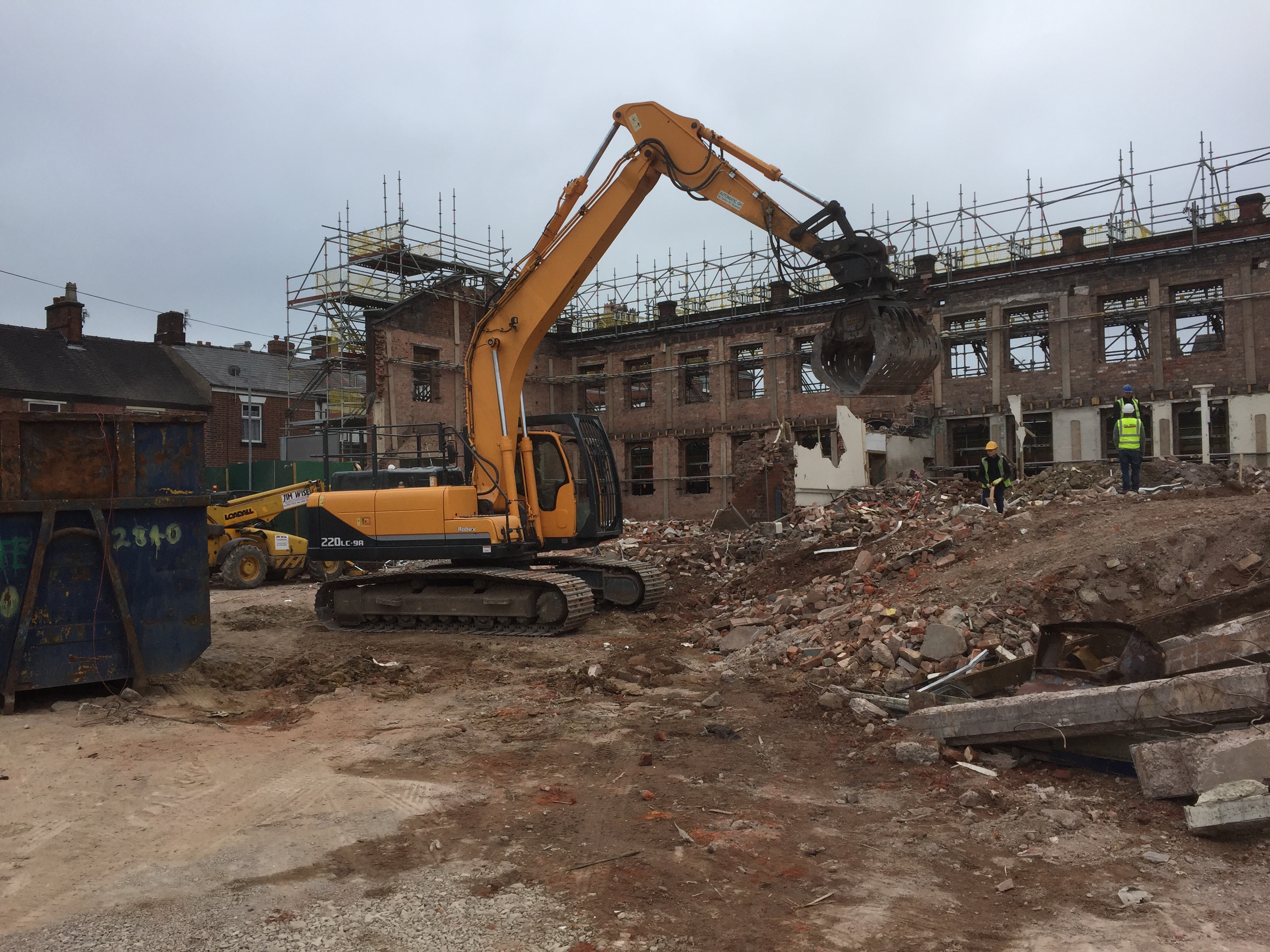
The Black Country earned its name from industry, and industry shaped every acre of it. Wolverhampton and its neighbours — Bilston, Willenhall, Wednesfield, Walsall, Dudley, Tipton — grew around foundries, forges, lock works, tube works and a thousand specialist metal trades, and the buildings those trades left behind are still threaded through every town. For demolition contractors in Wolverhampton, that legacy is the day job: taking down the industrial past safely so the next chapter has somewhere to stand.
We deliver demolition across Wolverhampton and the whole Black Country from our Staffordshire base a short run up the road, and this guide covers what the region's stock demands — and why the survey matters more here than almost anywhere.
Why Black Country Demolition Is Busy in 2026
The region's industrial land is wanted again — that's the headline. Modern manufacturing and logistics want big, well-connected plots, housing demand presses on every town, and the brownfield-first instinct of planning policy points both at exactly the land the old works occupy. Public funding streams for brownfield remediation have kept marginal sites moving, and every one of those schemes starts with demolition and a clean, documented clearance.
The condition factor pushes the same way: works buildings that stood empty through the 2010s are another decade older, and roofs, gutters and Victorian brickwork don't wait politely. The result is a market with steady demand for contractors who can handle asbestos-heavy, structurally entangled, ground-sensitive sites as one accountable package — which is precisely the shape of the work this guide describes. If your site sounds like that, the sections below will feel familiar.
A Landscape of Works
Black Country industrial buildings span two centuries and every construction era: Victorian foundries with brick vaults and cast-iron frames; interwar steel-framed sheds; post-war works with asbestos cement roofs stretching for acres; and the infill of workshops, offices and stores that every works accumulated around itself. Many sites layer all of them — a Victorian core wrapped in seventy years of extensions, each built to a different logic.
That layering is the first challenge. Structures lean on each other in ways no drawing records; a 1950s shed may be using a Victorian wall as its own; and a roof you plan to strip may be restraining a gable you plan to keep for phase two. Unpicking the sequence is engineering work, done before pricing, and it's the difference between a controlled programme and an uncontrolled one. Our piece on what industrial demolition contractors actually do goes deeper on this.
Asbestos and the Metal Trades
Heat-intensive industry meant asbestos everywhere: furnace and ladle insulation, sprayed coatings on steelwork, lagging on steam and process pipework, AIB linings to offices and stores, and asbestos cement roofing across almost every shed of a certain age. A demolition and refurbishment survey under CAR 2012 is the non-negotiable first step, and on Black Country sites it regularly finds licensed-work materials in quantity.
We hold a current HSE asbestos licence and remove both licensed and non-licensed materials with our own teams — enclosures, air monitoring, four-stage clearances and serial-numbered consignment notes, then straight into the strip and demolition on one programme. One contractor for both halves of the job is faster and safer, and we've explained why in this guide.
What's Under a Foundry Floor
Nowhere in Britain has ground with more history in it. Foundry sites carry casting sands and residues; plating and finishing works leave metals and solvents; and the whole region sits over centuries of mining, with shafts, shallow workings and made ground appearing where least convenient. Remediation is its own specialism, but the demolition contractor sets it up to succeed or fail: tanks, pits and interceptors removed under control; slabs over suspect ground lifted carefully rather than smashed through; arisings segregated so clean material stays clean.
Our site clearance packages on former works sites are built around that discipline — and around the paperwork, because a fully documented waste trail is what lets the next contractor and the regulator trust the plot they've been handed. There's a full walkthrough in planning large-scale industrial site clearance.
| Get a Free Quote → | 0800 222 9772 |
Making Room for the Black Country's Next Act
The region isn't a museum. Wolverhampton's centre is changing, former works land across the four boroughs is being reclaimed for manufacturing, logistics and housing, and demolition is the enabling step for nearly all of it. The metals from the old works go straight back into the recycling chain — fitting, in the region that first put them to work — brick and hardcore are crushed for reuse via our concrete crushing service where volumes justify it, and across our projects around 96% of demolition waste is diverted from landfill.
Working tight to homes, schools and live businesses is standard here, and so are our controls: agreed hours, suppressed dust, monitored noise and vibration, banksman-controlled movements and a clean highway at the end of every shift.
A Black Country Works Clearance, Step by Step
- Untangle the site — construction eras mapped, shared walls and mutual support identified, phasing designed around what leans on what.
- Intrusive asbestos survey — under CAR 2012, thorough in boiler houses, roof voids and around anything that once ran hot.
- Notifications and isolations — Section 80, HSE notice for licensed works, and services proved dead — works sites hide live supplies in odd places.
- Asbestos removal — licensed enclosures, air monitoring and clearances by our own teams.
- Tanks, pits and interceptors — removed under control before heavy demolition, so ground risk is contained early.
- Structural demolition — sequenced to BS 6187:2011, steel processed for recycling as the frames come down.
- Clearance and handover — slabs lifted with ground protection in mind, hardcore crushed, full waste documentation delivered.
CDM 2015 planning wraps the lot, with RAMS briefed daily. On layered works sites, step one is the project: sequencing buildings that have propped each other since Victoria was on the throne is where experience shows, and it's the step that keeps every later one boring — which, in demolition, is exactly what you want.
What Drives Cost and Programme on Black Country Sites
Works-era sites price on four factors. Asbestos scope leads, as it always does on heat-industry buildings — sprayed coatings and lagging in quantity mean licensed enclosures, air monitoring and the HSE's fourteen-day notice in the programme. Structural entanglement is the Black Country speciality: buildings that lean on each other cost engineering time to unpick safely, and that time is the cheapest insurance a client can buy. Ground risk shapes how slabs and below-ground structures are handled on foundry and mining-legacy land. And metal credit works in your favour — steel-framed works carry real scrap value that flows back into the price.
Programmes run survey → notifications → asbestos → strip → structure → clearance, with licensed removal usually the pacing item. A single shed is weeks; a layered works complex is months. One contractor owning the full sequence — asbestos licence included — is what keeps Black Country programmes from slipping at the handovers.
Wolverhampton & Black Country: Quick Answers
The site has old mine workings marked nearby — is that a problem?
It's a design input, not a blocker. Mining legacy affects plant loadings, sequencing and what happens below slab — we build it into the method from the survey stage rather than discovering it with an excavator.
Who deals with the fuel tanks and pits on a former works?
We do — controlled removal of tanks, pits and interceptors with the right permits and documentation is part of our site clearance scope, done so contamination is contained rather than spread.
Is the scrap value of a steel works really credited back?
Yes — processed structural steel has genuine value and honest contractors reflect it in the price. Ask any bidder how metal credits are handled; vague answers tell you something.
Which areas do you cover from Wolverhampton?
The whole Black Country — Walsall, Dudley, West Bromwich, Bilston, Willenhall, Tipton — plus Birmingham and the wider West Midlands, minutes up the road from our Staffordshire base.
Choosing a Contractor for Black Country Work
Ask any prospective contractor the industrial questions: where's your asbestos licence and who holds it; show me works of comparable age and complexity; how will you sequence structures that lean on each other; how is contaminated ground protected during clearance; and where does every load go? Confident, documented answers are the mark of a serious firm — the full checklist is in our guide to choosing a demolition contractor.
We bring ConstructionLine Gold, SSIP Acclaim, NEBOSH and IOSH qualified management and forty-plus years of industrial experience to every project across Wolverhampton, Walsall, Dudley and West Bromwich — with zero prohibition notices in over a decade. Family-run since 1982: plan it properly, do it safely, leave the site clean.
Got a works, factory or former industrial site to clear? Visit our Wolverhampton demolition contractors page, arrange a free site visit, or call 0800 222 9772.
.svg)