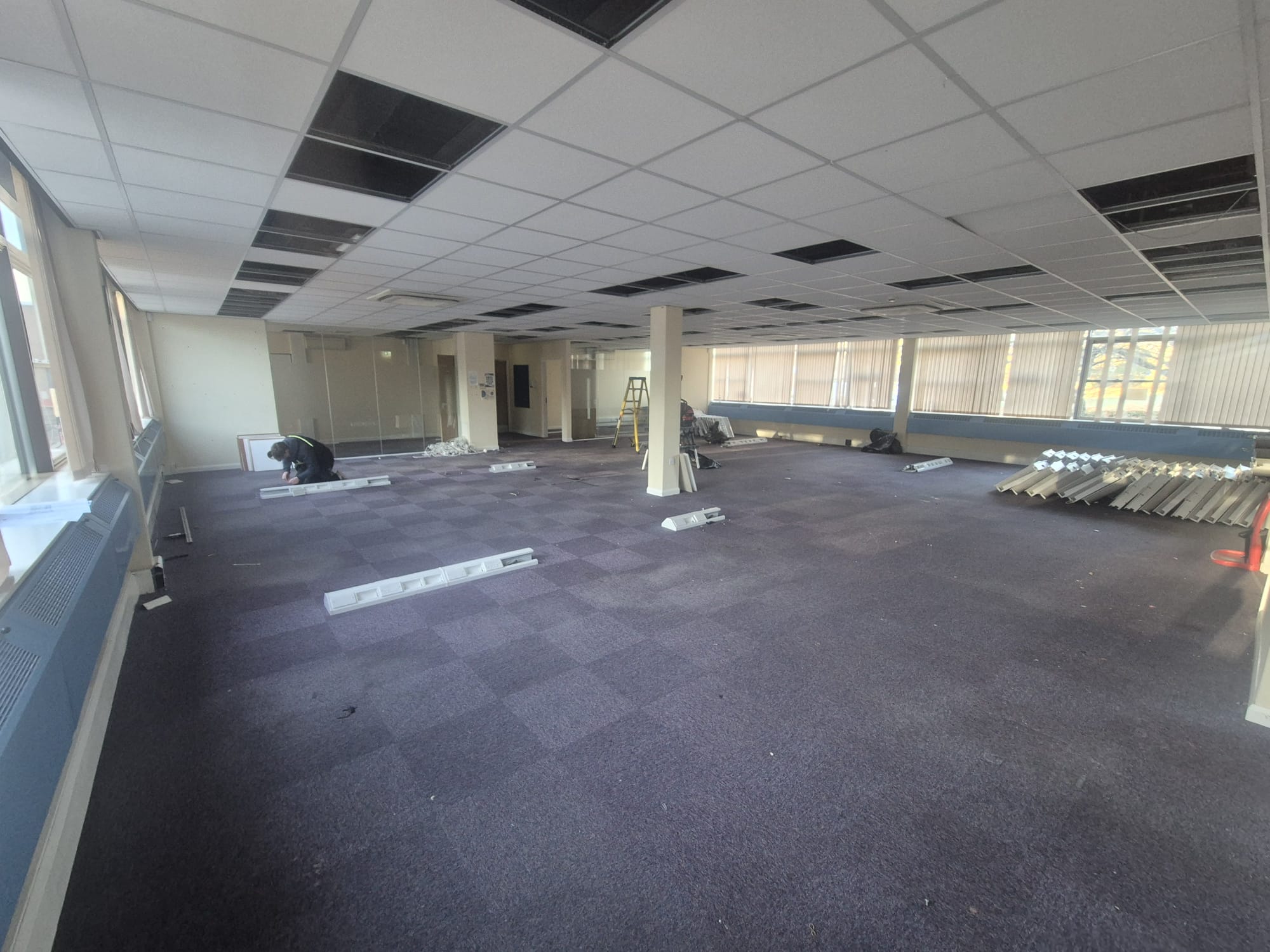
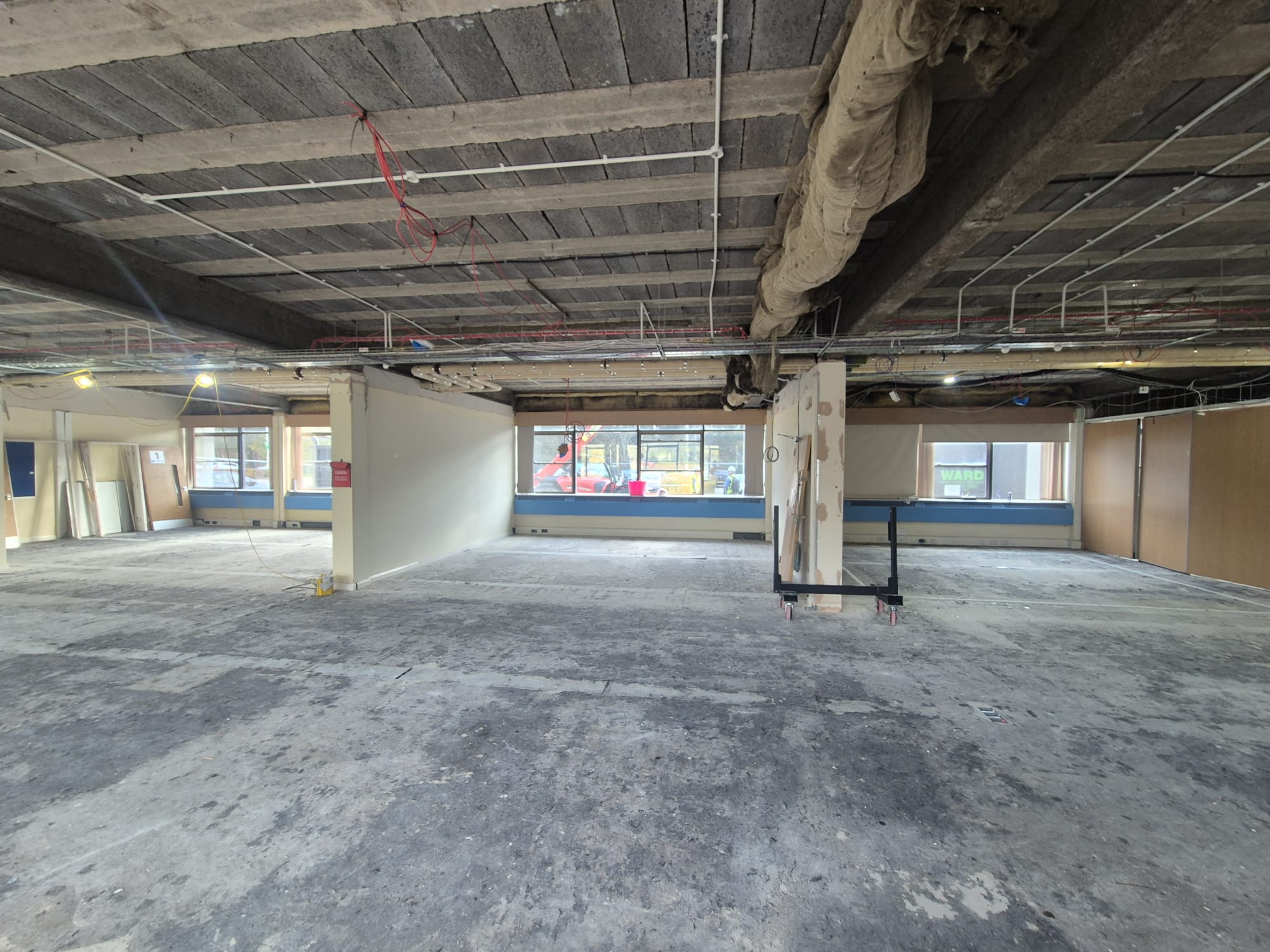
A two-storey former office and classroom building on Wilson Lane in Longford, Coventry, taken back to a clean timber-framed shell for a developer's refurbishment: non-licensed asbestos materials removed first, then ceilings, floor finishes, partitions and fixtures stripped floor by floor and loaded out through the windows by telehandler into 40-yard bins. A small job, run exactly the way we run the big ones.
- Where: Wayside House, Wilson Lane, Longford, Coventry CV6 6NY
- What: Full internal soft strip of a two-storey office and classroom building ahead of refurbishment
- Client: A Coventry property developer, acting as principal contractor
- Scope: Non-licensed asbestos removal, suspended and plasterboard ceilings, carpet and vinyl floors, stud partitions, wall finishes, fixed furniture, full clearance and handover
- Standards: BS 6187:2011, Control of Asbestos Regulations 2012, CDM 2015
The job
Wayside House is a two-storey building on the Wayside Business Park, just off Wilson Lane in Longford, on the north side of Coventry. The developer wanted the redundant office and classroom areas taken back to the structure so the refurbishment could start on a clean shell, with the hardcore and concrete arisings kept clean for later reuse. The instruction was a soft strip only: no mechanical demolition, no slab, no foundations. Everything non-structural out; every load-bearing timber, post and boundary wall left untouched.
Two things made it a job for a specialist rather than a general builder. The refurbishment and demolition survey had identified non-licensed asbestos-containing materials in the fabric, which had to come out first under the Control of Asbestos Regulations 2012. And the building sits on a working business park with neighbouring tenants and a public road on the boundary, so dust, noise, access and waste movements all had to be planned rather than improvised.
Step one: the asbestos
Before any strip-out tool was picked up, our UKATA-trained non-licensed asbestos operatives removed the materials flagged in the survey. The affected areas were barriered off and signed, the materials were removed by hand with water misting to suppress fibre release, and everything went into UN-approved red bags, swan-necked, double-bagged in clear and sealed before leaving the building. The waste left site under hazardous waste consignment notes, each one uniquely numbered for the audit trail, and the asbestos clearance was signed off before the general strip began.
Every operative on site held asbestos awareness training and was face-fitted for FFP3 respiratory protection, and the method statement set out what happens if anything suspect is found that the survey missed: stop, seal the area, inform the site manager, and sample before work resumes. Nothing was.
Step two: the strip, floor by floor
With the asbestos clearance in the file and the electrical and mechanical isolation certificates cross-checked, the team worked the first floor first, then the ground floor, in a fixed sequence:
- Fixed furniture and loose fixtures dismantled with hand tools and impact drivers, working from the far end of each floor back towards the waste-drop window.
- Carpet tiles and vinyl cut into one-metre strips, scraped from the subfloor, rolled and taped.
- Grid-suspended ceilings taken down tile by tile from PASMA-certified towers and podium steps, with the runners and cross-tees cut and lowered rather than pulled.
- Plasterboard ceilings and stud partitions pried away in controlled sections, with inspection holes opened first to re-check for hidden live services, then the exposed non-load-bearing studs cut into manageable lengths with reciprocating saws.
- Wall finishes (cladding, panelling, perimeter plasterboard) wedged away from the timber frame top to bottom with thin pry bars, so nothing came down uncontrolled.
All of it was segregated at source into timber, plasterboard and general waste, and moved along a designated internal route so the work face stayed clear and the fire escapes stayed open.
Loading out through the window
There is no goods lift in a building like this and no sense carrying everything down the stairs. Instead, a seven-metre telehandler fitted with a certified materials bucket worked inside a barriered exclusion zone outside the building. The operator positioned the bucket flush under the first-floor window or ground-floor door, locked it off, signalled, and the floor team loaded the segregated waste straight into it. Bucket full, guardrails closed, hand signal, and the telehandler reversed away, dropped to travel height and tipped into the 40-yard RoRo skip. Then back for the next load. Hand signals between the floor team and the operator were agreed before the first window was opened, and the cycle ran for the whole of the first floor before it was inspected, signed off and repeated downstairs.
Dust, noise and the neighbours
On a business park with people working next door, this is the part that gets a contractor invited back or not. Plasterboard and stud work were misted with hand sprayers before and during cutting; transit piles and bucket loads were damped down if they started to generate dust; windows were opened for cross-ventilation and adjusted or closed if the wind turned towards the boundary. Site hours were fixed at 07:30 to 16:00 on weekdays and 09:00 to 13:00 on Saturdays, with no Sunday or bank holiday working, plant on sound-reduced models, and a photographic dilapidation survey of the pavement and road taken before we started. A banksman controlled every vehicle movement in and out of the exclusion zone, and the site was swept, inspected and locked at the end of every shift.
Handover
Both floors were handed over clean: timber frame and subfloor exposed, all debris and offcuts bagged or shovelled into the final bucket loads, floors swept from the back corners out, and the exclusion zone cleared. The paperwork went with it: the asbestos clearance sign-off, the consignment notes for the hazardous waste, waste transfer notes for everything else, and the method statement and daily briefing records for the client's health and safety file.
Why a small job gets the full method
A two-storey soft strip is not a complicated job, which is exactly why it is easy to do badly. The same things go wrong on a small site as on a large one: asbestos disturbed because nobody read the survey, a ceiling pulled down onto someone's head, dust across the car park next door, mixed waste in a skip with no paperwork behind it. Our method statement for Wilson Lane ran to 40 pages for a job that took a few days, because the sequence, the isolation checks, the asbestos controls and the loading cycle are what make it safe, and the client gets a file that proves it. Family-run since 1982. Plan it properly, do it safely, leave the site clean.
Frequently asked questions
What is a soft strip?
The removal of everything non-structural from a building, such as ceilings, partitions, floor finishes, fixtures and services, leaving a clean structural shell for refurbishment or, where applicable, for full demolition. Wilson Lane was soft strip only; the structure stays.
Why was asbestos removed before the strip out?
The refurbishment and demolition survey identified non-licensed asbestos-containing materials. Under the Control of Asbestos Regulations 2012 those must be removed under controlled conditions by trained operatives before the general strip disturbs them, and the clearance signed off before other trades start.
Can you strip a building while the neighbours keep working?
Yes. On Wilson Lane the neighbouring units on the business park stayed open throughout. Dust suppression, fixed working hours, an exclusion zone around the loading area and a banksman on vehicle movements are what make it work.
What happens to the waste?
It is segregated at source into timber, plasterboard, general waste and, separately, asbestos. Asbestos leaves under hazardous waste consignment notes; everything else under waste transfer notes by registered carrier. The client receives the full set at handover.
How long does a soft strip of a small office take?
A two-storey building of this size is typically a matter of days once the asbestos clearance is in place, depending on the volume of fit-out and the loading arrangement. Our soft strip guide gives timescales by building type.
Do you cover Coventry regularly?
Yes. Recent Coventry and Warwickshire work includes the three-storey warehouse demolition in Coventry and the former Same Deutz-Fahr site in Rugby. See demolition contractors in Coventry.