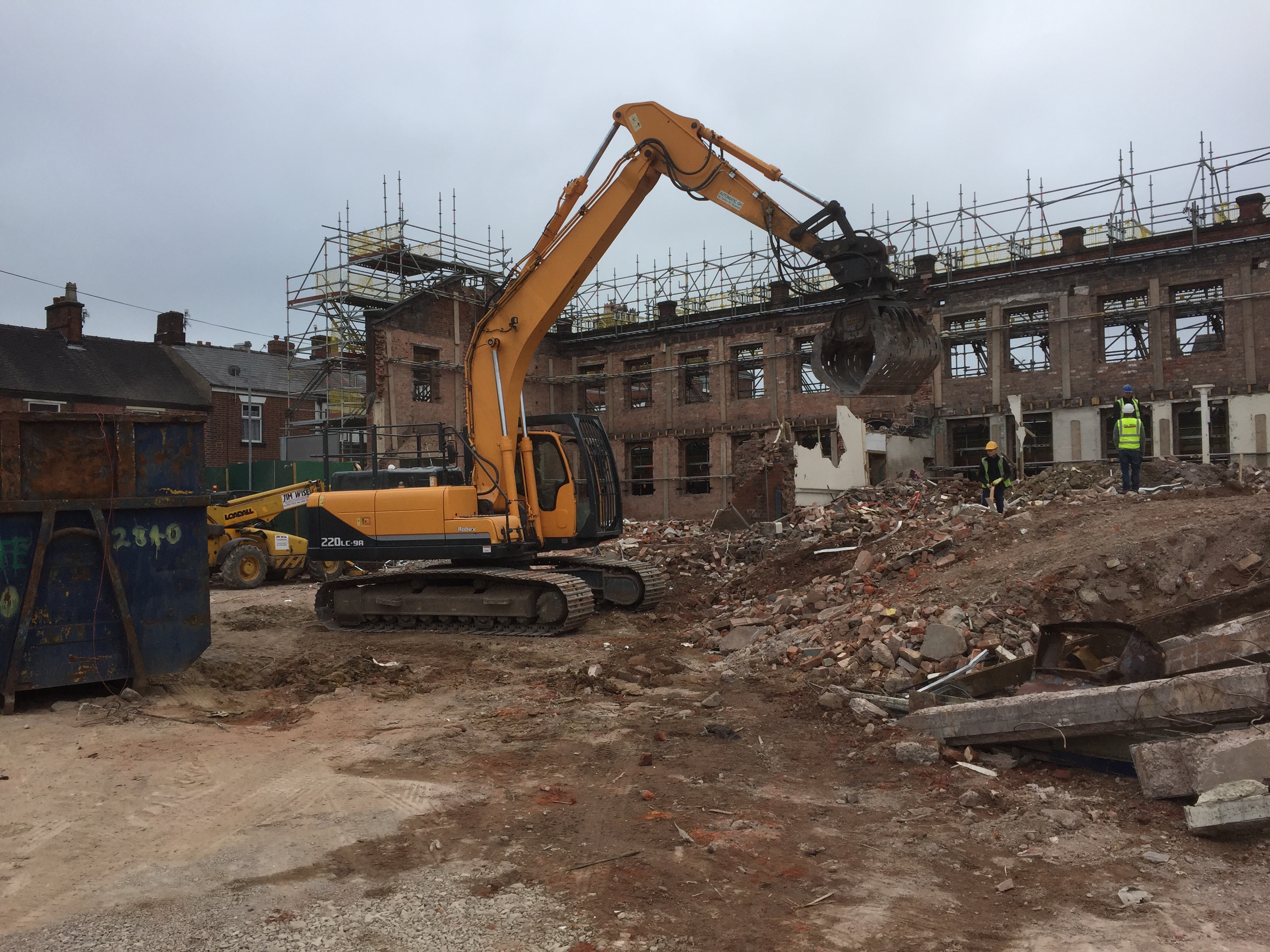
This guide starts from a real job. Our warehouse strip out in Kent — racking, mezzanines and fixtures removed with full waste segregation — is exactly the kind of project the county generates in volume, and delivering it taught us the practical texture of Kent work: big industrial units along the motorway corridors, landlords repositioning stock between occupiers, and programmes driven by reletting dates that don't move. If you're commissioning demolition or strip out anywhere from Dartford to Dover in 2026, here's the county as we've found it.
Kent's Market in 2026: Corridors, Coast and Conversion
Kent's demolition demand runs on three tracks. The industrial corridors — M20, M2, A2 — carry one of the country's densest logistics markets, and logistics stock churns: units are stripped between tenants, older sheds cleared for bigger ones, and yards reconfigured constantly. The Thames-side and Medway regeneration story keeps releasing complex former-industrial plots where clearance and documentation matter as much as machinery. And the coastal towns — Margate, Folkestone, Dover, Ramsgate — continue their reinvention, which means end-of-life commercial buildings coming down and tired stock being stripped for new uses.
The county's building generations bring the usual suspects: pre-2000 industrial and commercial stock carries asbestos as standard, surveyed under CAR 2012 and removed by our HSE licensed in-house teams before anything else happens.
What the Kent Warehouse Job Actually Involved
The project brief was clean: a warehouse full of racking, mezzanine structures and accumulated fixtures, needed back to a lettable shell. The delivery is where the lessons live:
- Racking as structure — high-bay racking is engineered like a building and dismantled like one: reverse order, sequenced bays, exclusion zones honestly sized. Pulling it over is how people die; taking it apart is how landlords get their unit back undamaged.
- Mezzanines with care — steel mezzanine floors come out in planned lifts, protecting the slab beneath, because a gouged slab is a reletting problem the strip out was supposed to solve.
- Segregation from hour one — steel, timber, plastics and general waste in separate streams from the first bay, which is why recovery rates stay high and disposal costs stay low.
- The building protected throughout — cladding, doors, sprinklers and services that stay are assets; the method treats them that way.
The same disciplines ran through our West Quay Southampton project — mezzanine steel and escalators out of a live retail environment — and they're the core of our warehouse strip out service nationwide.
Kent Stock Types and What Each Demands
| Stock type | Structure | Typical need | Delivery emphasis |
|---|---|---|---|
| Logistics units (1980s+) | Portal frames, composite cladding | Strip out between tenants; fast clearance for redevelopment | High metal recovery, slab protection |
| Older industrial (pre-1980) | Steel/concrete, asbestos-era | Licensed removal, then demolition | Survey-led, one-programme delivery |
| Thames-side/Medway brownfield | Layered industrial history | Documented clearance, ground care | Segregation, transfer notes, level handover |
| Coastal commercial | Victorian to post-war mixed | Conservation settings, tight access | Protection-led, hand work at interfaces |
| Get a Free Quote → | 0800 222 9772 |
Delivering into Kent: The Honest Logistics
We serve Kent the way we served that warehouse: mobilise properly, then run the site as if the yard were next door. Plant travels by low-loader; a secure compound and welfare go in first; supervision is resident for the duration; and 24/7 response contacts are established before works start. Mobilisation is a visible line in the price and a minor share of anything beyond small works — the M20 is a far smaller obstacle than a bad survey. Our delivery footprint already runs from Berwick-upon-Tweed to Southampton; Kent sits well inside it.
A Kent Project, Step by Step
- Survey visit — intrusive asbestos survey under CAR 2012 plus structural appraisal; scope fixed before price.
- Notifications — Section 80 to the district council, HSE notice for licensed works, utilities isolations booked.
- Mobilisation — compound, welfare, resident supervision established.
- Asbestos removal — licensed and non-licensed, in-house, with clearances and air monitoring.
- Strip out — racking, mezzanines, fixtures and services out in sequence, streams segregated.
- Structure (where required) — top-down to BS 6187:2011 under a CDM 2015 phase plan.
- Clearance and handover — crushing where volumes justify, waste transfer notes on every load, unit or plot handed back ready.
Kent Cost Drivers
| Factor | How it moves the price |
|---|---|
| Asbestos scope | Survey-set; pre-2000 industrial stock rarely comes back clean |
| Programme pressure | Reletting dates reward properly-crewed, properly-planned delivery |
| What stays | Protecting slab, cladding and services is skilled work priced honestly |
| Metal volumes | Racking and mezzanine steel return real credits against the price |
| Mobilisation | Visible line; minor beyond small works |
Across our projects around 96% of demolition and strip out waste is diverted from landfill, and the documentation to prove it is part of the handover, not an extra.
Kent: Quick Answers
Have you actually delivered in Kent?
Yes — the warehouse strip out project on this site describes the scope. It's the evidence behind this guide.
Can you strip a unit while the estate stays live?
Constantly — managed vehicle movements, protected routes and agreed hours are standard; neighbouring occupiers shouldn't know we're there beyond the paperwork.
Who handles out-of-hours issues on an away project?
We do — response arrangements, security and escalation contacts are set up at project start.
What consents does a Kent demolition need?
A Section 80 notice before works, plus planning or prior approval as the building and setting require; coastal conservation areas carry extra consents we flag at survey.
Do you cover the whole county?
Dartford to Dover — the corridors, the Medway towns and the coast, as part of our 125+ UK locations.
The Framework Behind the Kent Job — and Every Job
The warehouse project ran on the same legal spine every English demolition runs on, and Kent clients should expect to see it evidenced by any bidder. CDM 2015 made it planned work: a written construction phase plan before mobilisation, principal-contractor duties discharged properly, welfare on site from day one. BS 6187:2011 shaped the method statement — and on strip out, that includes treating racking and mezzanines as the engineered structures they are, with dismantling sequences and exclusion zones designed, not improvised. CAR 2012 governed the survey-first discipline: the demolition and refurbishment survey before pricing, licensed removal under the HSE's fourteen-day notification where findings demand it. And waste duty of care documented every load off site: licensed carriers, transfer notes, consignment notes for anything hazardous.
None of this is bureaucratic decoration. The phase plan is why nobody was under a bay when it came down; the survey is why the price held; the tickets are why the client can answer any question about where ten thousand kilos of steel went. Ask every Kent bidder for these documents from a comparable recent job — it's the fastest quality filter available. More in what contractors actually do.
Where the Material Went — and Goes
| Stream | Handling | Destination | Recovery |
|---|---|---|---|
| Racking & mezzanine steel | Dismantled in sequence, graded on site | Scrap metal recycling | ~100% |
| Cladding & metals | Segregated at source | Metal recycling | ~100% |
| Timber & packaging legacy | Own stream from hour one | Recycling / biomass | High |
| Concrete (where clearance applies) | Crushed on site where volumes justify | Recycled aggregate for the next scheme | ~100% |
| Plasterboard from offices | Dedicated stream | Gypsum recycling | High |
| Asbestos (older units) | Double-wrapped, consignment-noted | Licensed hazardous facility | Safe disposal |
Steel-heavy strip outs are where our roughly 96% diversion record climbs highest — on the Kent job, as on the Newcastle racking project, near enough everything structural went round again. The weighbridge and transfer documentation lands with the client at handover; the wider approach is in clean demolition.
The Full Kent Service Set
Corridor and coastal Kent between them call on the whole menu. Unit repositioning: warehouse strip out — the project class this guide is built on. Buildings going back to shell for refurbishment: soft strip out. End-of-life commercial stock in the towns: commercial demolition. Older industrial and Medway-side works: industrial demolition with asbestos handled in-house. Development plots: site clearance to a documented, level handover. Heavy slabs: on-site crushing. And fire or failure at any hour: emergency demolition. Most instructions combine several — a shed clearance is typically strip, structure, crush and clear as one programme — and single-contractor delivery is what keeps those interfaces seamless.
Five Mistakes Kent Clients Can Avoid
Hiring shelving-fitters for racking. Storage steel is structure; it hurts people when treated otherwise. Pricing without the survey. Older corridor units carry asbestos in exactly the corners a walk-round misses. Sacrificing the slab for speed. The reletting value lives in that floor; protect it in the method. Late utilities booking. Isolation lead times pace programmes; book them first. Judging bids by distance. Our Kent project was delivered from the Midlands on programme — evidence beats postcode, every time.
Coverage Across the County
| Area | Postcodes | Typical work |
|---|---|---|
| Dartford & the Thames corridor | DA1–DA12 | Industrial clearance, brownfield plots |
| Medway towns | ME1–ME8 | Former-industrial sites, commercial stock |
| Maidstone & the M20 | ME14–ME20 | Logistics strip out — our project territory |
| Ashford | TN23–TN27 | Unit repositioning, growth-area clearance |
| Canterbury & east Kent | CT1–CT4 | Conservation-adjacent commercial work |
| Coastal towns | CT9–CT21 | End-of-life commercial, emergency response |
One delivery model covers the lot — mobilise once, resident supervision, identical standards Dartford to Dover — exactly as the warehouse project ran. Sussex and south London borders are reached from the same programmes.
Realistic Timelines for Kent Projects
| Project type | Lead-in | On-site duration | What moves it |
|---|---|---|---|
| Warehouse strip out (our project class) | 1–2 weeks | 2–6 weeks | Racking volume and slab-protection method |
| Commercial demolition | 2–4 weeks | 6–12 weeks | Asbestos scope and setting |
| Industrial clearance with slab | 2–4 weeks | 8–16 weeks | Crushing on site shortens the tail |
| Licensed asbestos phase | 14-day HSE notice | Scope-dependent | Statutory — build it in from day one |
Reletting-driven programmes live and die in the lead-in: surveys, notices and isolations booked at appointment are what let the on-site phase run at full speed. That's precisely how the Kent job hit its dates.
What Working With Us in Kent Looks Like
The model the warehouse project ran on: mobilisation planned like any other task, a resident supervisor accountable daily, estate management kept informed so neighbouring occupiers never had cause to ask, and the client updated weekly with photographs and progress against programme. Waste documentation accumulated live rather than assembled retrospectively, and the handover pack closed the file the day the unit was ready. Landlords and agents get the thing they actually want from strip out — a lettable shell, on the date promised, with the paper trail complete.
Can you work around a partial occupation?
Yes — phased strip out with protected separation between works and occupied areas is a standard configuration for us.
Do you deal directly with managing agents?
Routinely — agents, landlords and monitoring surveyors all get direct communication and the documentation standard described above.
How quickly can you survey in Kent?
Typically within the week — we travel for surveys as readily as for works. Call 0800 222 9772.
Asbestos in Kent's Stock: A Closer Look
Kent's corridor-and-coast building mix hides the mineral in predictable places. Older industrial units — pre-1980s especially — carry cement roof and wall sheets as near-standard, with AIB in office pods, lagging around heating plant, and gaskets and rope seals through the services. Thames-side and Medway former-industrial sites add the process layer: insulation on plant and pipe runs, residues in odd corners, and materials buried in made ground that only careful clearance finds safely. Coastal-town commercial stock — Victorian shells refitted repeatedly through the twentieth century — carries textured coatings, floor tiles, boiler-room board and cement flues in combinations no drawing records. Even modern logistics sheds occasionally surprise in inherited yard buildings and legacy plant rooms.
For clients the practical line is the one our Kent project ran on: survey first, classify findings, and let the classification write the programme. Licensed materials add the HSE's fourteen-day notification, enclosures and four-stage clearance; non-licensed cement work moves faster under strict controls. In-house licensed capability keeps both inside one programme — on a reletting-driven strip out, that's the difference between a surprise find costing days and costing weeks.
The First 48 Hours After You Appoint Us
The Kent job's punctuality was built in its first two days, and every project gets the same start. Within 48 hours: survey booked or existing survey audited; Section 80 drafted for the district council; utilities disconnections applied for — the longest queue on most jobs; HSE notification prepared where licensed material is already known; estate management and neighbouring occupiers' communication drafted; mobilisation planned — plant movement, compound, welfare, resident supervision cover; and the phase plan made site-specific with the reletting date driving the sequence backwards. The statutory lead-in then runs concurrently with everything else instead of ahead of it — which is how away projects hit local deadlines.
Four More Questions Kent Clients Ask
Can you clear a unit that still has the previous tenant's kit in it?
Yes — abandoned racking, plant, stock residue and general accumulation are all part of a normal strip out scope. Everything is assessed, segregated and documented on the way out, with anything of value identified rather than skipped by default.
Do you remove mezzanine floors without planning issues?
Mezzanine removal is usually straightforward consent-wise, but building-regulations and fire-strategy implications belong on the checklist — we flag them at survey so your professional team can close them off early.
What about the sprinklers and fire systems?
Isolated, drained and removed or protected per the strategy agreed with the landlord and insurer — never simply cut. Live systems and strip out coexist only by plan.
Can you start before all the paperwork clears?
Preparation yes, works no — and you wouldn't want otherwise. The lead-in runs concurrently precisely so that the legal clocks cost the programme nothing.
Do you offer dilapidations-driven strip out for outgoing tenants?
Yes — strip out scoped directly against the schedule of dilapidations is regular work, delivered with photographic evidence of compliance item by item, so the negotiation between tenant and landlord ends with our handover pack rather than continuing after it. For outgoing occupiers on a lease deadline, the same programme discipline applies: dates fixed, lead-in cleared early, unit returned on time.
Is weekend working possible on estate strip outs?
Where the landlord and any consents allow, yes — weekend and out-of-hours phases are a normal tool for compressing programmes on live estates, planned and priced openly rather than improvised.
Choosing a Contractor for Kent Work
Judge every bidder on evidence: current HSE asbestos licence with in-house removal; verifiable ConstructionLine Gold and SSIP accreditation; project references — ours for Kent is linked above; an intrusive survey before the price; and clear away-working arrangements. The full checklist is in our complete UK guide to choosing a demolition contractor.
We bring 2,489+ projects, NEBOSH and IOSH qualified management and zero prohibition notices in over a decade to every Kent job. Family-run since 1982: plan it properly, do it safely, leave the site clean.
Unit to strip or site to clear? Arrange a free site visit or call 0800 222 9772.
.svg)